| Piú viste - Saturn: the "Ringed Beauty" and His Moons |

Saturn-PIA10585.jpgSaturnian Terminator (Natural Colors; credits: Lunar Explorer Italia)54 visiteCaption NASA:"The Terminator nearly covers the South Pole of Saturn and its stormy vortex in darkness.
As the Southern Hemisphere moves toward Winter in the Planet's 29-year orbit, darkness eventually will consume the vortex. But this seasonal change also will bring the North Pole into the light.
This view looks toward the sunlit side of the Rings from about 69° below the Ring-Plane.
The image was taken with the Cassini Spacecraft wide-angle camera on Jan. 6, 2009 using a spectral filter sensitive to wavelengths of near-InfraRed Light centered at 752 nanometers. The view was acquired at a distance of approx. 761.000 Km (about 473.000 miles) from Saturn and at a Phase Angle of 96°.
Image scale is roughly 42 Km (approx. 26 miles) per pixel.MareKromium
|
|

Rhea-PIA10586.jpgRhea (Natural Colors; credits: Lunar Explorer Italia)54 visiteCaption NASA:"A wide crater dominates the lower right of this image while part of Rhea's brightly lit, wispy terrain can still be seen near the limb of the moon.
Smaller craters are overprinted upon this crater, telling the story of an extremely old feature that has collected impacts over the eons. Younger craters also have been collected on another of Rhea's large basins — Tirawa (see also PIA08976).
North on Rhea (approx. 1528 Km, or about 949 miles across) is up. This view looks toward the Saturn facing-Side of Rhea. The image was taken in visible light with the Cassini Spacecraft narrow-angle camera on Aug. 27, 2008. The view was acquired at a distance of approx. 1,1 MKM (such as about 680,000 miles) from Rhea and at a Sun-Rhea-Spacecraft, or Phase, Angle of 56°.
Image scale is roughly 6 Km (about 4 miles) per pixel".MareKromium
|
|
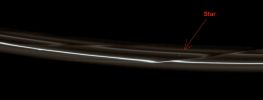
PIA10587.jpgThe "Fragile" F-Ring54 visiteCaption NASA:"Set starkly against the blackness of space are the F-Ring's delicate strands which are periodically gored by its shepherding moon, Prometheus.
Prometheus (approx. 86 Km, or about 53 miles across) and Pandora (approx. 81 Km, or about 50 miles across) both interact with the F-Ring but neither is visible here. Prometheus has the larger effect (see, for instance, PIA08397 for a movie of Prometheus creating a Streamer-Channel in the ring).
A star can be seen through the ring on the right side (Dx) of the image.
This view looks toward the unilluminated side of the Rings from about 33° above the Ring-Plane. The image was taken in visible light with the Cassini Spacecraft narrow-angle camera on Jan. 11, 2009.
The view was acquired at a distance of approx. 1 MKM (such as about 620,000 miles) from Saturn and at a Sun-Saturn-Spacecraft, or Phase, Angle of 37°.
Image scale is roughly 6 Km (about 4 miles) per pixel".MareKromium
|
|

Moonlet-PIA11148-1.jpgTiny Moonlet within a G-Ring Arc54 visiteCaption NASA:"This sequence of three images, obtained by NASA's Cassini Spacecraft over the course of about 10 minutes, shows the path of a newly found moonlet in a bright arc of Saturn's faint G-Ring.
In each image, a small streak of light within the Ring is visible. Unlike the streaks in the background, which are distant stars smeared by the camera's long exposure time of 46", this streak is aligned with the G-Ring and moves along the ring as expected for an object embedded in the Ring.
Cassini scientists interpret the moving streak to be reflected light from a tiny moon half a kilometer (a third of mile) wide that is likely a major source of material in the arc and the rest of the G-Ring.
Debris knocked off this moon forms a relatively bright arc of material near the inner edge of the G-Ring, the most visible part of the Ring in these images. That arc, in turn, leaks material to form the entire Ring.
These images were captured by Cassini's narrow-angle camera on Oct. 27, 2008.
The first image (left) was taken in Visible Light, the second image (middle) was taken in Red Light, and the third image (right) in Near-InfraRed Light centered at a wavelength of 750 nanometers.
Image scale for the first image is roughly 7 Km (a little more than 4 miles) per pixel while the second and third were taken at reduced resolution.
These spatially compressed images were captured at 14 Km (about 9 miles) per pixel and then displayed at a size equal to the first image. This view looks toward the un-illuminated side of the Rings from about 5° above the Ring-Plane.
The view was acquired at a distance of approx. 1,2 MKM (such as about 751.000 miles) from Saturn and at a sun-Saturn-Spacecraft, or Phase, Angle of 23°".MareKromium
|
|

Saturn-PIA10591.jpgHigh Southern Latitudes (Natural Colors; credits: Lunar Explorer Italia)54 visiteCaption NASA:"Intricate curlicues and circular patterns of storms swirl through the High Latitudes near Saturn's South Pole in this image from the Cassini Spacecraft.
The view was obtained at a distance of approx. 588.000 Km (such as abpout 365.000 miles) from Saturn and at a Sun-Saturn-Spacecraft, or Phase, Angle of 140°. At this High Phase Angle, the Sun is illuminating the limb of the Planet from almost the opposite side of Saturn from the Spacecraft.The image was taken with the Cassini Spacecraft wide-angle camera on Jan. 5, 2009 using a spectral filter sensitive to wavelengths of near-InfraRed Light centered at 752 nanometers.
Image scale is roughly 32 Km (about 20 miles) per pixel".MareKromium
|
|

Tethys.jpgTethys, from Voyager 1 (Natural Colors; credits: Ted Stryk)54 visitenessun commentoMareKromium
|
|

Rhea.jpgTirawa Basin on Reha, from Voyager 1 (Natural Colors; credits: Ted Stryk)54 visiteAs Voyager 1 receded from its close flyby of Rhea, it snapped this view of Rhea's Tirawa Basin, a large impact structure seen on the Terminator in this crescent view.
It is on of the worst-imaged parts of this world, and this Voyager view is still the best. Rhea is a moon that shows some similar features to more active Dione and Tethys, but seems to have been inactive for longer, as evidenced by the fact that all of its surface is extremely worn from impacts and the evidences of internal activity are much more subtle.MareKromium
|
|

Saturn-W00051968-70-71.jpgThe North Pole of Saturn (Natural Colors; credits: Dr M. Faccin)54 visiteCon calma, abbiamo "rivelato" quelli che, se non altro a nostro parere (ed in accordo alla nostra tecnica di colorizzazione delle immagini RAW), erano e sono i "True" e "Natural" colors di Marte.
Adesso è la volta di Saturno e delle sue mutevoli lune. In questa elaborazione, un esempio (il primo, di fatto) di processing RGB per i Colori Naturali realizzato dal nostro ECCEZIONALE Dr Faccin.
Guardate e valutate Voi.MareKromium
|
|

Dione-N00048330.jpgThe Marvelous Face of Dione (possible True Colors; credits: Dr M. Faccin & Lunar Explorer Italia)54 visitenessun commentoMareKromium
|
|

Saturn-PIA10598.jpgThe C-Ring (Natural Colors; credits: NASA/JPL/Space Science Institute)54 visiteCaption NASA:"The Cassini Spacecraft peers through Saturn's delicate, translucent inner C-Ring to see the diffuse blue limb of Saturn's Atmosphere.
This view looks toward the unilluminated side of the rings from about 20° above the Ring-Plane. Images taken using red, green and blue spectral filters were combined to create this Natural Color view. The images were obtained with the Cassini Spacecraft narrow-angle camera on April 25, 2008 at a distance of approx. 1,5 MKM (about 930.000 miles) from Saturn.
Image scale is roughly 8 Km (approx. 5 miles) per pixel".MareKromium
|
|

Tethys-PIA10597.jpgBetween Sunshine and Saturnshine (Natural Colors; credits: Lunar Explorer Italia)54 visiteCaption NASA:"The huge Odysseus Crater is clearly illuminated by the Sun on the Western Limb (Sx) of Tethys, but Saturn - shining from the right - makes the smaller craters on the Eastern part of the moon also visible.
The ancient Odysseus Crater is 450 Km, or about 280 miles, across and covers a sizable chunk of the moon. North on Tethys is up and rotated 31° to the left.
This view looks toward the Saturn-facing side of the moon.
The image was taken in visible light with the Cassini Spacecraft narrow-angle camera on Jan. 22, 2009. The view was acquired at a distance of approx. 793.000 Km (such as about 493.000 miles) from Tethys and at a Sun-Tethys-Spacecraft, or Phase, Angle of 112°.
Image scale is roughly 5 Km (a little more than 3 miles) per pixel".MareKromium
|
|

Saturn-W00051152.jpgSaturn: from b&w to Natural Colors (by Dr M. Faccin)54 visitenessun commentoMareKromium
|
|
| 2245 immagini su 188 pagina(e) |
 |
|
|
|
|
178 | |
|
|
|
|





