| |

| Piú viste - Saturn: the "Ringed Beauty" and His Moons |

Enceladus-N00093896.jpgThe Gem in the Sky of Saturn... (possible true colors; elab. Lunexit)54 visiteE così come è stato per Marte ed il Paving di Victoria Crater, oggi abbiamo il piacere e l'onore di proporVi quella che - ovviamente a nostro parere - riteniamo essere la migliore interpretazione dei Colori (e delle sfumature...) di Encelado: un'autentica Gemma di Neve che splende nel Cielo di Saturno.
Attendiamo i Vostri commenti!MareKromium
|
|
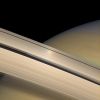
Saturn-PIA08393.jpgThe "Opposition Effect" (again)54 visiteThe Opposition Effect, a brightness surge that is visible on Saturn's Rings when the Sun is directly behind the Spacecraft, is captured here as a colorful halo of light moving across Saturn's Sunlit Rings. The rainbow of color seen here is actually an artifact and a by-product of the spot's movement and the way the color image was produced. Cassini acquires color images by taking sequential exposures using red, green and blue spectral filters, which are then composited together to form a color view. The bright patch traveled across the Rings between exposures taken for this view, creating a series of 3 colorful spots showing its position at 3 separate moments.
This view looks toward the Sunlit side of the Rings from about 9° below the Ring-Plane.
The images in this view were acquired with the Cassini spacecraft wide-angle camera on June 12, 2007, at a distance of approx. 523.000 Km (such as about 325.000 miles) from Saturn.
Image scale is roughly 31 Km (about 19 miles) per pixel.
MareKromium
|
|

Saturn-PIA08392.jpgShadows on the Giant54 visiteLike a silvery pearl, an icy moon crosses the face of Saturn, while 2 of its siblings cast shadows onto the Planet.
Rhea hangs in the foreground. Near upper left on Saturn is the small shadow of Mimas. Near lower right is the penumbral shadow of Japetus - the part of the moon's shadow where Japetus does not completely block the Sun.
This view looks toward the unilluminated side of the Rings from less than 1° above the Ring-Plane. The Rings' shadows drape across the Northern Hemisphere. Images taken using red, green and blue spectral filters were combined to create this natural color view. The images were obtained with the Cassini spacecraft wide-angle camera on June 15, 2007, at a distance of approx. 1,2 MKM (such as about 744.000 miles) from Rhea and 1,7 MKM (1,1 MMs) from Saturn.
Image scale is roughly 71 Km (about 44 miles) per pixel on Rhea and 103 Km (about 64 miles) on Saturn.MareKromium
|
|

Saturn-PIA08390.jpgMirrors of Darkness...54 visiteOur robotic explorer Cassini regards the shadow-draped face of Saturn.
This view looks toward the unilluminated side of the Rings from about 14° above the Ring-Plane. In this viewing geometry all of the Main Rings, except for the B-Ring, appear transparent. The Rings cast their mirror image onto the Planet beyond.
Images taken using red, green and blue spectral filters were combined to create this natural color view. The images were acquired with the Cassini spacecraft wide-angle camera on June 9, 2007, at a distance of approx. 1,6 MKM (about 972.000 miles) from Saturn.
Image scale is roughly 90 Km (about 56 miles) per pixel. MareKromium
|
|
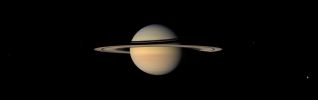
Saturn-PIA08387.jpgA View from Japetus54 visiteWhile on final approach for its Sept. 2007 close encounter with Saturn's moon Japetus, Cassini spun around to take in a sweeping view of the Saturn System.
Japetus is the only major moon of Saturn with a significant inclination to its orbit. From the other major satellites, the Rings would appear nearly edge-on, but from Japetus, the Rings usually appear at a tilt, as seen here.
This natural color mosaic consists of 15 red, green and blue spectral filter images acquired in five wide-angle camera footprints that swept across the scene.
Moons visible in this image: Dione at center left, Enceladus near the left side ansa (or ring edge), Mimas is a speck against the ring shadows on Saturn's Western Limb, Rhea can be seen against the bluish backdrop of the Northern Hemisphere, Tethys is near the right ansa, and Titan near lower right.
The images were obtained on Sept. 10, 2007, at a distance of approx. 3,3 MKM (such as about 2,1 MMs) from Saturn at a Sun-Saturn-Spacecraft, or phase, angle of 33°. Image scale is about 195 Km (approx. 121 miles) per pixel on the Planet. MareKromium
|
|

Tethys-PIA08401.jpgThe Edge of Tethys54 visiteThe cold, cratered landscape of Saturn's moon Tethys shines in stark relief in this crescent view. Aside from its obvious aesthetic beauty, this particular Cassini mosaic was obtained mainly to understand important details about how the surface of Tethys reflects light at high phase angles (the Sun-Tethys-Spacecraft viewing angle). The beautiful interplay of light with surface topographic features is an important factor in this regard. The surface is heavily cratered, and at this oblique angle the craters give the surface a highly scalloped appearance.
Unlike some HR crescent views of Saturn's moons, this image truly gives Tethys the appearance of being composed of ice and frost. There appear to be numerous sun glints sparkling across the surface. Some of these might be specular (or mirror-like) reflections off of exposed walls of solid ice inside craters, or they might be uniformly large, frosty or icy-particle covered facets of topography that are so oriented as to give exceptionally bright but diffuse reflections.
The shadows cast by most craters in the scene are not dark, but rather, they are illuminated by light bouncing off of their sunlit walls and those of other craters. This light, which has been scattered multiple times, makes visible some details along the shadowed walls and floors of craters that would not otherwise be visible in this viewing geometry.
This mosaic was assembled from four clear filter, narrow-angle camera images, with low resolution, wide-angle camera data filling a small gap in coverage. The view is an orthographic projection and has a resolution of 211 meters (692 feet) per pixel. An orthographic view is most like the view seen by a distant observer looking through a telescope. North is up.
The view was obtained by the Cassini spacecraft on June 29, 2007, from a distance of approximately 38.000 Km (about 24.000 miles) and at a Sun-Tethys-Spacecraft, or phase, angle of 152°.
MareKromium
|
|

The_Rings-PIA08389_fig1.jpgThe Rings54 visiteA scan across Saturn's incredible halo of ice rings yields a study in precision and order. This natural color mosaic was acquired by the Cassini spacecraft as it soared 39 degrees above the unilluminated side of the Rings.
Major named gaps are labeled at the top. The main rings themselves, along with the F-Ring, are labeled at the bottom, along with their inner and outer boundaries.
The view combines 45 images -- 15 separate sets of red, green and blue images -- taken over the course of about 2,5 hours, as Cassini scanned across the Rings.
The images in this view were obtained on May 9, 2007, at a distance of approx. 1,1 MKM (about 700,000 miles) from Saturn. Image scale in the radial (horizontal) direction is about 6 Km (approx. 4 miles) per pixel.MareKromium
|
|

Dione-PIA09772.jpgThe "Face" of Dione (HR)54 visiteCaption NASA:"Canyons slink southward on Dione, while bright-walled craters gleam in the Sun. (...) This view is centered on 9° North Latitude and 51° West Longitude.
North on Dione is up.
The image was taken in polarized green light with the Cassini spacecraft narrow-angle camera on Sept. 30, 2007. The view was acquired at a distance of approx. 197.000 Km (such as about 122.000 miles) from Dione and at phase angle of 25°.
Image scale is roughly 1 Km (about 0,6 mile) per pixel".MareKromium
|
|
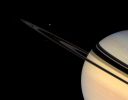
Saturn-PIA09776.jpgJust like the Solar System!54 visiteCaption NASA:"Saturn's icy satellites wheel about the colorful Giant Planet, while the Rings shine dimly in scattered sunlight. The Ringed Planet is, in many ways, a laboratory for investigating the history of our Solar System and how planets form around other stars. There are 4 moons visible in this view. Tethys (1071 Km, or 665 miles across), largest in the scene, is on the far side of the Ring-Plane. Mimas (397 Km, or 247 miles across), is the one on the near side of the Rings, below Tethys. Janus (181 Km, or 113 miles across), is left of the Rings' edge. Pandora (84 Km, or 52 miles across) is a speck below the Rings' edge, between Janus and Mimas. Mimas casts a shadow onto Saturn's bluish Northern Hemisphere.
This view looks toward the unilluminated side of the Rings from about 2° above the Ring-Plane. Images taken using red, green and blue spectral filters were combined to create this natural color view. The view was acquired with the Cassini spacecraft wide-angle camera on Oct. 30, 2007.
The view was taken at a distance of approx. 2,6 MKM (such as about 1,6 MMs) from Saturn.
Image scale is roughly 153 Km (about 95 miles) per pixel on the Planet".MareKromium
|
|

Epimetheus-N00098342.jpgEpimetheus (2)54 visiteCaption NASA:"N00098342.jpg was taken on December 03, 2007 and received on Earth December 04, 2007. The camera was pointing toward EPIMETHEUS that, at the time, was approximately 40.388 Km away, and the image was taken using the RED and CL2 filters.
This image has not been validated or calibrated".MareKromium
|
|
Epimetheus-N00098337.jpgEpimetheus (1)54 visiteCaption NASA:"N00098337.jpg was taken on December 03, 2007 and received on Earth December 04, 2007. The camera was pointing toward EPIMETHEUS that, at the time, was approx. 39.290 Km away, and the image was taken using the P120 and GRN filters.
This image has not been validated or calibrated".MareKromium
|
|
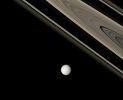
Tethys-PIA09788.jpgTrue Colors?54 visiteCaption NASA:"As seen from the side not illuminated by the Sun, Saturn's thinner Rings are highlighted in shades of brown and gold, contrasting with the more neutral appearance of the icy moon Tethys. The A-Ring and Cassini Division are separated by the optically thick B-Ring, which does not permit sunlight to penetrate and appears as the broad, dark lane between them in this view.
This view looks toward the anti-Saturn side of Tethys.
North is up and rotated 35° to the right.
The view looks toward the unilluminated side of the rings from about 2° above the Ring-Plane.
Images taken using red, green and blue spectral filters were combined to create this natural color view. The view was acquired with the Cassini spacecraft narrow-angle camera on Oct. 29, 2007, at a distance of approx. 2,1 MKM (about 1,3 MMs) from Tethys and at a Sun-Tethys-spacecraft, or phase, angle of 21°.
Image scale is roughly 12 kilometers (8 miles) per pixel".MareKromium
|
|
| 2245 immagini su 188 pagina(e) |
|
|
|
|
|
176 | |
|
|
|
|
|
|





