| Piú viste - Saturn: the "Ringed Beauty" and His Moons |
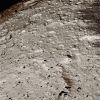
Japetus-N00092254.jpgStill the "Cassini Regio" of Japetus - possible natural colors; elab. Lunexit54 visiteCaption NASA:"N00092254.jpg was taken on September 10, 2007 and received on Earth September 12, 2007. The camera was pointing toward Japetus that, at the time, was approximately 39.965 Km away, and the image was taken using the CL1 and CL2 filters. This image has not been validated or calibrated".MareKromium
|
|
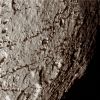
Japetus-N00092247.jpgDeep Canyons and Craters (possible natural colors; elab. Lunexit)54 visiteCaption NASA:"N00092247.jpg was taken on September 10, 2007 and received on Earth September 12, 2007. The camera was pointing toward Japetus that, at the time, was approximately 23.824 Km away, and the image was taken using the CL1 and CL2 filters. This image has not been validated or calibrated".MareKromium
|
|

Japetus-N00092126.jpgThe "Eye" of Japetus (possible natural colors; elab. Lunexit)54 visiteCaption NASA:"N00092126.jpg was taken on September 10, 2007 and received on Earth September 12, 2007. The camera was pointing toward Japetus that, at the time, was approximately 79.464 Km away, and the image was taken using the P120 and GRN filters. This image has not been validated or calibrated".MareKromium
|
|

Japetus-3D.jpgJapetus in 3D54 visiteCaption NASA:"This bizarre, equatorial ridge extending across and beyond the dark, Leading Hemisphere of Japetus gives the two-toned Saturnian moon a distinct walnut shape. With red/blue glasses you can check out a remarkable stereo composition of this extraordinary feature -- based on close-up images from this week's Cassini Spacecraft flyby.
In fact, the ridge's combination of equatorial symmetry and scale, about 20 Km wide and reaching up to 20 Km above the surface, is not known to be duplicated anywhere else in our Solar System. The unique feature was discovered in Cassini images from 2004. It appears to be heavily cratered and therefore ancient, but the origin of the equatorial ridge on Iapetus remains a mystery".MareKromium
|
|

Japetus-PIA08374.jpgThe "Transition Region" of Japetus54 visiteCaption NASA:"Dark material splatters the walls and floors of craters in the surreal, frozen wastelands of Japetus. This image shows terrain in the Transition Region between the moon's dark Leading Hemisphere and its bright Trailing Hemisphere.
The view was acquired during Cassini's only close flyby of the two-toned Saturn moon.
The image was taken on Sept. 10, 2007, with the Cassini spacecraft narrow-angle camera at a distance of approximately 6.030 Km (3.750 miles) from Japetus. Image scale is 36 meters (118 feet) per pixel".MareKromium
|
|

Saturn-N00092694.jpgSaturnian Turbulence (Enhanced Natural Colors; credits for the additional process. and color.: Dr Paolo C. Fienga - Lunexit Team)54 visiten.a.d.MareKromium
|
|

Saturn-PIA09734.jpgTurbulences54 visiteCaption NASA:"The Cassini Spacecraft has a peek beneath the hazes in Saturn's Upper Atmosphere at the swirling vortices that lurk below.
Many vortices can be seen in this image, varying in size from small to large.
The largest one in this image exhibits a collar of bright clouds surrounding the central dark core.
The view is centered on a region about 46° South of the Planet's Equator.
The image was taken with the Cassini spacecraft narrow-angle camera on Aug. 12, 2007 using a spectral filter sensitive to wavelengths of infrared light centered at 750 nanometers. The view was acquired at a distance of approx. 4,1 MKM (such as about 2,5 MMs) from Saturn.
Image scale is roughly 24 Km (about 15 miles) per pixel".MareKromium
|
|

Tethys-PIA09737.jpgCrescent Tethys54 visiteCaption NASA:"The pockmarked crescent of Tethys displays slightly darker terrain in a band at its Equator. The rim of the great crater Odysseus lurks on the Terminator.
Lit terrain seen here is on the Leading Hemisphere of Tethys. North is up.
The image was taken in visible light with the Cassini spacecraft wide-angle camera on Aug. 29, 2007. The view was obtained at a distance of approx. 56.000 Km (such as about 35.000 miles) from Tethys and at a Sun-Tethys-spacecraft, or phase, angle of 105°.
Image scale is roughly 3 Km (about 2 miles) per pixel".MareKromium
|
|
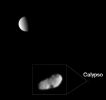
Tethys_and_Calypso-PIA09735.jpgTethys and Calypso54 visiteCaption NASA:"Two companion moons share the sky before the Cassini Spacecraft. Tethys is seen here with one of its two Trojan moons. Calypso, which trails the larger moon in its orbit by 60°, is a couple of pixels across near lower right. Telesto (not pictured) is the other Tethys co-orbital moon, leading Tethys by 60°.
The image was taken in visible light with the Cassini spacecraft narrow-angle camera on Aug. 25, 2007. The view was obtained at a distance of approx. 2,2 MKM (about 1,4 MMs) from Tethys.
Image scale is roughly 13 Km (about 8 miles) per pixel on Tethys".MareKromium
|
|

Japetus-PIA08376-2.jpgRising Japetus (possible natural colors - elab. Lunexit)54 visitenessun commentoMareKromium
|
|

Japetus-PIA08376-1.jpgRising Japetus (false colors - elab. NASA)54 visiteThe slim crescent of Iapetus looms before the Cassini spacecraft as it approaches the mysterious moon.
Iapetus, 1,468 kilometers (912 miles) across, seen here in false color, is unique in its dramatic variation in brightness between the northern polar region and the middle and low latitudes. Equally prominent is the moon's equatorial ridge of towering mountains. The profile of the ridge against the darkness of space reveals that it is topped by a cratered plateau approximately 15 kilometers (9 miles) wide. Further west, the profile of the ridge changes from a long plateau to discrete peaks.
The mosaic consists of four image footprints across the surface of Iapetus and has a resolution of 489 meters (0.3 miles) per pixel.
A full-resolution clear filter image was combined with half-resolution images taken with infrared, green and ultraviolet spectral filters (centered at 752, 568 and 338 nanometers, respectively) to create this full-resolution false color mosaic.
The color seen in this view represents an expansion of the wavelength region of the electromagnetic spectrum visible to human eyes. The intense reddish-brown hue of the dark material is far less pronounced in true color images. The use of enhanced color makes the reddish character of the dark material more visible than it would be to the naked eye. In addition, the scene has been brightened to improve the visibility of surface features.
This view was acquired with the Cassini spacecraft narrow-angle camera on Sept. 10, 2007, at a distance of about 83,000 kilometers (51,600 miles) from Iapetus.
MareKromium
|
|

Enceladus-N00093907.jpgThe Gem in the Sky of Saturn... (possible true colors; elab. Lunexit)54 visitenessun commentoMareKromium
|
|
| 2245 immagini su 188 pagina(e) |
 |
|
|
|
|
175 | |
|
|
|
|





