| Piú viste - Saturn: the "Ringed Beauty" and His Moons |

Pandora-PIA08315.jpgPandora, from about 2 MKM54 visiteCaption NASA:"Less intrusive than her sibling shepherd moon (Prometheus), Pandora nonetheless provides a gravitational influence that helps confine and perturb the F-Ring's shape.
Also notable here is the brightness of the region of the outer A-Ring which lies outside the very narrow Keeler Gap. This view looks toward the unlit side of the Rings from about 38° above the Ring-Plane.
The image was taken in visible light with the Cassini spacecraft narrow-angle camera on Oct. 16, 2006 at a distance of approx. 2 MKM (about 1,2 MMs) from Pandora and at a Sun-Pandora-spacecraft, or phase, angle of 157°. Image scale is roughly 12 Km (about 7 miles) per pixel".
Nota: nell'inset, Pandora da poco meno di 52.000 Km di distanzaMareKromium
|
|

Mimas-N00070733.jpgMimas (1)54 visiteCaption NASA:"N00070733.jpg was taken on November 20, 2006 and received on Earth November 23, 2006. The camera was pointing toward Mimas that, at the time, was approximately 156.199 KM away.
The image was taken using the CL1 and CL2 filters and has not been validated or calibrated".
|
|

Pan-PIA08317.jpgA "Bright Pearl" in the Darkness: Pan in the Gap54 visiteCaption NASA originale:"This Cassini spacecraft view of Pan in the Encke Gap shows hints of detail on the moon's dark side, which is lit by Saturnshine -- sunlight reflected off Saturn.
Pan (26 Km, or 16 miles across) cruises the Encke Gap (325 Km, or 200 miles wide) with several faint ringlets.
This view looks toward the lit side of the Rings from about 52° below the Ring-Plane. The sunlit portion of Pan is partly overexposed.
The image was taken in visible light with the Cassini spacecraft narrow-angle camera on Oct. 27, 2006 at a distance of approx. 385.000 Km (about 239.000 miles) from Pan and at a Sun-Pan-spacecraft, or phase, angle of 86°. Image scale is roughly 2 Km (1,4 miles) per pixel".
|
|

Japetus-N00071141.jpgJapetus in natural colors54 visiteCaption NASA:"N00071141.jpg was taken on November 27, 2006 and received on Earth November 28, 2006. The camera was pointing toward Japetus that, at the time, was approximately 1.998.833 Km away.
The image was taken using the CL1 and IR3 filters. This image has not been validated or calibrated".
|
|
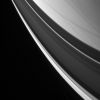
Saturn-PIA08833.jpgNorthern Latitudes of Saturn and the B-Ring's shadow54 visiteCaption NASA:"Streaks of cloud are overlain with graceful ring shadows in this view of Saturn's Northern Latitudes.
Structure is visible in the shadow of the A-Ring and Cassini Division, which widen at the highest latitudes, near lower right. The lower left half of the image does not show the blackness of space, but rather the shadow of the B-Ring, which is perfectly dark here.
The image was acquired from a high inclination above the Planet's Ring-Plane and looks obliquely toward the limb. (...)
The image was taken with the Cassini spacecraft narrow-angle camera using a spectral filter sensitive to wavelengths of infrared light centered at 938 nanometers on Oct. 30, 2006. Cassini was then at a distance of approx. 1,2 MKM (about 700.000 miles) from Saturn and at a Sun-Saturn-spacecraft, or phase, angle of 142°.
Image scale is roughly 7 Km (a little more than 4 miles) per pixel".
|
|

The_Rings-PIA08836.jpgThe Rings' texture54 visiteCaption NASA:"This close-up of the inner edge of the Cassini Division shows an enormous amount of structure, including a grainy texture in the bright outer B-Ring material near the gap edge.
An extreme enhancement of the original image, presented at right, reveals the grainy region with greater clarity.
This view looks toward the lit side of the rings from about 54° below the Ring-Plane.
The image was taken in visible light with the Cassini spacecraft narrow-angle camera on Nov. 8, 2006 at a distance of approx. 378.000 Km (about 235.000 miles) from Saturn and at a Sun-Saturn-spacecraft, or phase, angle of 68°.
Image scale is roughly 2 Km (a little more than 1 mile) per pixel".
|
|

The_Rings-PIA08825.jpgBright "things" in the Sky of Saturn54 visiteCaption NASA:"Saturn's shadow cloaks the faint D-Ring at the bottom of this image. Observations of the shadow boundary, like this one, enable scientists to clearly detect and measure the brightness of diffuse and faint Ring features like the inner part of the D-Ring. Such brightness measurements are often difficult to make, but the shadow region provides a very dark standard against which to compare the D-Ring, as the only brightness in the shadow is provided by the background of space.
The bright specks across the scene, both in the bright Rings and in the shadow, are either stars or cosmic ray hits on the camera's detector. This view looks toward the unlit side of the rings from about 42° above the Ring-Plane.
The image was taken in visible light with the Cassini spacecraft wide-angle camera on Nov. 12, 2006. Cassini was then at a distance of approx. 1,4 MKM (about 900.000 miles) from Saturn and at a phase angle of 152°.
Image scale is roughly 8 Km (5 miles) per pixel".MareKromium
|
|

Mimas-PIA08842.jpgMonochrome Mimas54 visitenessun commento
|
|

The_Rings-N00073991.jpgSomething's in the Rings...54 visitenessun commento
|
|

The_Rings-PIA08846.jpgLights through the Rings...54 visiteCaption NASA:"With the Sun directly behind Cassini, the spacecraft spies the Opposition Surge in Saturn's inner A-Ring. The opposition effect becomes visible from this special viewing geometry. (...)
This view looks toward the Rings from about 11° below the Ring-Plane.
The image was taken in visible light with the Cassini spacecraft wide-angle camera on Dec. 2, 2006 at a distance of approx. 287.000 Km (178.000 miles) from Saturn. Image scale is roughly 17 Km (about 11 miles) per pixel".
|
|

The_Rings-PIA08855.jpgMulticolored Rings...54 visiteCaption NASA:"Both luminous and translucent the C-Ring sweeps out of the darkness of Saturn's shadow and obscures the Planet at lower left.
The Ring is characterized by broad, isolated bright areas, or "plateaux", surrounded by fainter material. This view looks toward the unlit side of the Rings from about 19° above the Ring-Plane. North on Saturn is up. The dark, inner B-Ring is seen at lower right.
The image was taken in visible light with the Cassini spacecraft wide-angle camera on Dec. 15, 2006 at a distance of approx. 632.000 Km (about 393.000 miles) from Saturn and at a phase angle of 56°.
Image scale is roughly 34 Km (about 21 miles) per pixel".
Nota: il sistema di elaborazione in "colori naturali" non è cambiato ma, come vedete Voi stessi, i colori di Saturno sono (leggermente) mutati. Come mai? La risposta, a nostro parere, deve essere rinvenuta nel tipo di filtraggio utilizzato dalla NASA per l'ottenimento dell'immagine originale in b/n. Questo vuol dire, fra l'altro, che i frames in b/n NON sono affatto tutti uguali (come molti invece ritengono). E' il tipo di flitro impiegato per l'ottenimento dell'immagine originale - ottenuta sulla scala dei grigi - che poi determinerà, in sede di trasformazione del frame in immagine a colori, il "tipo di colori"!
|
|

Pan-PIA08857.jpgPan54 visiteCaption NASA:"Pan is seen in this color view as it sweeps through the Encke Gap with its attendant ringlets. As the lemon-shaped little moon orbits Saturn, it always keeps its long axis pointed along a line toward the Planet. From this vantage point, the dark side of the moon is visible.
This view looks toward Pan (26 Km or 16 miles across) within the Encke Gap (325 Km or 200 miles wide), on the unlit side of the Rings, and from an inclination of about 33° above the Ring-Plane.
Images taken using red, green and blue spectral filters were combined to create this natural color view. The image was taken with the Cassini spacecraft narrow-angle camera on Dec. 16, 2006 at a distance of approx. 779.000 Km (about 484.000 miles) from Pan and at a Sun-Pan-spacecraft, or phase angle of 83°.
Image scale is roughly 5 Km (a little more than 3 miles) per pixel".MareKromium
|
|
| 2245 immagini su 188 pagina(e) |
 |
|
|
|
|
171 | |
|
|
|
|





