| |

| Piú viste - Saturn: the "Ringed Beauty" and His Moons |
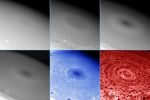
Saturn-PIA08333.jpgThe VERY RESTLESS South Pole of Saturn54 visiteThese images of Saturn's south pole, taken by two different instruments on Cassini, show the hurricane-like storm swirling there and features in the clouds at various depths surrounding the pole. Different wavelengths reveal the height of the clouds, which span tens of kilometers in altitude.
The four monochrome images displayed here were acquired by the imaging science subsystem; the blue and red images in the bottom row were taken by the visual and infrared mapping spectrometer. The images are arranged in order of increasing wavelength in nanometers as follows: (top row) 460 nm, 752 nm, 728 nm; (bottom row) 890 nm, 2,800 nm, 5,000 nm.
At the center of the cauldron of storms spinning around the south pole is the south pole itself, which literally appears to be the eye of this vast polar storm system. As in a hurricane on Earth, the south polar "eye" is relatively clear of clouds and is surrounded by a wall of towering clouds that cast shadows into the center. However, while morphologically similar, it is not clear if this vortex operates in the same fashion as a terrestrial hurricane. In most of the images, the center of the polar storm is quite dark, indicating an unusually cloud-free atmosphere in the upper skies, which are otherwise typically inhabited by bright ammonia clouds. This polar hole in the ammonia cloud layer represents the eye of the hurricane-like storm. Unusually dark clouds likely exist at the bottom of this deep hole, enhancing the murkiness there.
The first image in this montage (at upper left) shows a muted eye, due to the enhanced scattering of light from the atmosphere itself at this blue wavelength (460 nanometers), just as in the blue skies of Earth. In the last image at bottom right, the eye appears relatively bright. This image is taken at a wavelength of 5,000 nanometers, where the dominant source of light is the thermal glow of the planet itself. The bright thermal glow seen in this polar hole again shows that the eye is relatively cloud-free to unusual depths.
In the imaging science subsystem images, the eye looks dark at wavelengths where methane gas absorbs the light (728 nanometers and 890 nanometers, at upper right and lower left) and only the highest clouds are visible, confirming that the clouds within the eye are deeper than their surroundings. This effect is also seen in visual and infrared mapping spectrometer images that show gas absorption.
In the visual and infrared mapping spectrometer image taken at 2,800 nanometers, four times the wavelength of light visible to the human eye, this cloud clearing appears dark, which is consistent with the idea that the atmosphere above any distinct clouds is unusually deep there. The eye is some 1,500 kilometers (930 miles) across, and is surrounded by a distinct ring of clouds some 300 kilometers (185 miles) across. The images also indicate the prevalence of smaller but vertically well-developed storms across the entire south polar region, indicating the extent to which convection characterizes the area.
Literally hundreds of storm clouds encircle the pole, appearing as dark spots in the infrared spectrometer thermal image (red image) and as both bright and dark spots in images taken in sunlight (blue image). Each of these spots represents a storm. These pictures reveal that Saturn's south pole is a cauldron of storm activity, unlike anything ever seen on any planet.
The individual storms surrounding the pole are seen as dark "leopard spots" in the thermal image (red) taken at a wavelength of 5,000 nanometers, some seven times the wavelength of light visible to the human eye. Here, these spots are blocking the thermal light, or heat, from the interior of Saturn. The storm clouds are thus seen in silhouette against Saturn's thermal glow. The effectiveness of these clouds in blocking Saturn's interior thermal glow indicates that the storm clouds are unusually thick, extending deep down into Saturn's atmosphere, and are comprised of relatively large cloud particles, likely condensates formed in upwelling air currents.
The large number of dark, circular leopard spots at the south pole seen at 5,000 nanometer wavelength, and their correlation with the features seen in sunlight at 2,800 nanometer wavelength, indicates that convective activity extending over dozens of kilometers in altitude is surprisingly rampant in the south polar region. Why such unusual dynamics exist there is perhaps linked to Saturn's southern summer, which is the season Saturn is in now. Observations taken over the next few years, as the south pole season changes from summer to fall, will help scientists understand the role seasons play in driving the dramatic meteorology at the south pole of Saturn. The images in this montage were acquired on Oct. 11, 2006, when Cassini was approximately 340,000 kilometers (210,000 miles) from Saturn. The original imaging science subsystem images have a scale of about 17 kilometers (11 miles) per pixel. The visual and infrared spectrometer images have a scale of about 174 kilometers (108 miles) per pixel. The images have been resized to approximately the same scale for presentation here.
|
|

Pandora-PIA08315.jpgPandora, from about 2 MKM54 visiteCaption NASA:"Less intrusive than her sibling shepherd moon (Prometheus), Pandora nonetheless provides a gravitational influence that helps confine and perturb the F-Ring's shape.
Also notable here is the brightness of the region of the outer A-Ring which lies outside the very narrow Keeler Gap. This view looks toward the unlit side of the Rings from about 38° above the Ring-Plane.
The image was taken in visible light with the Cassini spacecraft narrow-angle camera on Oct. 16, 2006 at a distance of approx. 2 MKM (about 1,2 MMs) from Pandora and at a Sun-Pandora-spacecraft, or phase, angle of 157°. Image scale is roughly 12 Km (about 7 miles) per pixel".
Nota: nell'inset, Pandora da poco meno di 52.000 Km di distanzaMareKromium
|
|

Mimas-N00070733.jpgMimas (1)54 visiteCaption NASA:"N00070733.jpg was taken on November 20, 2006 and received on Earth November 23, 2006. The camera was pointing toward Mimas that, at the time, was approximately 156.199 KM away.
The image was taken using the CL1 and CL2 filters and has not been validated or calibrated".
|
|

Pan-PIA08317.jpgA "Bright Pearl" in the Darkness: Pan in the Gap54 visiteCaption NASA originale:"This Cassini spacecraft view of Pan in the Encke Gap shows hints of detail on the moon's dark side, which is lit by Saturnshine -- sunlight reflected off Saturn.
Pan (26 Km, or 16 miles across) cruises the Encke Gap (325 Km, or 200 miles wide) with several faint ringlets.
This view looks toward the lit side of the Rings from about 52° below the Ring-Plane. The sunlit portion of Pan is partly overexposed.
The image was taken in visible light with the Cassini spacecraft narrow-angle camera on Oct. 27, 2006 at a distance of approx. 385.000 Km (about 239.000 miles) from Pan and at a Sun-Pan-spacecraft, or phase, angle of 86°. Image scale is roughly 2 Km (1,4 miles) per pixel".
|
|

Japetus-N00071141.jpgJapetus in natural colors54 visiteCaption NASA:"N00071141.jpg was taken on November 27, 2006 and received on Earth November 28, 2006. The camera was pointing toward Japetus that, at the time, was approximately 1.998.833 Km away.
The image was taken using the CL1 and IR3 filters. This image has not been validated or calibrated".
|
|

Saturn-PIA08833.jpgNorthern Latitudes of Saturn and the B-Ring's shadow54 visiteCaption NASA:"Streaks of cloud are overlain with graceful ring shadows in this view of Saturn's Northern Latitudes.
Structure is visible in the shadow of the A-Ring and Cassini Division, which widen at the highest latitudes, near lower right. The lower left half of the image does not show the blackness of space, but rather the shadow of the B-Ring, which is perfectly dark here.
The image was acquired from a high inclination above the Planet's Ring-Plane and looks obliquely toward the limb. (...)
The image was taken with the Cassini spacecraft narrow-angle camera using a spectral filter sensitive to wavelengths of infrared light centered at 938 nanometers on Oct. 30, 2006. Cassini was then at a distance of approx. 1,2 MKM (about 700.000 miles) from Saturn and at a Sun-Saturn-spacecraft, or phase, angle of 142°.
Image scale is roughly 7 Km (a little more than 4 miles) per pixel".
|
|

The_Rings-PIA08836.jpgThe Rings' texture54 visiteCaption NASA:"This close-up of the inner edge of the Cassini Division shows an enormous amount of structure, including a grainy texture in the bright outer B-Ring material near the gap edge.
An extreme enhancement of the original image, presented at right, reveals the grainy region with greater clarity.
This view looks toward the lit side of the rings from about 54° below the Ring-Plane.
The image was taken in visible light with the Cassini spacecraft narrow-angle camera on Nov. 8, 2006 at a distance of approx. 378.000 Km (about 235.000 miles) from Saturn and at a Sun-Saturn-spacecraft, or phase, angle of 68°.
Image scale is roughly 2 Km (a little more than 1 mile) per pixel".
|
|

The_Rings-PIA08825.jpgBright "things" in the Sky of Saturn54 visiteCaption NASA:"Saturn's shadow cloaks the faint D-Ring at the bottom of this image. Observations of the shadow boundary, like this one, enable scientists to clearly detect and measure the brightness of diffuse and faint Ring features like the inner part of the D-Ring. Such brightness measurements are often difficult to make, but the shadow region provides a very dark standard against which to compare the D-Ring, as the only brightness in the shadow is provided by the background of space.
The bright specks across the scene, both in the bright Rings and in the shadow, are either stars or cosmic ray hits on the camera's detector. This view looks toward the unlit side of the rings from about 42° above the Ring-Plane.
The image was taken in visible light with the Cassini spacecraft wide-angle camera on Nov. 12, 2006. Cassini was then at a distance of approx. 1,4 MKM (about 900.000 miles) from Saturn and at a phase angle of 152°.
Image scale is roughly 8 Km (5 miles) per pixel".MareKromium
|
|

Mimas-PIA08842.jpgMonochrome Mimas54 visitenessun commento
|
|

The_Rings-N00073991.jpgSomething's in the Rings...54 visitenessun commento
|
|

The_Rings-PIA08846.jpgLights through the Rings...54 visiteCaption NASA:"With the Sun directly behind Cassini, the spacecraft spies the Opposition Surge in Saturn's inner A-Ring. The opposition effect becomes visible from this special viewing geometry. (...)
This view looks toward the Rings from about 11° below the Ring-Plane.
The image was taken in visible light with the Cassini spacecraft wide-angle camera on Dec. 2, 2006 at a distance of approx. 287.000 Km (178.000 miles) from Saturn. Image scale is roughly 17 Km (about 11 miles) per pixel".
|
|

The_Rings-PIA08855.jpgMulticolored Rings...54 visiteCaption NASA:"Both luminous and translucent the C-Ring sweeps out of the darkness of Saturn's shadow and obscures the Planet at lower left.
The Ring is characterized by broad, isolated bright areas, or "plateaux", surrounded by fainter material. This view looks toward the unlit side of the Rings from about 19° above the Ring-Plane. North on Saturn is up. The dark, inner B-Ring is seen at lower right.
The image was taken in visible light with the Cassini spacecraft wide-angle camera on Dec. 15, 2006 at a distance of approx. 632.000 Km (about 393.000 miles) from Saturn and at a phase angle of 56°.
Image scale is roughly 34 Km (about 21 miles) per pixel".
Nota: il sistema di elaborazione in "colori naturali" non è cambiato ma, come vedete Voi stessi, i colori di Saturno sono (leggermente) mutati. Come mai? La risposta, a nostro parere, deve essere rinvenuta nel tipo di filtraggio utilizzato dalla NASA per l'ottenimento dell'immagine originale in b/n. Questo vuol dire, fra l'altro, che i frames in b/n NON sono affatto tutti uguali (come molti invece ritengono). E' il tipo di flitro impiegato per l'ottenimento dell'immagine originale - ottenuta sulla scala dei grigi - che poi determinerà, in sede di trasformazione del frame in immagine a colori, il "tipo di colori"!
|
|
| 2245 immagini su 188 pagina(e) |
|
|
|
|
|
170 | |
|
|
|
|
|
|





