| Piú viste - Saturn: the "Ringed Beauty" and His Moons |

Rhea-PIA07614.jpgMimas, Rhea and the Rings54 visiteOriginal caption:"The Saturn moon Mimas is much smaller than Rhea, but the geometry of this scene exaggerates the actual differences in size. Here, Mimas is on the opposite side of the rings from Rhea and Cassini. Saturn's shadow slices across the Ring-plane here.
The view looks toward the Saturn-facing hemisphere on Mimas and the anti-Saturn hemisphere on Rhea.
The image was taken in visible light with the narrow-angle camera on Sept. 9, 2005, from a distance of approx. 1,5 MKM (about 900.000 miles) from Rhea. Mimas was located on the far side of the Rings, such as about 670.000 Km (approx. 420.000 miles) farther from Cassini. The image scale is roughly 9 Km (about 6 miles) per pixel on Rhea and 13 Km (about 8 miles) per pixel on Mimas".
|
|
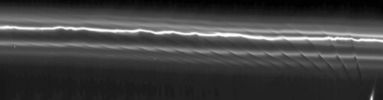
The Rings-PIA07750.jpgSurfing the waves of the F-Ring (from 1,1 MKM)54 visiteOriginal caption:"This mosaic of 15 Cassini images of Saturn's F-Ring shows how the moon Prometheus creates a gore in the Ring once every 14 h and 42', as it approaches and recedes from the F-Ring on its eccentric orbit. The individual images have been processed to make the Ring appear as if it has been straightened, making it easier to see the Ring's structure. The mosaic shows a Region 147.000 Km (about 91.000 miles) along the Ring (horizontal direction in the image); this represents about 60° of Longitude around the Ring. The Region seen here is about 1500 Km (900 miles) across (vertical direction). The first and last images in the mosaic were taken approximately 2,5 hours apart.
Each dark channel, or "gore," is clearly visible across more than 1,000 kilometers (600 miles) of the ring and is due to the gravitational effect of Prometheus (102 kilometers, or 63 miles across), even though the moon does not enter the F ring. The channels have different tilts because the ring particles closer to Prometheus (overexposed, stretched, and just visible at the bottom right of the image) move slower with respect to the moon than those farther away. This causes the channels to shear with time, their slopes becoming greater, and gives the overall visual impression of drapes of ring material. The channels at the right are the youngest and have near-vertical slopes, while those at the left are the oldest and have near-horizontal slopes. This phenomenon has not previously been detected in any other planetary ring system, but computer simulations of the system prove that the disturbance is caused by a simple gravitational interaction. The eccentric orbit of Prometheus is gradually moving so that the moon will eventually come even closer in its closest approach to the eccentric F ring. Scientists calculate that its perturbations of the F ring will reach a maximum in December 2009".
|
|

Tethys and Dione-PIA07621.jpgTethys and Dione54 visiteOriginal caption:"This image shows Tethys partially occulting Dione. For comparison purposes, we remind you that the diameter of Tethys is 1.071 Km (about 665 miles), while Dione is 1.126 Km (such as about 700 miles) across; the difference in the surface brightness of the two moons is immediately apparent.
This still image was acquired on Sept. 16, 2005, at a distance of 2,1 MKM (such as about 1,3 MMs) from Dione and 2,7 MKM (about 1,7 MMs) from Tethys. Resolution in the original images was 13 Km (approx. 8 miles) per pixel on Dione and 16 Km (approx. 10 miles) per pixel on Tethys.
The image was magnified by a factor of two to aid visibility of surface features".
|
|
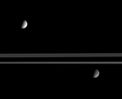
Tethys-PIA07623.jpgTethys and Dione54 visiteOriginal caption:"Saturn's expansive Rings separate the moon's Tethys (at the top) from Dione (at the bottom). Even in this distant view, it is easy to see that the moons' surfaces, and likely their evolutionary paths, are very different.
Both moons are on the far side of the Rings in this scene, which shows their Saturn-facing Hemispheres (terrain centered on 0° Long.). The dark shadow across the rings is cast by Saturn's Southern Hemisphere.
Note that the diameter of Tethys is about 1.071 Km while the diameter of Dione is approx. 1.126 Km.
This image was taken in visible light with the Cassini spacecraft narrow-angle camera on Sept. 12, 2005, at a distance of approx. 2,4 MKM (such as about 1,5 MMs) from Saturn. The image scale is about 17 Km (about 11 miles) per pixel on the two moons".
|
|
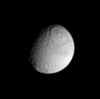
Tethys-PIA07622.jpgOdysseus and Melanthius54 visiteOriginal caption:"Cassini offers up this nice view of the craters Odysseus (at the top) and Melanthius (at the bottom) on Saturn's moon Tethys. Melanthius appears to have an elongated mountain range, rather than a single central peak, at its center.
This is the trailing hemisphere of Tethys, being centered on terrain at roughly 270° Longitude. North on Tethys is up.
This image was taken with the Cassini spacecraft narrow-angle camera on Sept. 20, 2005, through a filter sensitive to wavelengths of ultraviolet light centered at 338 nanometers. This view was obtained at a distance of approx. 1,4 MKM (about 900.000 miles) from Tethys and at a phase angle of 50°. Resolution in the original image was 8 Km (about 5 miles) per pixel. The image has been magnified by a factor of 2 to aid visibility".
|
|

Dione-N00042630.jpgDione behind the Rings54 visiteOriginal caption:"N00042630.jpg was taken on November 03, 2005 and received on Earth November 05, 2005. The camera was pointing toward DIONE at approximately 2.460.100 Km away, and the image was taken using the P120 and UV3 filters. This image has not been validated or calibrated".
|
|

PandoraandDione-PIA07625.jpgPandora and Dione54 visiteOriginal caption:"This view looks up toward the sunlit side of Saturn's rings, as Dione and Pandora trundle by. The moons are on the near side of the Rings and the Planet's shadow stretches across the Rings in the background.
The Cassini spacecraft took this image in visible light with its narrow-angle camera on Sept. 16, 2005, at a distance of approx. 2,4 MKM (such as roughly 1,5 MMs) from Saturn. The image scale is of about 12 Km (7 miles) per pixel on Dione".
|
|

Japetus-N00042815.jpgApproaching Japetus54 visiteOriginal caption:"N00042815.jpg was taken on November 08, 2005 and received on Earth November 08, 2005. The camera was pointing toward Japetus at approximately 853.040 Km away and the image was taken using the CL1 and IR1 filters".
Giapeto, una Luna misteriosa come tutte, forse più di altre. La vedremo meglio? La conosceremo di più? Forse. Ma il prossimo fly-by è ancora lontano, nel futuro... (Sett. 10, 2007 - 1.227 Km ovvero, circa 762 miglia)
Nota: osservate, con il frame a full-size, l'apparente Polo Nord di Giapeto e la sua configurazione superficiale. Semplicemente incredibile...
|
|

Dione-PIA07627.jpgDione and the F-Ring (in natural colors)54 visiteOriginal caption:"Saturn's moon Dione is about to swing around the edge of the thin F-Ring in this color view. More than one thin strand of the F-Ring's tight spiral can be seen here.
The terrain seen on Dione is on the moon's Saturn-facing hemisphere.
Images taken using infrared, green and ultraviolet spectral filters were composited to create this color view. The images were taken with the Cassini spacecraft narrow-angle camera on Sept. 20, 2005, at a distance of approx. 2 MKM (about 1,2 MMs) from Dione and at a phase angle of 48°.
The image scale is of about 12 Km (such as roughly 7 miles) per pixel".
|
|

Mimas-N00042871.jpgMimas and Titan54 visiteOriginal caption:"N00042871.jpg was taken on November 11, 2005 and received on Earth November 11, 2005. The camera was pointing toward Mimas (and Titan) at approximately 3.224.642 Km away, and the image was taken using the CL1 and CL2 filters".
|
|

Japetus-N00043065.jpgLand of night54 visiteOriginal caption:"N00043065.jpg was taken on November 14, 2005 and received on Earth November 15, 2005. The camera was pointing toward Japetus at approximately 554.430 Km away, and the image was taken using the P60 and MT2 filters. This image has not been validated or calibrated".
Nota: questa immagine ci offre, oltre ad una "inquietante" (e comunque davvero molto bella) veduta di Giapeto, anche un interessante ed assai variegato campionario di photographic artifacts (incluse anche alcune strisce di luce che vengono ufficialmente attribuite al transito di Raggi Cosmici).
|
|
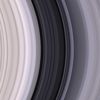
The Rings-PIA07631.jpgThe sweet colors of the Rings (approx. true colors)54 visiteOrigThe dark Cassini Division, within Saturn's Rings, contains a great deal of structure, as seen in this color image. The sharp inner boundary of the division (left of center) is the outer edge of the massive B-Ring and is maintained by the gravitational influence of the moon Mimas.
Spectroscopic observations by Cassini indicate that the Cassini Division, similar to the C-Ring, contains more contaminated ice than do the B and A-Rings on either side.
This view is centered on a region approx. 118.500 Km (about 73.600 mi) from Saturn's center. (Saturn is about 120.500 Km wide - roughly 74.900 mi - at the equator.) From left to right, the image spans approx. 11.000 Km (about 6.800 mi) across the Ring-Plane. Images taken using red, green and blue spectral filters were combined to create this view, which approximates what the human eye might see. The image was taken with the Cassini spacecraft narrow-angle camera on May 18, 2005, at a distance of approx. 1,6 MKM (about 1 MMs) from Saturn. Res. is 9 Km per px.
|
|
| 2245 immagini su 188 pagina(e) |
 |
|
|
|
|
167 | |
|
|
|
|





