| Piú viste - Saturn: the "Ringed Beauty" and His Moons |
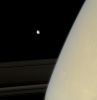
Saturn-PIA10510.jpgAtmosferic Distortion (natural colors; credits: NASA/JPL/Space Science Institute)55 visiteCaption NASA:"Mimas emerges from behind hazy Saturn. The Rings appear (slightly) distorted near the Planet as their image passes through the Upper Atmosphere.
The limb of Mimas (about 396 Km, or approx. 246 miles across) is slightly flattened on the left side by the rim of the large crater Herschel (see also PIA08278).
This view looks toward the unilluminated side of the Rings from about 9° above the Ring-Plane. Images taken using red, green and blue spectral filters were combined to create this natural color view. The images were acquired with the Cassini Spacecraft narrow-angle camera on Nov. 30, 2007 at a distance of approx. 1,7 MKM (such as about 1,1 MMs) from Mimas.
Image scale is roughly 10 Km (about 6 miles) per pixel on Mimas".MareKromium
|
|

TITAN-1.jpgCrescent Titan (possible True Colors; credits: Calvin J. Hamilton)55 visiteVi invitiamo a leggere, sul nostro blog TruePlanets, la prima parte della Monografia su Titano "Oltre la Nebbia", scritta dal Dr Paolo C. Fienga.
Un tentativo - si spera riuscito - di riassumere in un quantitativo ragionevole di pagine le ultime scoperte relative alla Luna Nebbiosa.
Nella prima parte, un pò di Storia, di Geografia e di Meteorologia, ed una serie di riflessioni dedicate ai "Colori di Titano" (perchè non esistono solo i "Colori di Marte"...).
In seguito (parte seconda), la Geografia di dettaglio di Titano, con cenni alla sua Storia Geologica ed alla possibile evoluzione; nella parte terza, infine - pubblicazione prevista nel Marzo 2009 - qualche ipotesi sugli scopi e le modalità di colonizzazione dello Spazio Profondo...
Buona Lettura!MareKromium
|
|

Pandora-N00125271.jpgIn the Space of Saturn...55 visiteLa rubricazione NASA di questo frame riportava solo la dicitura "Sky". A noi, invece, sembra di vedere la piccola luna Pandora, in alto a Dx (la riconosciamo sia a causa della sua forma "a fuso", sia in ragione del cratere che si trova proprio sulla sua punta - ivi: Polo Nord, rispetto all'Osservatore).
Certo, potremmo anche sbagliarci, però...MareKromium
|
|

Enceladus-PIA11139.jpgAxial Discontinuity on Enceladus55 visiteCaption NASA:"These two side-by-side images compare a "twisted" sea-floor spreading feature on Earth, known as an Offset Spreading Center (OSC), to a very similar looking twisted break, or Axial Discontinuity, in the Damascus Sulcus "Tiger Stripe" on Saturn’s moon Enceladus. The image of Enceladus was acquired by NASA’s Cassini Spacecraft imaging science sub-system during one of its four close targeted flybys of Enceladus in March, August and October 2008.
The image on the left shows a shaded relief map of bathymetry (or sonar-like topography) data along a spreading ridge on the East Pacific Rise near 9,5° North Lat. and 104° West Long.
On Earth, OSC's occur only along fast-spreading ridges - ones that spread faster than about 100 mm (such as 4") per year. They do not occur on slow-spreading ridges, like the famous Mid-Atlantic Ridge where spreading rates are often less than 20 mm (0,7") per year.
The Axial Discontinuity on Enceladus’ Damascus Sulcus, shown in the image on the right, twists in the same helical way that the OSC does on Earth. However, the morphological resemblance is no guarantee that both features are caused by fast spreading.
On Earth OSCs form when two nearly parallel spreading ridges lengthen along their ridge (or long) axes. As the lengthening tips of the ridges pass each other side-by-side in opposite directions, shear forces caused by tectonic spreading between them force the two tips to twist around each other. The twisting tip of each one eventually merges with the "neck" of the other in a "yin-yang" shaped pattern.
The result is an oval shaped basin that is surrounded by the twisted ridge tips.
On Enceladus, the twisted features have not produced an oval basin, but the pattern of the twist is very similar to the terrestrial OSC and probably similar tectonic shear forces, perhaps even tectonic spreading, resulted in this twisted shape. Note that the Enceladus image has been flipped right-to-left to make comparison to the sea-floor feature easier to see".MareKromium
|
|

Rhea-PIA11143.jpgRhea (possible True Colors credits: Lunar Explorer Italia)55 visiteCaption NASA:"The Cassini Spacecraft's narrow-angle camera captured Saturn's moon Rhea as it gradually slipped into the Planet's (i.e.: Saturn) shadow — an event known as "ingress" — on Aug. 19, 2008.
This image was acquired by NASA's Cassini Spacecraft at a Solar Phase, or Sun-Rhea-Spacecraft, angle of about 28° and at a distance from Rhea of approx. 450.000 Km (about 280.000 miles). Image scale is roughly 2,7 Km (about 1,7 miles) per pixel".MareKromium
|
|

Saturn-PIA11141.jpgThe Lord of the Rings (natural colors; credits: NASA)55 visiteCaption NASA:"As Saturn advances in its orbit toward Equinox and the Sun gradually moves Northward on the Planet, the motion of Saturn's Ring shadows and the changing colors of its atmosphere continue to transform the face of Saturn as seen by Cassini.
This captivating natural color view was created from images collected shortly after Cassini began its extended Equinox Mission in July 2008. It can be contrasted with earlier images from the Spacecraft's four-year Prime Mission that show the shadow of Saturn's Rings first draped high over the Planet's Northern Hemisphere, then shifting Southward as Northern Summer changed to Spring.
During this time, the colors of the Northern Hemisphere have evolved from azure/blue to a multitude of muted-colored bands.
This mosaic combines 30 images — 10 each of red, green and blue light — taken over the course of approximately two hours as Cassini panned its wide-angle camera across the entire Planet and Ring System on July 23, 2008, from a southerly elevation of 6°.
Six moons complete this constructed panorama: Titan, Janus, Mimas, Pandora, Epimetheus and Enceladus.
NASA's Cassini Spacecraft captured these images at a distance of approx. 1,1 MKM (such as about 690.000 miles) from Saturn and at a Sun-Saturn-Spacecraft, or phase, angle of 20°. Image scale is roughly 70 Km (about 43,6 miles) per pixel".MareKromium
|
|

Tethys-PIA10547.jpgPenelope's still waiting... (possible True Colors; credits: Lunar Explorer Italia)55 visiteCaption NASA:"The Terminator encroaches upon Penelope, one of the largest craters on Saturn's moon Tethys. Two other large craters, Polyphemus and Phemius, are visible near the Limb in this view of the southern portions of Tethys' Trailing Hemisphere.
The far Rim of Phemius disrupts the smooth profile of the icy moon's limb. (Features on Tethys are named from characters and places mentioned in "The Odyssey")
The image was taken in Visible Light with the Cassini Spacecraft narrow-angle camera on Nov. 24, 2008 at a distance of approximately 62,000 kilometers (38,000 miles) from Tethys and at a Sun-Tethys-Spacecraft, or Phase, Angle of 94°. Image scale is 366 meters (about 1200 feet) per pixel".MareKromium
|
|
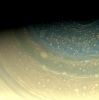
Saturn-PIA10553-1.jpgThe Blue Pole of Saturn (natural colors; credits: NASA/JPL/Space Science Institute and Lunar Explorer Italia)55 visiteCaption NASA:"Saturn's North Pole is littered with storms, as we see in this color view of it. A bit of the North Polar Hexagon is also visible at the upper-right. Cassini scientists are looking forward to sunrise on this Pole next year so that they can better study it in Visible Light.
Images taken using red, green and blue spectral filters were combined to create this full color view. The images were obtained with the Cassini Spacecraft wide-angle camera on Nov. 16, 2008 at a distance of approx. 673.000 Km (such as about 418.000 miles) from Saturn and at a Sun-Saturn-Spacecraft, or Phase, Angle of 71°.
Image scale is roughly 37 Km (about 23 miles) per pixel".MareKromium
|
|
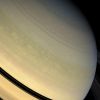
Saturn-PIA10578.jpgThe Northern Hemisphere of Saturn (Natural Colors; credits: NASA/JPL/Space Science Institute)55 visiteCaption NASA:"A chef's bounty of colors is represented in this full color view of Saturn's Northern Hemisphere.
Butternut, peach, and olive hues have replaced the azure blue of Winter. The blue of Saturn's Winter Hemisphere during the early Cassini Prime Mission still remains a puzzle. Over the course of time, the blue color has faded and has been replaced with bands of other hues (see also PIA11141).
This picture is a combination of images taken in red, green and blue light with the Cassini spacecraft wide-angle camera on Jan. 1, 2009. The view was obtained at a distance of approx. 1,1 MKM (such as about 680.000 miles) from Saturn and at a Sun-Saturn-Spacecraft, or Phase, Angle of 28°.
Image scale is roughly 65 Km (about 40 miles) per pixel".MareKromium
|
|

Tethys.jpgTethys, from Voyager 1 (Natural Colors; credits: Ted Stryk)55 visitenessun commentoMareKromium
|
|

Rhea.jpgTirawa Basin on Reha, from Voyager 1 (Natural Colors; credits: Ted Stryk)55 visiteAs Voyager 1 receded from its close flyby of Rhea, it snapped this view of Rhea's Tirawa Basin, a large impact structure seen on the Terminator in this crescent view.
It is on of the worst-imaged parts of this world, and this Voyager view is still the best. Rhea is a moon that shows some similar features to more active Dione and Tethys, but seems to have been inactive for longer, as evidenced by the fact that all of its surface is extremely worn from impacts and the evidences of internal activity are much more subtle.MareKromium
|
|
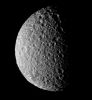
Mimas-V1.jpgMimas, from Voyager 155 visitenessun commentoMareKromium
|
|
| 2245 immagini su 188 pagina(e) |
 |
|
|
|
|
166 | |
|
|
|
|





