| Piú viste - Saturn: the "Ringed Beauty" and His Moons |
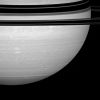
Saturn-PIA09913.jpgJust a Matter of "Proportions"...55 visiteCaption NASA:"A great, eye-like vortex stares out of Saturn's roiling atmosphere. The storm is wide enough to span the distance from Washington, DC to London. Bright Enceladus drifts past in the foreground.
This view looks toward the unilluminated side of the Rings from about 3° above the Ring-Plane.
The image was taken with the Cassini Spacecraft wide-angle camera on April 23, 2008 using a combination of spectral filters sensitive to wavelengths of polarized infrared light centered at 752 nanometers. The view was acquired at a distance of approx. 1,3 MKM (such as about 783.000 miles) from Saturn.
Image scale is roughly 72 Km (about 45 miles) per pixel".MareKromium
|
|
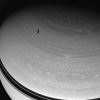
Saturn-PIA09917.jpgFrom farther North, than the North Pole...55 visiteCaption NASA:"Myriad vortices churn through Saturn's high Northern Latitudes while Dione's shadow drifts across the gas giant's face.
This view looks toward the unilluminated side of the Rings from about 43° above the Ring-Plane.
The image was taken with the Cassini Spacecraft wide-angle camera on May 7, 2008 using a spectral filter sensitive to wavelengths of infrared light centered at 752 nanometers.
The view was obtained at a distance of approx. 1,2 MKM (about 760.000 miles) from Saturn. Image scale is roughly 69 Km (about 43 miles) per pixel".MareKromium
|
|
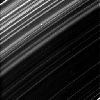
TheRings-N00114226-N00114326.gifThe Rings, with "noise", "cosmic rays" and "unknown objects" - GIF Movie (credits: Dr Gianluigi Barca)55 visiteUno splendido filmato GIF il quale, oltre a darci la sensazione visiva del "movimento" degli Anelli (rectius: di Cassini rispetto agli Anelli), ci fornisce un gran numero di esempi di possibili Anomalìe e "disturbi" di segnale.
In tre parole: un Filmato Didattico. Congratulazioni, come sempre, al Dr Barca!
...e per gli Esperti: riuscite a distinguere alcune "Spikes"?MareKromium
|
|

Methone-N00111933.jpgStar-Trails and Methone55 visitenessun commentoMareKromium
|
|

Saturn-PIA08415.jpgSpringtime's Hues - (natural colors; credits: NASA)55 visiteCaption NASA:"New hues are creeping into Saturn's Northern Cloud Bands as Winter gives way to Spring there.
During its first four years of exploration, Cassini has made the Saturn System a familiar place to us Earthlings. The intrepid craft has returned more than 150.000 images since arriving in orbit in mid-2004. In this natural color image, the blues and grays of Saturn's Northern Hemisphere, so striking in early Cassini images, are diminishing in intensity with the slow change of seasons on Saturn, and are almost imperceptibly being replaced by pale shades of the colors commonly seen by Cassini in the Planet's Southern Hemisphere.
This view looks toward the sunlit side of the Rings from about less than 1° below the Ring-Plane. Images taken using red, green and blue spectral filters were combined to create this natural color view. The images were acquired with the Cassini Spacecraft wide-angle camera on April 23, 2008, at a distance of approx. 1,2 MKM (such as about 740.000 miles) from Saturn.
Image scale is roughly 68 Km (about 42 miles) per pixel".MareKromium
|
|
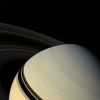
Saturn-PIA08414.jpgPerspectives... (natural colors; credits: NASA)55 visiteCaption NASA:"The Ringed Planet sits in repose, the center of its own macrocosm of many rings and moons and one artificial satellite named Cassini. Mimas (approx. 397 Km, or about 247 miles across) is visible at upper left. Although unseen in this view, Enceladus (approx. 504 Km, or about 313 miles across) casts its shadow upon the Planet. The Rings also block the Sun's light from the low Latitudes of the Northern Hemisphere.
During Cassini's extended mission, dubbed the Cassini Equinox Mission, which begins on July 1, 2008, the Ring shadows will slip past the Planet's Equator and into the Southern Hemisphere as Saturn passes through its Northern Vernal Equinox on August 11, 2009, and the Sun moves northward through the Ring-Plane.
This view looks down on the unilluminated side of the Rings, from about 22° above (such as North of) the Ring-Plane. Images taken using red, green and blue spectral filters were combined to create this natural color view. The images were obtained with the Cassini Spacecraft wide-angle camera on Dec. 16, 2007, at a distance of approx. 1,4 MKM (such as about 900,000 miles) from Saturn.
Image scale is roughly 86 Km (about 53 miles) per pixel".MareKromium
|
|

Saturn-PIA10413.jpgSwirling Clouds (MULTISPECTRUM; credits: Lunexit)55 visiteCaption NASA:"Sinuous clouds and hurricane-sized vortices mingle in Saturn's Northern Skies. This view looks toward a Region located at 70° North Latitude on Saturn.
Despite the level of detail visible here, the Region shown is wide enough to contain the planet Mars comfortably.
The image was taken with Cassini's CB1 spectral filter, which is sensitive to wavelengths of visible red light centered at 619 nanometers. The view was acquired with the spacecraft's narrow-angle camera on May 23, 2008 at a distance of approx. 1,2 MKM (about 775.000 miles) from Saturn.
Image scale is roughly 7 Km (about 4 miles) per pixel".MareKromium
|
|
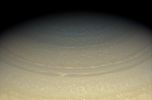
Saturn-PIA10414.jpgNorthern Blue (natural colors; credits: NASA/JPL/Space Science Institute)55 visiteCaption NASA:"Golden hues continue to creep Northward on Saturn, subduing the blues and grays the Cassini Spacecraft witnessed upon arrival in mid-2004. This view was acquired from about 27° above the Ring-Plane.
Images taken using red, green and blue spectral filters were combined to create this natural color view. The images were acquired with the Cassini Spacecraft wide-angle camera on May 23, 2008 at a distance of approx. 1,3 MKM (such as about 780.000 miles) from Saturn.
Image scale is roughly 71 Km (about 44 miles) per pixel".MareKromium
|
|

Janus-N00114757.jpgRugged Janus and various image-artifacts (MULTISPECTRUM-2; credits: Lunexit)55 visiteCaption NASA:"N00114757.jpg was taken on June 30, 2008 and received on Earth July 01, 2008.
The camera was pointing toward JANUS which, at the time, was approx. 33.205 Km away and the image was taken using the CL1 and MT2 filters.
This image has not been validated or calibrated".MareKromium
|
|

Janus-N00114756.jpgRugged Janus and various image-artifacts (MULTISPECTRUM-2; credits: Lunexit)55 visiteCaption NASA:"N00114756.jpg was taken on June 30, 2008 and received on Earth July 01, 2008.
The camera was pointing toward JANUS that, at the time, was approx. 32.994 Km away and the image was taken using the CL1 and CL2 filters.
This image has not been validated or calibrated".MareKromium
|
|
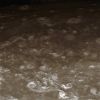
Saturn-PIA10416.jpgSaturnian "Twirling Vortices" and "Cirrus-like" Clouds Formation (MULTISPECTRUM-2; credits: Lunexit)55 visiteCaption NASA:"Twirling vortices swim through a vast ocean of Hydrogen and Helium in Saturn's far North. This view looks toward a region at 70° North Latitude.
The image was taken with the Cassini spacecraft narrow-angle camera on May 23, 2008 using a spectral filter sensitive to wavelengths of infrared light centered at 750 nanometers. The view was obtained at a distance of approx. 1,2 MKM (such as about 776.000 miles) from Saturn.
Image scale is roughly 7 Km (about 4 miles) per pixel".MareKromium
|
|

Dione-PIA09838.jpgDione (MULTISPECTRUM-2; credits: Lunexit)55 visiteCaption NASA:"The Cassini Spacecraft looks down from high latitude over Dione and the system of wispy fractures that coats the moon's Trailing Side.
This view looks toward Dione from 43° above the Equator. North is up.
The image was taken in visible light with the Cassini Spacecraft narrow-angle camera on Jan. 14, 2008. The view was acquired at a distance of approx. 938.000 Km (such as about 583.000 miles) from Dione and at a Sun-Dione-Spacecraft angle of 54°.
Image scale is roughly 6 Km (a little less than 4 miles) per pixel".MareKromium
|
|
| 2245 immagini su 188 pagina(e) |
 |
|
|
|
|
165 | |
|
|
|
|





