| Piú viste - Saturn: the "Ringed Beauty" and His Moons |

Enceladus-PIA10355.jpgGas and Dust Jets Match Up!55 visiteCaption NASA:"Jets of high-density gas detected by Cassini's Ultraviolet Imaging Spectrograph on Saturn's moon Enceladus match the locations of dust jets determined from Cassini images, labeled here with Roman numerals. The spectrograph pinpointed the locations of individual gas streams in the plume in a "stellar occultation", which involves measuring the light of a star (in this case, Zeta Orionis), as it passed behind the plume from Cassini's viewpoint.
The blue line in this projection shows the path of the starlight through the plume, over the South Polar Region of Enceladus.
The instrument looked at the star across this path in the direction indicated by the short blue lines.
Some of the dust jets appear to merge together in stellar occultation data. The dimming of starlight labeled "a" was caused by dust jets V and VII. The dimming of starlight marked as feature "b" may be associated with dust jet I if the jet is not perfectly vertical.
Dimming of starlight labeled "c" corresponds to dust jet VI, and "d" is dust jet III, with dust jet II in between. The individual jets come from sources with an area of less than 300 by 300 meters (such as about 1000 feet square) - about the size of half a tennis court - probably stretched out rectangularly along the Tiger Stripes.
The new data indicate that the water molecules are blasting off from Enceladus at faster than 600 meters per second (about 1200 mph)".MareKromium
|
|

Saturn-PIA09876~0.jpgNorthern Latitudes (Natural Colors; credits: NASA)55 visiteCaption NASA:"Saturn dominates this colorful view, taken from a vantage point high above the Rings. From here the Cassini Spacecraft can see the Rings' far side, where the dark shadow of Saturn abruptly terminates their visibility.
Mimas (about 397 Km, or approx. 247 miles across) casts its shadow onto the Planet's Northern Latitudes (just below center).
This view looks toward the unilluminated side of the Rings from about 27° above the Ring-Plane.
Images taken using red, green and blue spectral filters were combined to create this natural color view. The images were acquired with the Cassini spacecraft wide-angle camera on Feb. 26, 2008 at a distance of approx. 1,6 MKM (such as about 1 MMs) from Saturn.
Image scale is roughly 93 Km (about 58 miles) per pixel".MareKromium
|
|

Sun-N00107153.jpgSunshine through the Rings... (natural colors; credits: Lunexit)55 visiteCaption NASA:"N00107153.jpg was taken on April 10, 2008 and received on Earth on April 11, 2008. The camera was pointing toward SATURN, F-RING that, at the time, was approx. 609.375 Km away, and the image was taken using the CL1 and CL2 filters. This image has not been validated or calibrated".MareKromium
|
|

Sun-N00107151.jpgSunshine through the Rings... (natural colors; credits: Lunexit)55 visiteCaption NASA:"Caption NASA:"N00107151.jpg was taken on April 10, 2008 and received on Earth on April 11, 2008. The camera was pointing toward SATURN, F-RING that, at the time, was approx. 613.189 Km away, and the image was taken using the CL1 and CL2 filters. This image has not been validated or calibrated".MareKromium
|
|
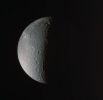
Dione-PIA09886.jpgThe North Polar Regions of Dione (True Colors; credits: Lunexit)55 visiteCaption NASA:"The Cassini Spacecraft looks down, almost directly at the North Pole of Dione. The feature just left of the Terminator at the bottom is Janiculum Dorsa, a long, roughly North-South trending ridge. Lit terrain seen here is on the anti-Saturn and Trailing Sides of Dione.
The image was taken with the Cassini spacecraft narrow-angle camera on March 22, 2008 using a spectral filter sensitive to wavelengths of UV light centered at 338 nanometers. The view was acquired at a distance of approx. 650.000 Km (about 404.000 miles) from Dione and at a Sun-Dione-Spacecraft angle of 99°.
Image scale is roughly 4 Km (about 2 miles) per pixel".MareKromium
|
|

Saturn-PIA08411.jpgElectrical Storm on Saturn's Upper Troposphere (approx. true colors; credits: NASA)55 visiteCaption NASA:"It is no Great Red Spot, but these two side-by-side views show the longest-lived electrical storm yet observed on Saturn by NASA's Cassini Spacecraft.
The views were acquired more than 3 months after the storm was first detected from its lightning-produced radio discharges on Nov. 27, 2007.
Cassini imaging scientists believe the storm to be a vertically extended disturbance that penetrates from Saturn's Lower to Upper Troposphere.
The view at left was created by combining images taken using red, green and blue spectral filters, and shows Saturn in colors that approximate what the human eye would see. The storm stands out with greater clarity in the sharpened, enhanced color view at right. This view combines images taken in infrared, green and violet light at 939, 567 and 420 nanometers respectively and represents an expansion of the wavelength region of the electromagnetic spectrum visible to human eyes. This view looks toward the un-illuminated side of the Rings from about 3° above the Ring-Plane.
Janus (about 181 Km, or approx. 113 miles across) appears as a dark speck just beneath the Rings in both images.
These images were obtained with the Cassini spacecraft wide-angle camera on March 4, 2008, at a distance of approx. 1,3 MKM (about 800.000 miles) from Saturn.
Image scale is roughly 74 Km (about 46 miles) per pixel".MareKromium
|
|

Saturn-PIA08410.jpgElectrical Storm on Saturn's Upper Troposphere (natural colors; credits: NASA)55 visiteCaption NASA:"A bright, powerful, lightning-producing storm churns and coasts along the lane of Saturn's Southern Hemisphere nicknamed "Storm Alley" by scientists.
NASA's Cassini spacecraft detected this particular tempest after nearly 2 years during which Saturn did not appear to produce any large electrical storms of this kind. The storm appears as a bright, irregular splotch on the Planet near lower right.
Lightning flashes within the persistent storm produce radio waves, called Saturn Electrostatic Discharges, which the Cassini radio and plasma wave science instrument first detected on Nov. 27, 2007. Cassini's imaging cameras then spotted the storm, taking the images used to create this color view about a week later on Dec. 6, 2007.
This electrical storm is similar in appearance and intensity to those previously monitored by Cassini. All of these powerful electrostatic producing storms appeared at about 35° South Latitude on Saturn.
This storm has now been continuously tracked by Cassini for several months, whereas previous storms observed by the Spacecraft lasted for less than 30 days.
The view looks toward the un-illuminated side of the Rings from about 5° above the Ring-Plane. Tethys (about 1071 Km, or approx. 665 miles across) is seen here in the foreground, and casts its shadow onto the high Northern Latitudes.
Images taken using red, green and blue spectral filters were combined to create this natural color view. The images were acquired with the Cassini spacecraft wide-angle camera at a distance of approx. 1,7 MKM (1 MMs) from Saturn.
Image scale is roughly 97 Km (about 60 miles) per pixel".MareKromium
|
|
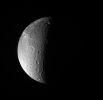
Dione-PIA09886~0.jpgJaniculum Dorsa55 visiteCaption NASA:"The Cassini spacecraft looks down, almost directly at the North Pole of Dione. The feature just left of the Terminator at bottom is Janiculum Dorsa, a long, roughly North-South trending ridge.
Lit terrain seen here is on the anti-Saturn and trailing sides of Dione (1126 Km, or approx. 700 miles across).
This image was taken with the Cassini spacecraft narrow-angle camera on March 22, 2008 using a spectral filter sensitive to wavelengths of ultraviolet light centered at 338 nanometers. The view was acquired at a distance of approx. 650.000 Km (about 404.000 miles) from Dione and at a Sun-Dione-Spacecraft, or phase, angle of 99°.
Image scale is roughly 4 Km (about 2 miles) per pixel".MareKromium
|
|
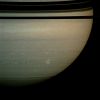
Saturn-PIA09900.jpgContinuing or Perpetual Storm? (MULTISPECTRUM; credits: Lunexit)55 visiteCaption NASA:"The longest-lived continuously monitored electrical storm ever observed on Saturn continues to churn through the tempest-tossed region nicknamed "Storm Alley" because of its preponderance of storm activity. This image of the storm was taken about 5 months after it was first detected by Cassini's Imaging Cameras and the Radio and Plasma Wave Science Experiment.
This view looks toward the unilluminated side of the Rings from about 1° above the Ring-Plane. The bands of the Ring shadows blanket the Planet at the top of the scene.
The image was taken with the Cassini spacecraft wide-angle camera on April 23, 2008 using a combination of spectral filters sensitive to wavelengths of polarized infrared light centered at 752 nanometers. The view was acquired at a distance of approx. 1,2 MKM (such as about 760.000 miles) from Saturn.
Image scale is roughly 70 Km (about 43 miles) per pixel".MareKromium
|
|

Saturn-PIA09906.jpgNorthern Latitudes (approx. true colors; credits: NASA)55 visiteCaption NASA:"Stately Saturn sits surrounded by its darkened disk of ice. An increasing range of hues has become visible in the Northern Hemisphere as Spring approaches and the Ring shadows slide southward.
This view looks toward the unilluminated side of the rings from about 17° above the Ring-Plane. Images taken using red, green and blue spectral filters were combined to create this natural color view. The images were acquired with the Cassini Spacecraft wide-angle camera on April 15, 2008 at a distance of approx. 1,5 MKM (such as about 906.000 miles) from Saturn.
Image scale is roughly 84 Km (about 52 miles) per pixel".MareKromium
|
|

Atlas-PIA09907.jpgBrothers in the Night: Atlas and Daphnis55 visiteCaption NASA:"Looking upward from beneath the Ring-Plane, the Cassini Spacecraft spies Saturn's "Wave Maker" and "Flying Saucer" moons.
Daphnis (8 Km, or about 5 miles across at its widest point) and its gravitationally induced edge waves are seen at left within the Keeler Gap. The equatorial bulge on Atlas (30 Km, or about 19 miles across at its widest point) is clearly visible here.
This view looks toward the sunlit side of the Rings from about 16° below the Ring-Plane. The image was taken in visible light with the Cassini spacecraft narrow-angle camera on April 22, 2008. The view was acquired at a distance of approx. 898.000 Km (such as about 558.000 miles) from Saturn.
Image scale is roughly 5 Km (about 3 miles) per pixel".MareKromium
|
|

Saturn-PIA09908.jpgThrough the Rings...55 visiteCaption NASA:"The Cassini spacecraft peers through the Gossamer Strands of Saturn's innermost rings, whose own shadows adorn the Planet beyond.
This view looks toward the sunlit side of the rings from about 35° below the Ring-Plane. The image was taken in visible light with the Cassini Spacecraft wide-angle camera on April 21, 2008. The view was obtained at a distance of approximately 620.000 Km (approx. 385.000 miles) from Saturn.
Image scale is roughly 67 Km (approx. 42 miles) per pixel".MareKromium
|
|
| 2245 immagini su 188 pagina(e) |
 |
|
|
|
|
164 | |
|
|
|
|





