| |

| Piú viste - Saturn: the "Ringed Beauty" and His Moons |
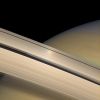
Saturn-PIA08393.jpgThe "Opposition Effect" (again)55 visiteThe Opposition Effect, a brightness surge that is visible on Saturn's Rings when the Sun is directly behind the Spacecraft, is captured here as a colorful halo of light moving across Saturn's Sunlit Rings. The rainbow of color seen here is actually an artifact and a by-product of the spot's movement and the way the color image was produced. Cassini acquires color images by taking sequential exposures using red, green and blue spectral filters, which are then composited together to form a color view. The bright patch traveled across the Rings between exposures taken for this view, creating a series of 3 colorful spots showing its position at 3 separate moments.
This view looks toward the Sunlit side of the Rings from about 9° below the Ring-Plane.
The images in this view were acquired with the Cassini spacecraft wide-angle camera on June 12, 2007, at a distance of approx. 523.000 Km (such as about 325.000 miles) from Saturn.
Image scale is roughly 31 Km (about 19 miles) per pixel.
MareKromium
|
|
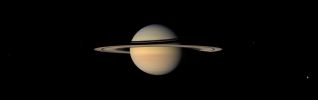
Saturn-PIA08387.jpgA View from Japetus55 visiteWhile on final approach for its Sept. 2007 close encounter with Saturn's moon Japetus, Cassini spun around to take in a sweeping view of the Saturn System.
Japetus is the only major moon of Saturn with a significant inclination to its orbit. From the other major satellites, the Rings would appear nearly edge-on, but from Japetus, the Rings usually appear at a tilt, as seen here.
This natural color mosaic consists of 15 red, green and blue spectral filter images acquired in five wide-angle camera footprints that swept across the scene.
Moons visible in this image: Dione at center left, Enceladus near the left side ansa (or ring edge), Mimas is a speck against the ring shadows on Saturn's Western Limb, Rhea can be seen against the bluish backdrop of the Northern Hemisphere, Tethys is near the right ansa, and Titan near lower right.
The images were obtained on Sept. 10, 2007, at a distance of approx. 3,3 MKM (such as about 2,1 MMs) from Saturn at a Sun-Saturn-Spacecraft, or phase, angle of 33°. Image scale is about 195 Km (approx. 121 miles) per pixel on the Planet. MareKromium
|
|

Tethys-PIA08401.jpgThe Edge of Tethys55 visiteThe cold, cratered landscape of Saturn's moon Tethys shines in stark relief in this crescent view. Aside from its obvious aesthetic beauty, this particular Cassini mosaic was obtained mainly to understand important details about how the surface of Tethys reflects light at high phase angles (the Sun-Tethys-Spacecraft viewing angle). The beautiful interplay of light with surface topographic features is an important factor in this regard. The surface is heavily cratered, and at this oblique angle the craters give the surface a highly scalloped appearance.
Unlike some HR crescent views of Saturn's moons, this image truly gives Tethys the appearance of being composed of ice and frost. There appear to be numerous sun glints sparkling across the surface. Some of these might be specular (or mirror-like) reflections off of exposed walls of solid ice inside craters, or they might be uniformly large, frosty or icy-particle covered facets of topography that are so oriented as to give exceptionally bright but diffuse reflections.
The shadows cast by most craters in the scene are not dark, but rather, they are illuminated by light bouncing off of their sunlit walls and those of other craters. This light, which has been scattered multiple times, makes visible some details along the shadowed walls and floors of craters that would not otherwise be visible in this viewing geometry.
This mosaic was assembled from four clear filter, narrow-angle camera images, with low resolution, wide-angle camera data filling a small gap in coverage. The view is an orthographic projection and has a resolution of 211 meters (692 feet) per pixel. An orthographic view is most like the view seen by a distant observer looking through a telescope. North is up.
The view was obtained by the Cassini spacecraft on June 29, 2007, from a distance of approximately 38.000 Km (about 24.000 miles) and at a Sun-Tethys-Spacecraft, or phase, angle of 152°.
MareKromium
|
|
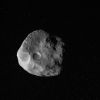
Epimetheus-N00098337.jpgEpimetheus (1)55 visiteCaption NASA:"N00098337.jpg was taken on December 03, 2007 and received on Earth December 04, 2007. The camera was pointing toward EPIMETHEUS that, at the time, was approx. 39.290 Km away, and the image was taken using the P120 and GRN filters.
This image has not been validated or calibrated".MareKromium
|
|
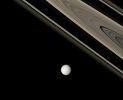
Tethys-PIA09788.jpgTrue Colors?55 visiteCaption NASA:"As seen from the side not illuminated by the Sun, Saturn's thinner Rings are highlighted in shades of brown and gold, contrasting with the more neutral appearance of the icy moon Tethys. The A-Ring and Cassini Division are separated by the optically thick B-Ring, which does not permit sunlight to penetrate and appears as the broad, dark lane between them in this view.
This view looks toward the anti-Saturn side of Tethys.
North is up and rotated 35° to the right.
The view looks toward the unilluminated side of the rings from about 2° above the Ring-Plane.
Images taken using red, green and blue spectral filters were combined to create this natural color view. The view was acquired with the Cassini spacecraft narrow-angle camera on Oct. 29, 2007, at a distance of approx. 2,1 MKM (about 1,3 MMs) from Tethys and at a Sun-Tethys-spacecraft, or phase, angle of 21°.
Image scale is roughly 12 kilometers (8 miles) per pixel".MareKromium
|
|
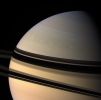
Saturn-PIA09793.jpgThe Northern Hemisphere of Saturn (natural colors; credits: NASA/Space Science Inst.)55 visiteCaption NASA:"Dark ring shadows adorn the Northern Hemisphere of Saturn.
The shadows have loosened their grip on the North compared to when Cassini arrived in 2004, and presently continue to slide farther South.
This view looks toward the unilluminated side of the rings from about 5° above the Ring-Plane. Images taken using red, green and blue spectral filters were combined to create this Natural Color View. The view was acquired with the Cassini spacecraft wide-angle camera on Oct. 22, 2007, at a distance of approx. 1,3 MKM (such as about 839.000 miles) from Saturn.
Image scale is roughly 77 Km (about 48 miles) per pixel".MareKromium
|
|
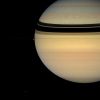
Saturn-PIA08394.jpgMoons... (natural colors; credits: NASA)55 visiteCaption NASA:"This colorful view, taken from edge-on with the Ring-Plane, contains 4 of Saturn's attendant moons. Tethys is seen against the black sky to the left of the Gas Giant's limb. Brilliant Enceladus sits against the Planet near right.
Irregular Hyperion is at the bottom of the image, near left. Much smaller Epimetheus is a speck below the Rings directly between Tethys and Enceladus. Epimetheus casts an equally tiny shadow onto the blue Northern Hemisphere, just above the thin shadow of the F-Ring.
Images taken using red, green and blue spectral filters were combined to create this natural color view. The images were acquired with the Cassini spacecraft wide-angle camera on July 24, 2007 at a distance of approx. 2 MKM (about 1,2 MMs) from Saturn. Image scale is 116 kilometers (72 miles) per pixel on Saturn".MareKromium
|
|

Epimetheus-PIA09813.jpgEpimetheus, from about 37.000 Km (enhanced - but natural - colors; credits: NASA)55 visiteCaption NASA:"The Cassini spacecraft's close flyby of Epimetheus in December 2007 returned detailed images of the moon's South Polar Region.
The view shows what might be the remains of a large impact crater covering most of this face, and which could be responsible for the somewhat flattened shape of the Southern part of Epimetheus (116 Km, or about 72 miles across) seen previously at much lower resolution.
The image also shows two terrain types: darker, smoother areas, and brighter, slightly more yellowish, fractured terrain. One interpretation of this image is that the darker material evidently moves down slopes, and probably has a lower ice content than the brighter material, which appears more like "bedrock". Nonetheless, materials in both terrains are likely to be rich in water ice. (...)".
MareKromium
|
|

Saturn_Titan-PIA09856.jpgFather and Son (natural colors; credits: NASA)55 visiteCaption NASA:"The Cassini Spacecraft captured this color portrait of Saturn and Titan only a few minutes before the haze-enshrouded moon slipped behind the planet's enormous bulk. The view looks toward the sunlit side of the Rings from about 5° below the Ring-Plane.
The Northern Hemisphere of Titan presently appears darker than the Southern, a feature presumed to be a seasonal effect.
Images taken using red, green and blue spectral filters were combined to create this natural color view. The images were acquired with the Cassini spacecraft wide-angle camera on Jan. 29, 2008 at a distance of approx. 2,3 MKM (such as about 1,4 MMs) from Titan and approx. 1 MKM (about 630.000 miles) from Saturn.
Image scale is roughly 135 Km (about 84 miles) per pixel on Titan and approx. 61 Km (about 38 miles) per pixel on Saturn".MareKromium
|
|

Enceladus-IMG002995-br500.jpgArabian Nights...On Enceladus!55 visiteCaption NASA:"This 3-image mosaic is the highest resolution view yet obtained of Enceladus' North Polar Region. The view looks southward over cratered plains from high above the North Pole of Enceladus.
Cassini's March 2008 flyby of Enceladus was designed to directly investigate the ongoing plume activity at the moon’s South Pole, but the path of the spacecraft allowed investigation of older evidence for internal activity near the North Pole.
Compared to much of the moon's Southern Hemisphere - the South Polar Region in particular - the North Polar Region is much older and covered with craters. These craters are captured at different stages of disruption and alteration by tectonic activity and probably past heating from below. Many of the craters seen here are sliced by small parallel cracks that seem to be ubiquitous throughout the old cratered terrains on Enceladus. The mosaic also shows a variety of impact crater shapes, some with bowed-up floors and smaller craters within, very likely indicating that the icy crust in this area was at some time warmer than at present. While this conclusion was previously reached from NASA Voyager spacecraft images, these new data provide a much more detailed look at the fractures that modify the surface. This data will give a significantly improved comparison of the geologic history at the satellite's north pole with that at the South Pole.
Two prominent craters in this view, Ali Baba and Aladdin (the two overlapping craters near center), are among the largest craters known on Enceladus.
Several areas of much younger terrain are visible in this mosaic, including Samarkand Sulci, an area of disrupted terrain that runs North-South at left of center, and the "Leading Hemisphere Terrain", a region, seen at right, filled with tectonic fractures, ridges and "ridged terrain".
Samarkand Sulci slices through some prominent craters that were seen in Voyager images. At that time, it was thought that the portions of the craters that extend into Samarkand were completely destroyed by whatever process formed Samarkand. However, Cassini images show remnants of the crater rims that have survived. This new insight provides a benchmark for measuring how tectonic processes modify older terrains, and will also help imaging scientists develop a more accurate timeline for the geologic history of these terrains.
Lit terrain seen here is on the Saturn-Facing Hemisphere of Enceladus.
The image was taken in visible light with the Cassini spacecraft narrow-angle camera on March 12, 2008. The view was acquired at a distance of approx. 32.000 Km (about 20.000 miles) from Enceladus and at a Sun-Enceladus-spacecraft, or phase, angle of 115°.
Image scale is roughly 176 meters (577 feet) per pixel".MareKromium
|
|

Saturn-PIA09864.jpgNever "Dark Nights"... (natural colors; credits: NASA)55 visiteCaption NASA:"Titan emerges from behind Saturn, while Tethys streaks into view, in this colorful scene. Saturn's shadow darkens the far arm of the Rings near the Planet's limb. Titan is about 5150 Km (approx. 3200 miles) wide; Tethys is 1071 Km (such as approx. 665 miles) wide.
This view looks toward the unilluminated side of the Rings from about 3° above the Ring-Plane. Images taken using red, green and blue spectral filters were combined to create this natural color view. The images were acquired with the Cassini spacecraft wide-angle camera on Jan. 30, 2008 at a distance of approx. 1,3 MKM (such as about 800.000 miles) from Saturn.
Image scale is roughly 77 Km (about 48 miles) per pixel on Saturn".MareKromium
|
|

Enceladus-PIA10355.jpgGas and Dust Jets Match Up!55 visiteCaption NASA:"Jets of high-density gas detected by Cassini's Ultraviolet Imaging Spectrograph on Saturn's moon Enceladus match the locations of dust jets determined from Cassini images, labeled here with Roman numerals. The spectrograph pinpointed the locations of individual gas streams in the plume in a "stellar occultation", which involves measuring the light of a star (in this case, Zeta Orionis), as it passed behind the plume from Cassini's viewpoint.
The blue line in this projection shows the path of the starlight through the plume, over the South Polar Region of Enceladus.
The instrument looked at the star across this path in the direction indicated by the short blue lines.
Some of the dust jets appear to merge together in stellar occultation data. The dimming of starlight labeled "a" was caused by dust jets V and VII. The dimming of starlight marked as feature "b" may be associated with dust jet I if the jet is not perfectly vertical.
Dimming of starlight labeled "c" corresponds to dust jet VI, and "d" is dust jet III, with dust jet II in between. The individual jets come from sources with an area of less than 300 by 300 meters (such as about 1000 feet square) - about the size of half a tennis court - probably stretched out rectangularly along the Tiger Stripes.
The new data indicate that the water molecules are blasting off from Enceladus at faster than 600 meters per second (about 1200 mph)".MareKromium
|
|
| 2245 immagini su 188 pagina(e) |
|
|
|
|
|
163 | |
|
|
|
|
|
|





