| Piú viste - Saturn: the "Ringed Beauty" and His Moons |

Enceladus-PIA08197.jpgIcy Plumes in the Ring-Shine55 visiteCaption NASA originale:"The plumes of Enceladus continue to gush icy particles into Saturn orbit, making this little moon one of a select group of geologically active bodies in the solar system.
Enceladus (505 Km, or 314 miles across) is seen here against the night side of Saturn. The extended exposure time used to image the plumes also makes the Southern Hemisphere, illuminated by Ring-Shine, appear bright.
The image was acquired in visible light with the Cassini spacecraft narrow-angle camera on May 4, 2006 at a distance of approx. 2,1 MKM (about 1,3 MMs) from Enceladus and 2,3 MKM (about 1,5 MMs) from Saturn. The image was taken at a Sun-Enceladus-spacecraft, or phase, angle of 159°. Image scale is roughly 13 Km (such as about 8 miles) per pixel on Enceladus".
|
|
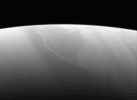
Saturn-PIA08198.jpgNightflight over Saturn55 visiteCaption NASA originale:"Saturn's atmosphere produces beautiful and sometimes perplexing features. Is the bright feature below center a rare crossing of a feature from a zone to a belt, or is it an illusion created by different cloud layers at different levels? The answer is not always easy to determine.
The image was taken using a spectral filter sensitive to wavelengths of infrared light centered at 938 nanometers.
The image was acquired with the Cassini spacecraft narrow-angle camera on May 12, 2006 at a distance of approx. 2,9 MKM (about 1,8 MMs) from Saturn and at a Sun-Saturn-spacecraft, or phase, angle of 145°. Image scale is roughly 17 Km (about 10 miles) per pixel".
|
|

The Rings-PIA06175_modest.jpgThe Rings (full view) in natural colors55 visiteCaption NASA originale:"Saturn's most prominent feature, its dazzling Ring System, takes center stage in this stunning natural color mosaic which reveals the color and diversity present in this wonder of the Solar System. Gaps, gravitational resonances and wave patterns are all present and the delicate color variations across the System are clearly visible.
This mosaic of 6 images covers a distance of approximately 62.000 Km along the ring plane, from a radius of 74.565 Km to 136.780 Km from the Planet's center.
This view is from Cassini's vantage point beneath the ring plane. The rings are tilted away from Cassini at an angle of about 4°.
Images taken using red, green and blue spectral filters were used to create this natural color mosaic. The images were acquired using the Cassini spacecraft narrow angle camera on Dec. 12, 2004, at a distance of approximately 1,8 MKM (1,1 MMs).
The image scale is 10,5 Km per pixel".
|
|

Rhea&Saturn-PIA07806.jpgRhea and Saturn in natural colors55 visiteCaption NASA originale:"The slim crescent of the moon Rhea glides silently onto the featureless, golden face of Saturn. In an interplay of contrast and shadow, the moon goes dark against the Planet, and then its crescent suddenly brightens as it slips in front of Saturn's night side.
This view looks down onto the unlit side of Saturns Rings, which cast soft, linear shadows onto the Planet's Northern Hemisphere.
The image was acquired by the Cassini spacecraft wide-angle camera on March 21, 2006, at a distance of approx. 221.000 Km (about 137.000 miles) from Rhea. The image scale is approx. 13 Km (about 8 miles) per pixel".
|
|

Mimas-PIA08223.jpgLand of Darkness...55 visiteCaption NASA originale:"The narrow and twisted F-Ring lights up this scene, which features Mimas against the unlit side of Saturn's Ring-Plane.
The F-Ring contains a great deal of fine, icy particles that are quite effective at scattering Sunlight at "high phase" angles.
Mimas (about 397 Km - approx. 247 miles - across) is seen as a mere crescent in the center of this haunting view.
The image was taken in visible light with the Cassini spacecraft narrow-angle camera on June 13, 2006 at a distance of approx. 3,9 MKM (such as about 2,4 MMs) from Mimas and at a Sun-Mimas-spacecraft, or phase, angle of 156°. Image scale is roughly 23 Km (about 15 miles) per pixel".
|
|

Tethys-N00064170.jpgThe "White Face" of Tethys55 visitenessun commento
|
|

Saturn-PIA08253.jpgThe "Ring-Masters"55 visiteCaption NASA:"This view looks down onto the unlit side of Saturn's Ringplane. It nicely shows a near-arm/far-arm brightness asymmetry in the B-Ring: The near arm of the B-Ring (in the lower half of the image) is notably darker from this viewing geometry than is the far arm (above).
Imaging scientists believe this to be a manifestation of the reflection of light from the disk of Saturn falling predominantly on the far arm of the Rings. (At the time this image was taken, Cassini was more or less on the dark side of the Planet.) As the B-Ring is the thickest part of Saturn's Rings, it scatters less sunlight from below, and reflects more Saturnshine from above, than either the A or C-Rings, making the effect look more dramatic in the B-Ring. Two small moons appear in this scene as well: Atlas and Pandora (32 and 84 Km across, respectively); between the two moons lie multiple clumps of material in the F-Ring.
The image was taken in visible light with the Cassini spacecraft wide-angle camera on July 25, 2006 at a distance of approximately 1 million kilometers (600,000 miles) from Saturn and at a Sun-Saturn-spacecraft, or phase, angle of 128 degrees. Image scale is 58 kilometers (36 miles) per pixel.
|
|

The Rings-PIA08255.jpg"Penumbral fade" on Saturn's Rings55 visiteCaption NASA:"As the particles comprising Saturn's A-Ring slip into the Planet's shadow, they find themselves briefly in the penumbra of Saturn's shadow. In this very narrow region along the edge of the shadow, part (but not all) of the Sun is still visible around the side of the Planet, creating only a partial shadow there and making the shadow edge look fuzzy.
The image was taken in visible light with the Cassini spacecraft narrow-angle camera on July 26, 2006 at a distance of approx. 1,5 MKM (such as about 900.000 miles) from Saturn. Image scale is roughly 9 Km (about 5 miles) per pixel".
|
|

Dione-PIA08256-C.jpgThe "White (and Bright) Cliffs" of Dione (detail mgnf n. 3)55 visitenessun commento
|
|

Dione-PIA08256-D.jpgThe "White (and Bright) Cliffs" of Dione (detail mgnf n. 4)55 visitenessun commento
|
|

Japetus-3D2.jpgJapetus (3D)55 visitenessun commento
|
|

Tethys-N00065796.jpgTethys (HR)55 visitenessun commento
|
|
| 2245 immagini su 188 pagina(e) |
 |
|
|
|
|
162 | |
|
|
|
|





