| Piú viste - Saturn: the "Ringed Beauty" and His Moons |
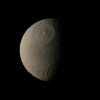
Tethys-PIA12588.jpgTethys (Absolute Natural Colors; credits: Dr Paolo C. Fienga - Lunexit Team)56 visiteCaption NASA:"Odysseus Crater, with a size of epic proportions, stretches across a large Northern Expanse on Saturn's moon Tethys.
This view looks toward the Leading Hemisphere of Tethys. Odysseus Crater is about 450 Km, or approx. 280 miles, across. North on Tethys is up and rotated 3° to the right.
The image was taken in Visible Green Light with the Cassini Spacecraft narrow-angle camera on Feb. 14, 2010. The view was obtained at a distance of approx. 178.000 Km (such as about 111.000 miles) from Tethys and at a Sun-Tethys-Spacecraft, or Phase, Angle of 73°.
Image scale is about 1 Km (3485 feet) per pixel".
MareKromium
|
|

Prometheus.jpgPrometheus56 visitenessun commentoMareKromium
|
|

Enceladus-EB-LXTT6.jpgBeyond the Visible Light: Enceladus in IR and UV (an Image-Mosaic by Elisabetta Bonora - Lunexit Team)56 visiteUn altro spettacolare "Educational" della nostra Amica e Partner Elisabetta Bonora, in attesa che anche la NASA o l'ESA - se non altro "ufficialmente" ed attraverso i loro "Canali Pubblici" - facciano qualcosa di ugualmente valido ed istruttivo.
Un'attesa che, molto probabilmente, sarà vana...MareKromium
|
|

The Rings from approx. 24.500.000 Km.jpgThe Rings from app.x 24.500.000 Km55 visitenessun commento
|
|

Mimas from appx. 5.100.000 Km.jpgMimas from approx. 5.100.000 Km55 visitenessun commento
|
|

Saturn_s Rings in color - PIA06114_modest.jpgSaturn's Rings in natural colors from Cassini-Huygens55 visiteCaption NASA originale:Saturn's faintly banded atmosphere is delicately colored and its threadbare rings cross their own shadows in this marvelous natural color view from Cassini.
The planet and its rings would nearly fill the space between Earth and the Moon. Yet, despite their great breadth, the rings are a few meters thick and in some places, very translucent. In this image, we can see through the C-Ring, which is closest to Saturn, and through the Cassini division, the 4.800-Km wide gap that arcs across the top of the image and separates the optically thick B-Ring from the A-Ring. The part of the atmosphere seen through the gap appears darker and more bluish due to scattering at blue wavelengths by the cloud-free upper atmosphere.
The different colors in Saturn's atmosphere are due to particles whose composition is yet to be determined.
The image was obtained with the Cassini spacecraft narrow angle camera on July 30, 2004, at a distance of 7.6 MKM from Saturn".
|
|

The F-Ring - N00023767.jpgThe "F-Ring" of Saturn from approx. 544.000 Km55 visiteUna spettacolare ripresa (una delle tantissime, a dire il vero) del misterioso "F-Ring" di Saturno da una distanza - relativamente - breve: poco più di mezzo milione di Km. Svariati dettagli di questo enigmatico anello sono chiaramente visibili e, in particolare, potete vedere i cosiddetti "clumps", ossìa una specie di "grumi" di roccia e detriti che rendono irregolari alcune sezioni dell'anello (in particolare ce ne sono 4 assai ben visibili in basso ed alla Vostra Dx).
Sul margine superiore interno dell'Anello, alla Dx dell'Osservatore, si vede un puntino bianco che potrebbe essere (ma di questo non ne siamo certi) un altro "Ring Master" oppure, se preferite, una "Shepherd Moon". Due modi e due nomi diversi per indicare una piccolissima Luna di Saturno che, con la sua sola presenza, contribuisce a mantenere in equilibrio il sistema degli anelli - da un lato - e, talvolta, ad "incresparlo" - dall'altro.
|
|
The E-Ring - W00002666.jpgThe "E-Ring" from approx. 411.000 Km55 visiteUn'immagine spettacolare ma assolutamente enigmatica: dalla distanza da cui è stata effettuata questa ripresa, infatti, la reale tessitura dell'Anello "E" non è ancora risolvibile. Certo, si vedono già molte cose ("clumps" e "punti luminosi" abbastanza ben definiti) ma, secondo noi, interpretarle in questo momento ed usando solo i pochi dati a nostra disposizione, equivarrebbe - in fondo - a "tirare ad indovinare". Per cui aspettiamo ancora un pò...
|
|

Enceladus-N00030111.jpgEnceladus, from approx. 4.000 Km55 visiteTabella riassuntiva delle caratteristiche superficiali di Encelado:
1. esistenza di una diffusa e fittissima rete di canyons, crepacci e canali;
2. sostanziale scarsità di crateri da impatto (salvo alcune aree, di modeste dimensioni);
3. presenza, accanto alle "reti di canali e canyons", di alcuni crepacci molto grandi, profondi e, apparentemente, recenti (si potrebbe trattare, forse, di "fratture tettoniche");
4. mancanza di profili "aspri" (anche i bordi dei pochi crateri visibili sembrano essere 'smussati');
5. albedo altissima (molte immagini recano chiari segni di sovraesposizione);
6. possesso di una atmosfera.
|
|
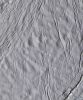
Enceladus~0.jpgEnceladus (close-up)55 visiteCaption NASA da "NASA - Picture of the Day" del 17 Marzo 2005:"The surface of Enceladus is as white as fresh snow. Still, an impressive variety of terrain is revealed in this contrast enhanced image. At a resolution of about 30 meters per pixel, the close-up view spans over 20 Km - recorded during the touring Cassini spacecraft's March flyby of the icy Saturnian moon. Enceladus is known to be the most reflective moon in the solar system and the recent Cassini encounters have also detected the presence of an atmosphere, making Enceladus the second moon of Saturn with such a distinction. In fact, Enceladus' fresh looking surface and significant atmosphere both indicate that the tiny, 500 Km diameter moon is active. Researchers suspect that ice volcanos or geysers coat the surface with fresh material and replenish the moon's atmosphere, ultimately providing the icy particles that compose Saturn's tenuous E-Ring".
|
|

Epimetheus-PIA06614.jpgEpimetheus, from approx. 1,1 MKM55 visiteCaption NASA originale:"Epimetheus is one of Saturn's "co-orbital moons" because it shares nearly the same orbit as Janus at a distance of approximately 151.000 Km (such as 94.000 miles) from Saturn. Epimetheus is about 116 Km (72 miles) across while Janus is 181 Km (113 miles) across.
The image was taken in visible light with the Cassini spacecraft narrow-angle camera on Feb. 18, 2005, at a distance of approx. 1,1 MKM (684,000 miles) from Epimetheus and at a phase angle of 96°. Resolution in the original image was 6 Km (4 miles) per pixel. The image has been contrast-enhanced and magnified by a factor of four to aid visibility".
|
|
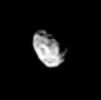
Hyperion-PIA06623.jpgHyperion from 1,7 MKM55 visiteCaption NASA originale:"The rugged surface of Saturn's irregular (and "tumbling") moon Hyperion is revealed in this Cassini image. Hyperion is 266 Km (approx. 165 miles) across.
The image was taken in visible light with the Cassini spacecraft narrow-angle camera on Feb. 23, 2005, at a distance of approx. 1,7 MKM (such as approx. 1 MMs) from Hyperion and at a Sun-Hyperion-spacecraft, or phase, angle of 42°. Resolution in the original image was 10 Km (approx. 6 miles) per pixel. The image has been contrast-enhanced and magnified by a factor of 3 to aid visibility".
|
|
| 2245 immagini su 188 pagina(e) |
 |
|
|
|
|
159 | |
|
|
|
|





