| Piú viste - Saturn: the "Ringed Beauty" and His Moons |

PIA07966-112203xx.mp3Audio Signals from the the Space of Saturn (by Dr M. Faccin)56 visitenessun commentoMareKromium
|
|
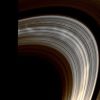
The_Rings-PIA11470.jpgMorning Spokes (Natural Colors; credits: Lunar Explorer Italia)56 visiteCaption NASA:"Bright spokes emerge from behind the shadow of the Planet and into sunlight in this view from the Cassini Spacecraft.
Saturn's long shadow covers the left side of the image. This view looks toward the sunlit side of the Rings from about 22° below the Ring-Plane.
The image was taken in visible light with the Cassini Spacecraft wide-angle camera on Feb. 26, 2009. The view was acquired at a distance of approx. 821.000 Km (about 510.000 miles) from Saturn and at a Sun-Saturn-Spacecraft, or Phase, Angle of 150°.
Image scale is roughly 46 Km (about 29 miles) per pixel".MareKromium
|
|

The_Rings-PIA11483.jpgShadows on the Rings56 visite...EccoVi un altro esempio delle "gigantesche navi spaziali" che si muoverebbero attraverso gli Anelli di Saturno, secondo il Dr Bergrun...
In realtà è soltanto la lunga ombra della luna saturniana Tethys la quale, all'avvicinarsi dell'Equinozio, si stende sugli Anelli del Gigante Gassoso, dando l'impressione - ma solo ad un osservatore completamente disattento - della esistenza di un vascello scuro a forma di fuso che si muove attraverso gli Anelli "F" ed "A".
Caption NASA:"Joining other moons in heralding the coming of Saturn's August 2009 Equinox, the moon Tethys casts its shadow across Saturn's F-Ring and part of the A-Ring.
The penumbra, or outer non-opaque part of Tethys' shadow, has intersected the A-ring. Only around the time of Equinox are the shadows of the moons cast onto Saturn's Rings. For an animation of the moon Epimetheus casting a shadow on the A-Ring, see also PIA11651.
The image on the left was taken in Visible Light with the Cassini Spacecraft wide-angle camera on March 20, 2009. The image on the right was taken with the narrow-angle camera at nearly the same time. Tethys itself is not visible in these images, but the small moon Prometheus can be seen between the F and A-Rings in the top of the wide-angle camera image.
This view looks toward the unilluminated side of the Rings from about 37° above the Ring-Plane. The view was obtained from a distance of approx. 880.000 Km (about 547.000 miles) from Saturn and at a Sun-Saturn-Spacecraft, or Phase, Angle of 124°.
Image scale is roughly 49 Km (about 31 miles) per pixel in the wide-angle image. In the narrow-angle camera image, the scale is roughly 5 Km (a little more than 3 miles) per pixel".MareKromium
|
|

The_Rings-PIA11489.jpgShadow on the Rings (Natural Colors; credits: Lunar Explorer Italia)56 visitenessun commentoMareKromium
|
|

Tethys-PIA11495.jpgOdysseus and Penelope56 visiteCaption NASA:"Two large craters named after characters in Homer's Odyssey take the stage in this scene on Saturn's moon Tethys.
The crater on the right is the Odysseus Crater (approx. 450 Km, or about 280 miles across). The one on the left is Penelope, named after the wife of Odysseus.
This view looks toward the anti-Saturn side of Tethys (approx. 1062 Km, or about 660 miles across). North on Tethys is up and rotated 44° to the right.
The image was taken in Visible Light with the Cassini Spacecraft narrow-angle camera on April 12, 2009. The view was acquired at a distance of approx. 931.000 Km (about 578.000 miles) from Tethys and at a Sun-Tethys-Spacecraft, or Phase, Angle of 33°.
Image scale is roughly 6 Km (a little less than 4 miles) per pixel".MareKromium
|
|

The_Rings-PIA11498.jpgShadow on the Rings (Natural Colors; credits: Lunar Explorer Italia)56 visiteCaption NASA:"The partial shadow of the moon Tethys demonstrates the variations in density across Saturn's Rings.
As the Cassini Spacecraft looks toward the unilluminated side of the Rings from about 37° above the Ring-Plane, part of Tethys' shadow is seen lying across the A-Ring and Cassini Division. The densest part of the A-Ring and the denser B-Ring let neither sunlight nor the darkness of Tethys' shadow pass through to the Spacecraft's camera, so the moon's shadow appears cut off. The B-Ring instead appears brightly lit here from Saturnshine. Tethys is not shown.
As Saturn approaches its August 2009 Equinox, the planet's moons cast shadows onto the Rings. (...)
The image was taken in Visible Light with the Cassini Spacecraft wide-angle camera on April 17, 2009. The view was obtained at a distance of approx. 1,3 MKM (about 808.000 miles) from Saturn and at a Phase Angle of 120°.
Image scale is roughly 75 Km (about 47 miles) per pixel".MareKromium
|
|

Pandora-PIA11499.jpgPandora56 visiteCaption NASA:"The thin shadow of the moon Pandora cuts across Saturn's narrow F-Ring.
As Saturn approaches its August 2009 Equinox, the planet's moons cast shadows onto the Rings. Pandora (about 81 Km, or approx. 50 miles across) is on the left of the image. Other bright points of light in the image are background stars.
This view looks toward the unilluminated side of the Rings from about 55° above the Ring-Plane. The image was taken in Visible Light with the Cassini Spacecraft narrow-angle camera on April 16, 2009. The view was obtained at a distance of approx. 1,3 MKM (such as about 808.000 miles) from Saturn and at a Sun-Saturn-Spacecraft, or Phase, Angle of 98°.
Image scale is roughly 8 Km (about 5 miles) per pixel".MareKromium
|
|
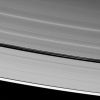
The_Rings-PIA11502.jpgEncke Ringlets56 visiteAlthough Saturn's moon Pan is absent from this image of the A-Ring's Encke Gap, the moon's handiwork is still displayed.
The two ringlets seen in the gap are maintained by the gravitational action of Pan (about 28 Km, or approx. 17 miles across). To learn more about this process, see also PIA07528.
The point of light near the bottom of the image is a star.
This view looks toward the unilluminated side of the Rings from about 41° above the Ring-Plane. The image was taken in Visible Light with the Cassini Spacecraft narrow-angle camera on April 17, 2009. The view was obtained at a distance of approx. 1,3 MKM (about 808.000 miles) from Saturn and at a Sun-Saturn-Spacecraft, or Phase, Angle of 115°.
Image scale is roughly 8 Km (about 5 miles) per pixel.MareKromium
|
|

The_Rings-PIA11658.jpgA Shadow's Traverse56 visiteCaption NASA:"Mimas' shadow traverses the sunlit side of Saturn's Rings in this mosaic showcasing the unusual sights seen at Saturn as the Planet approaches its August 2009 Equinox.
The novel illumination geometry created as the Saturnian System approaches Equinox allows moons orbiting in or near the plane of Saturn's Equatorial Rings to cast shadows onto the Rings. These scenes are possible only during the few months before and after Saturn's Equinox which occurs only once in about 15 Earth years.
Twenty images, each taken 3' and 36" apart, were combined to create this mosaic. Contiguous images were stitched together to create the mosaic showing the whole swath of the Rings across which the moon's shadow passed.
At the beginning of the sequence, the shadow starts on the bright B-Ring. It crosses the darker Cassini Division and then moves to the A-Ring. At the end, the edge of the shadow just catches the edge of the A-Ring, next to blackness of the Roche Division separating the A-Ring from the thin F-Ring.
These images have been processed, and background stars have been removed. To see a movie and mosaic of Mimas' shadow moving across the unlit side of the Rings, see PIA11660.
This view looks toward the sunlit side of the Rings from about 32° below the Ring-Plane. The images were taken in Visible Light with the Cassini Spacecraft narrow-angle camera on April 9, 2009. The view was obtained at a distance of approx. 1,1 MKM (such as about 684.000 miles) from Saturn and at a Sun-Saturn-Spacecraft, or Phase, Angle of 55°.
Image scale is roughly 6 Km (a little less than 4 miles) per pixel".MareKromium
|
|

The_Rings-PIA11659.jpgShadow from the Dark Side56 visiteCaption NASA:"The shadow of Saturn's moon Tethys seems to disappear as it crosses the Planet's Rings, demonstrating variations in the density of particles across the Rings themselves.
These images, which were combined to create a mosaic and a movie, show Saturn's A-Ring on the left, the Cassini Division in the middle and dense outer B-Ring on the right.
The Cassini Spacecraft looks toward the unilluminated side of the Rings in these frames from about 49° above the Ring-Plane.
The densest parts of the B-Ring do not let much sunlight pass through to the Spacecraft's camera. Consequently, one might expect these dense areas to appear dark because they are on the Dark Side of the Rings and also because the moon's shadow is draped across them. However, these dense areas may appear brighter than expected in this geometry most likely from Saturnshine reflecting from them: denser regions should look brighter in Saturnshine than other regions. As a result, the moon's shadow appears cut off and diminished in these areas.
Seventeen images, each taken about 2' and 17" apart, were combined to create this mosaic. Contiguous images were stitched together to create the mosaic showing the whole swath of the Rings across which the moon's shadow passed. Tethys itself is not shown.
The novel illumination geometry created as the Saturnian System approaches Equinox allows moons orbiting in or near the plane of Saturn's Equatorial Rings to cast shadows onto the Rings. These scenes are possible only during the few months before and after Saturn's Equinox which occurs only once in about 15 Earth years. To see similar movie and mosaic of Mimas' shadow moving across the unlit side of the Rings, see PIA11660.
These images have been processed, and background stars have been removed.
The images were taken in Visible Light with the Cassini Spacecraft narrow-angle camera on April 29, 2009. The view was acquired at a distance of approx. 1,3 MKM (such as about 808.000 miles) from Saturn and at a Sun-Saturn-Spacecraft, or Phase, Angle of 52°.
Image scale is roughly 8 Km (about 5 miles) per pixel".MareKromium
|
|

Mimas-PIA11661.jpgEclipsing Mimas56 visiteCaption NASA:"As the moon Enceladus eclipses its neighbor Mimas, Cassini records a scene possible only around the time of Saturn's approaching Equinox.
Seven images, each taken about 30" apart, were combined to create a movie which shows the shadow of Enceladus (about 504 Km, or approx. 313 miles, across) darkening Mimas (about 396 Km, or approx. 246 miles, across).
Although Saturn has eclipsed moons in previous images (see PIA11143 and PIA11508), this is the first time that Cassini has imaged one of Saturn's moons being eclipsed by another moon rather than the Planet.
The novel illumination geometry created as the Saturnian System approaches Equinox means that during this time moons orbiting in or near the plane of Saturn's Equatorial Rings can cast shadows onto the Rings and onto each other.
This image was taken in Visible Light with the Cassini Spacecraft narrow-angle camera on May 13, 2009. The view was obtained at a distance of approx. 1,3 MKM (about 808.000 miles) from Mimas and at a Phase Angle of 43°.
Image scale is roughly 8 Km (about 5 miles) per pixel".MareKromium
|
|
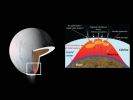
Enceladus-PIA12080.jpgMelted Ice56 visiteCaption NASA:"These drawings depict explanations for the source of intense heat that has been measured coming from Enceladus' South Polar Region. These models predict that water could exist in a deep layer as an ocean or sea and also near the Surface.
Cassini scientists infer that the temperature of the ice in the South Polar Region must be close to its melting point (shown in red). A layer of liquid water (dark blue) might exist between the ice and the silicate core (brown), allowing the ice to deform independent of the rock, providing even more mechanical energy and more flexing of the icy shell for extreme tidal heating.
Tidal heating could also cause friction in faults near the surface, leading to pockets of partially melted ice".MareKromium
|
|
| 2245 immagini su 188 pagina(e) |
 |
|
|
|
|
157 | |
|
|
|
|





