| Piú viste - Saturn: the "Ringed Beauty" and His Moons |

Tethys-PIA10527.jpgThe Odyssey on Tethys...56 visiteCaption NASA:"This Cassini Spacecraft image provides a view of the southern portion of Tethys' Trailing Hemisphere.
Prominent features include the huge canyon, Ithaca Chasma, approximately centered in this view, as well as Demodocus and Telemus, large basins just to the right of the rift.
Features on Tethys are named for characters in Homer's Odyssey.
The image was taken in visible green light with the Cassini Spacecraft narrow-angle camera on Oct. 10, 2008 at a distance of approx. 417.000 Km (about 259.000 miles) from Tethys and at a Sun-Tethys-Spacecraft, or Phase, angle of 55°.
Image scale is roughly 2 Km (a little more than 1 mile) per pixel".MareKromium
|
|

Enceladus-PIA11139.jpgAxial Discontinuity on Enceladus56 visiteCaption NASA:"These two side-by-side images compare a "twisted" sea-floor spreading feature on Earth, known as an Offset Spreading Center (OSC), to a very similar looking twisted break, or Axial Discontinuity, in the Damascus Sulcus "Tiger Stripe" on Saturn’s moon Enceladus. The image of Enceladus was acquired by NASA’s Cassini Spacecraft imaging science sub-system during one of its four close targeted flybys of Enceladus in March, August and October 2008.
The image on the left shows a shaded relief map of bathymetry (or sonar-like topography) data along a spreading ridge on the East Pacific Rise near 9,5° North Lat. and 104° West Long.
On Earth, OSC's occur only along fast-spreading ridges - ones that spread faster than about 100 mm (such as 4") per year. They do not occur on slow-spreading ridges, like the famous Mid-Atlantic Ridge where spreading rates are often less than 20 mm (0,7") per year.
The Axial Discontinuity on Enceladus’ Damascus Sulcus, shown in the image on the right, twists in the same helical way that the OSC does on Earth. However, the morphological resemblance is no guarantee that both features are caused by fast spreading.
On Earth OSCs form when two nearly parallel spreading ridges lengthen along their ridge (or long) axes. As the lengthening tips of the ridges pass each other side-by-side in opposite directions, shear forces caused by tectonic spreading between them force the two tips to twist around each other. The twisting tip of each one eventually merges with the "neck" of the other in a "yin-yang" shaped pattern.
The result is an oval shaped basin that is surrounded by the twisted ridge tips.
On Enceladus, the twisted features have not produced an oval basin, but the pattern of the twist is very similar to the terrestrial OSC and probably similar tectonic shear forces, perhaps even tectonic spreading, resulted in this twisted shape. Note that the Enceladus image has been flipped right-to-left to make comparison to the sea-floor feature easier to see".MareKromium
|
|

The_Rings-Shadow-N00127581.jpgEclipsing the Rings (2)56 visitenessun commentoMareKromium
|
|

TheRings-PIA10581.jpgBright Spokes (Natural Colors; credits: Lunar Explorer Italia)56 visiteCaption NASA:"Signaling a return to the bright Spokes first encountered by the Cassini Spacecraft in 2005, three large white Spokes stretch out across the B-Ring. Throughout most of the last year, Cassini captured views of dark Spokes.
This image of bright Spokes was taken Jan. 14, 2009 in Visible Light with the Spacecraft's wide-angle camera.
The small moon Atlas (about 30 Km, or approx. 19 miles across) has been brightened by 30% but still appears as a faint dot between the A and F Rings in the top right quadrant of the image.
This view looks toward the sunlit side of the Rings from about 6° below the Ring-Plane. The view was acquired at a distance of approx. 551.000 Km (about 342.000 miles) from Saturn and at a Sun-Saturn-Spacecraft, or Phase, Angle of 155°. Image scale is roughly 29 Km (such as about 18 miles) per pixel".MareKromium
|
|
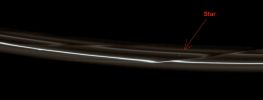
PIA10587.jpgThe "Fragile" F-Ring56 visiteCaption NASA:"Set starkly against the blackness of space are the F-Ring's delicate strands which are periodically gored by its shepherding moon, Prometheus.
Prometheus (approx. 86 Km, or about 53 miles across) and Pandora (approx. 81 Km, or about 50 miles across) both interact with the F-Ring but neither is visible here. Prometheus has the larger effect (see, for instance, PIA08397 for a movie of Prometheus creating a Streamer-Channel in the ring).
A star can be seen through the ring on the right side (Dx) of the image.
This view looks toward the unilluminated side of the Rings from about 33° above the Ring-Plane. The image was taken in visible light with the Cassini Spacecraft narrow-angle camera on Jan. 11, 2009.
The view was acquired at a distance of approx. 1 MKM (such as about 620,000 miles) from Saturn and at a Sun-Saturn-Spacecraft, or Phase, Angle of 37°.
Image scale is roughly 6 Km (about 4 miles) per pixel".MareKromium
|
|

Moonlet-PIA11148-1.jpgTiny Moonlet within a G-Ring Arc56 visiteCaption NASA:"This sequence of three images, obtained by NASA's Cassini Spacecraft over the course of about 10 minutes, shows the path of a newly found moonlet in a bright arc of Saturn's faint G-Ring.
In each image, a small streak of light within the Ring is visible. Unlike the streaks in the background, which are distant stars smeared by the camera's long exposure time of 46", this streak is aligned with the G-Ring and moves along the ring as expected for an object embedded in the Ring.
Cassini scientists interpret the moving streak to be reflected light from a tiny moon half a kilometer (a third of mile) wide that is likely a major source of material in the arc and the rest of the G-Ring.
Debris knocked off this moon forms a relatively bright arc of material near the inner edge of the G-Ring, the most visible part of the Ring in these images. That arc, in turn, leaks material to form the entire Ring.
These images were captured by Cassini's narrow-angle camera on Oct. 27, 2008.
The first image (left) was taken in Visible Light, the second image (middle) was taken in Red Light, and the third image (right) in Near-InfraRed Light centered at a wavelength of 750 nanometers.
Image scale for the first image is roughly 7 Km (a little more than 4 miles) per pixel while the second and third were taken at reduced resolution.
These spatially compressed images were captured at 14 Km (about 9 miles) per pixel and then displayed at a size equal to the first image. This view looks toward the un-illuminated side of the Rings from about 5° above the Ring-Plane.
The view was acquired at a distance of approx. 1,2 MKM (such as about 751.000 miles) from Saturn and at a sun-Saturn-Spacecraft, or Phase, Angle of 23°".MareKromium
|
|

Dione-N00048330.jpgThe Marvelous Face of Dione (possible True Colors; credits: Dr M. Faccin & Lunar Explorer Italia)56 visitenessun commentoMareKromium
|
|

Saturn-W00051152.jpgSaturn: from b&w to Natural Colors (by Dr M. Faccin)56 visitenessun commentoMareKromium
|
|
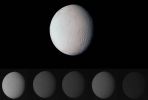
Enceladus_Approach.jpgApproaching Enceladus, from Voyager 256 visitenessun commentoMareKromium
|
|
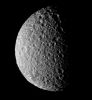
Mimas-V1.jpgMimas, from Voyager 156 visitenessun commentoMareKromium
|
|

PIA07967-072504.wavAudio Signals from the the Space of Saturn (by Dr M. Faccin)56 visitenessun commentoMareKromium
|
|
PIA07966-112203xx.mp3Audio Signals from the the Space of Saturn (by Dr M. Faccin)56 visitenessun commentoMareKromium
|
|
| 2245 immagini su 188 pagina(e) |
 |
|
|
|
|
156 | |
|
|
|
|





