| Piú viste - Saturn: the "Ringed Beauty" and His Moons |
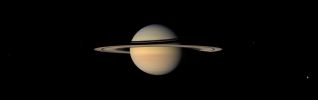
Saturn-PIA08387.jpgA View from Japetus56 visiteWhile on final approach for its Sept. 2007 close encounter with Saturn's moon Japetus, Cassini spun around to take in a sweeping view of the Saturn System.
Japetus is the only major moon of Saturn with a significant inclination to its orbit. From the other major satellites, the Rings would appear nearly edge-on, but from Japetus, the Rings usually appear at a tilt, as seen here.
This natural color mosaic consists of 15 red, green and blue spectral filter images acquired in five wide-angle camera footprints that swept across the scene.
Moons visible in this image: Dione at center left, Enceladus near the left side ansa (or ring edge), Mimas is a speck against the ring shadows on Saturn's Western Limb, Rhea can be seen against the bluish backdrop of the Northern Hemisphere, Tethys is near the right ansa, and Titan near lower right.
The images were obtained on Sept. 10, 2007, at a distance of approx. 3,3 MKM (such as about 2,1 MMs) from Saturn at a Sun-Saturn-Spacecraft, or phase, angle of 33°. Image scale is about 195 Km (approx. 121 miles) per pixel on the Planet. MareKromium
|
|

Tethys-PIA08400.jpgOdysseus is looking up!56 visiteThe vast expanse of the crater Odysseus spreads out below Cassini in this mosaic view of Saturn's moon Tethys.
The crater (about 450 Km or approx. 280 miles across) is a remarkably well-preserved example of an ancient multi-ringed impact basin: the outer ring is defined by steep, cliff-like walls that descend to generally broad internal terraces. The inner ring is formed by a prominent, crown-shaped, 140-Km (88-mile) diameter circular band of icy mountains. Multi-ring basins are seen on rocky bodies as well as icy ones.
The complex internal structure and multi-ringed nature of these very large basins are believed to arise from the rebound of intense shock waves that penetrated the body at the time of impact.
This mosaic was assembled from four clear filter, narrow-angle camera images. The view is an orthographic projection centered on 3° South Latitude, 119° West Longitude and has a resolution of 572 meters (0,35 mile) per pixel. An orthographic view is most like the view seen by a distant observer looking through a telescope. North is up.
The view was obtained by the Cassini spacecraft on Aug. 30, 2007, from a distance of approximately 97.000 Km (about 60.000 miles) and at a Sun-Tethys-Spacecraft, or phase, angle of 51°.MareKromium
|
|
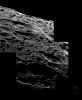
Japetus-PIA08403.jpgMiddle Northern Latitudes of Japetus56 visiteCassini soars above the many pits and basins in the rolling landscape of Saturn's moon Japetus. This mosaic view looks out onto an area close to the Northern bright/dark boundary, but still within the Dark Region, Cassini Regio.
Near upper left is a large crater with terraced walls, a mostly flat floor and a prominent group of peaks in its center. The sharp features make this likely one of the youngest craters in this area of Japetus. Cassini imaged another similarly flat-floored and relatively fresh crater during its Dec. 2004 Japetus flyby.
The mosaic consists of 3 image footprints across the surface of Japetus. The view is centered on terrain near 43,3° North Latitude, 138° West Longitude. Image scale is approx. 75 meters (246 feet) per pixel.
The clear spectral filter images in this mosaic were obtained with the Cassini spacecraft narrow-angle camera on Sept. 10, 2007, at a distance of approx. 13.500 Km (about 8.400 miles) from Japetus and at a Sun-Japetus-Spacecraft, or phase, angle of 139°.MareKromium
|
|
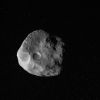
Epimetheus-N00098337.jpgEpimetheus (1)56 visiteCaption NASA:"N00098337.jpg was taken on December 03, 2007 and received on Earth December 04, 2007. The camera was pointing toward EPIMETHEUS that, at the time, was approx. 39.290 Km away, and the image was taken using the P120 and GRN filters.
This image has not been validated or calibrated".MareKromium
|
|
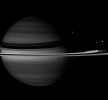
Saturn-PIA09795.jpgObscure Planet, Bright Moons... (IR)56 visiteCaption NASA:"Just before Rhea slipped behind Saturn, the Cassini Spacecraft captured the moon in its disappearing act.
Along with the partly obscured Rhea are Tethys, at right, and Enceladus, left of Tethys.
At the wavelength in which this image was taken, absorption of Sunlight by Methane gas in Saturn's Atmosphere is strong, causing the Planet to appear darker than at other wavelengths.
This view looks toward the unilluminated side of the Rings from about 4° above the Ring-Plane. The image was taken with the Cassini spacecraft wide-angle camera on Nov. 9, 2007 using a spectral filter sensitive to wavelengths of Infrared Light centered at 890 nanometers. The view was acquired at a distance of approx. 2,8 MKM (about 1,7 MMs) from Saturn and at a Sun-Saturn-spacecraft, or phase, angle of 44°.
Image scale is roughly162 Km (such as about 101 miles) per pixel".MareKromium
|
|
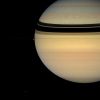
Saturn-PIA08394.jpgMoons... (natural colors; credits: NASA)56 visiteCaption NASA:"This colorful view, taken from edge-on with the Ring-Plane, contains 4 of Saturn's attendant moons. Tethys is seen against the black sky to the left of the Gas Giant's limb. Brilliant Enceladus sits against the Planet near right.
Irregular Hyperion is at the bottom of the image, near left. Much smaller Epimetheus is a speck below the Rings directly between Tethys and Enceladus. Epimetheus casts an equally tiny shadow onto the blue Northern Hemisphere, just above the thin shadow of the F-Ring.
Images taken using red, green and blue spectral filters were combined to create this natural color view. The images were acquired with the Cassini spacecraft wide-angle camera on July 24, 2007 at a distance of approx. 2 MKM (about 1,2 MMs) from Saturn. Image scale is 116 kilometers (72 miles) per pixel on Saturn".MareKromium
|
|

Dione-N00098970.jpgDione is missing a piece...56 visiteCaption NASA:"N00098970.jpg was taken on December 19, 2007 and received on Earth December 20, 2007. The camera was pointing toward DIONE that, at the time, was approximately 243.552 Km away, and the image was taken using the P60 and UV3 filters.
This image has not been validated or calibrated".MareKromium
|
|
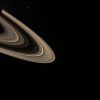
The_Rings-PIA09824.jpgThe Golden Rings of Saturn and some of His Moons... - (natural colors; credits: NASA)56 visiteCaption NASA:"A color portrait of Saturn's sunlight-scattering Rings hosts a group of several moons.
Enceladus (505 Km, or 314 miles across) is visible at top. At bottom, in increasing distance from the Rings, are Pandora (84 Km, or 52 miles across), Janus (181 Km, or 113 miles across) and Mimas (397 Km, or 247 miles across).
This view looks toward the unilluminated side of the Rings from about 10° above the Ring-Plane. Saturn's shadow can be seen on the Rings at upper left.
Images taken using red, green and blue spectral filters were combined to create this composite color view.
The images were taken with the Cassini spacecraft wide-angle camera on Dec. 22, 2007. The view was acquired at a distance of approx. 1,8 MKM (such as about 1,1 MMs) from Saturn. Image scale is about 110 Km (approx. 68 miles) per pixel". MareKromium
|
|

Saturn_Titan-PIA09856.jpgFather and Son (natural colors; credits: NASA)56 visiteCaption NASA:"The Cassini Spacecraft captured this color portrait of Saturn and Titan only a few minutes before the haze-enshrouded moon slipped behind the planet's enormous bulk. The view looks toward the sunlit side of the Rings from about 5° below the Ring-Plane.
The Northern Hemisphere of Titan presently appears darker than the Southern, a feature presumed to be a seasonal effect.
Images taken using red, green and blue spectral filters were combined to create this natural color view. The images were acquired with the Cassini spacecraft wide-angle camera on Jan. 29, 2008 at a distance of approx. 2,3 MKM (such as about 1,4 MMs) from Titan and approx. 1 MKM (about 630.000 miles) from Saturn.
Image scale is roughly 135 Km (about 84 miles) per pixel on Titan and approx. 61 Km (about 38 miles) per pixel on Saturn".MareKromium
|
|

Saturn-PIA09864.jpgNever "Dark Nights"... (natural colors; credits: NASA)56 visiteCaption NASA:"Titan emerges from behind Saturn, while Tethys streaks into view, in this colorful scene. Saturn's shadow darkens the far arm of the Rings near the Planet's limb. Titan is about 5150 Km (approx. 3200 miles) wide; Tethys is 1071 Km (such as approx. 665 miles) wide.
This view looks toward the unilluminated side of the Rings from about 3° above the Ring-Plane. Images taken using red, green and blue spectral filters were combined to create this natural color view. The images were acquired with the Cassini spacecraft wide-angle camera on Jan. 30, 2008 at a distance of approx. 1,3 MKM (such as about 800.000 miles) from Saturn.
Image scale is roughly 77 Km (about 48 miles) per pixel on Saturn".MareKromium
|
|

Enceladus-PIA10355.jpgGas and Dust Jets Match Up!56 visiteCaption NASA:"Jets of high-density gas detected by Cassini's Ultraviolet Imaging Spectrograph on Saturn's moon Enceladus match the locations of dust jets determined from Cassini images, labeled here with Roman numerals. The spectrograph pinpointed the locations of individual gas streams in the plume in a "stellar occultation", which involves measuring the light of a star (in this case, Zeta Orionis), as it passed behind the plume from Cassini's viewpoint.
The blue line in this projection shows the path of the starlight through the plume, over the South Polar Region of Enceladus.
The instrument looked at the star across this path in the direction indicated by the short blue lines.
Some of the dust jets appear to merge together in stellar occultation data. The dimming of starlight labeled "a" was caused by dust jets V and VII. The dimming of starlight marked as feature "b" may be associated with dust jet I if the jet is not perfectly vertical.
Dimming of starlight labeled "c" corresponds to dust jet VI, and "d" is dust jet III, with dust jet II in between. The individual jets come from sources with an area of less than 300 by 300 meters (such as about 1000 feet square) - about the size of half a tennis court - probably stretched out rectangularly along the Tiger Stripes.
The new data indicate that the water molecules are blasting off from Enceladus at faster than 600 meters per second (about 1200 mph)".MareKromium
|
|

Sun-N00107151.jpgSunshine through the Rings... (natural colors; credits: Lunexit)56 visiteCaption NASA:"Caption NASA:"N00107151.jpg was taken on April 10, 2008 and received on Earth on April 11, 2008. The camera was pointing toward SATURN, F-RING that, at the time, was approx. 613.189 Km away, and the image was taken using the CL1 and CL2 filters. This image has not been validated or calibrated".MareKromium
|
|
| 2245 immagini su 188 pagina(e) |
 |
|
|
|
|
152 | |
|
|
|
|





