| Piú viste - Saturn: the "Ringed Beauty" and His Moons |

Enceladus-N00030073.jpgEnceladus, from approx. 21.000 Km55 visiteUn grande cratere da impatto (in alto) il quale presenta, sul suo fondo, i segni di un evidente accumulo di materiale - polveri e macigni? - il quale, probabilmente, è franato all'interno del cratere dai suoi stessi bordi (forse a causa di movimenti sismici o, magari, a seguito di processi di gravity-wasting). Potrebbe anche trattarsi, tuttavia, di quello che residua di un "central peak" il quale, nelle ere, si è quasi completamente disintegrato, lasciando al suo posto una collina di detriti.
|
|

Enceladus-N00030111.jpgEnceladus, from approx. 4.000 Km55 visiteTabella riassuntiva delle caratteristiche superficiali di Encelado:
1. esistenza di una diffusa e fittissima rete di canyons, crepacci e canali;
2. sostanziale scarsità di crateri da impatto (salvo alcune aree, di modeste dimensioni);
3. presenza, accanto alle "reti di canali e canyons", di alcuni crepacci molto grandi, profondi e, apparentemente, recenti (si potrebbe trattare, forse, di "fratture tettoniche");
4. mancanza di profili "aspri" (anche i bordi dei pochi crateri visibili sembrano essere 'smussati');
5. albedo altissima (molte immagini recano chiari segni di sovraesposizione);
6. possesso di una atmosfera.
|
|
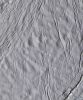
Enceladus~0.jpgEnceladus (close-up)55 visiteCaption NASA da "NASA - Picture of the Day" del 17 Marzo 2005:"The surface of Enceladus is as white as fresh snow. Still, an impressive variety of terrain is revealed in this contrast enhanced image. At a resolution of about 30 meters per pixel, the close-up view spans over 20 Km - recorded during the touring Cassini spacecraft's March flyby of the icy Saturnian moon. Enceladus is known to be the most reflective moon in the solar system and the recent Cassini encounters have also detected the presence of an atmosphere, making Enceladus the second moon of Saturn with such a distinction. In fact, Enceladus' fresh looking surface and significant atmosphere both indicate that the tiny, 500 Km diameter moon is active. Researchers suspect that ice volcanos or geysers coat the surface with fresh material and replenish the moon's atmosphere, ultimately providing the icy particles that compose Saturn's tenuous E-Ring".
|
|

Epimetheus-PIA06614.jpgEpimetheus, from approx. 1,1 MKM55 visiteCaption NASA originale:"Epimetheus is one of Saturn's "co-orbital moons" because it shares nearly the same orbit as Janus at a distance of approximately 151.000 Km (such as 94.000 miles) from Saturn. Epimetheus is about 116 Km (72 miles) across while Janus is 181 Km (113 miles) across.
The image was taken in visible light with the Cassini spacecraft narrow-angle camera on Feb. 18, 2005, at a distance of approx. 1,1 MKM (684,000 miles) from Epimetheus and at a phase angle of 96°. Resolution in the original image was 6 Km (4 miles) per pixel. The image has been contrast-enhanced and magnified by a factor of four to aid visibility".
|
|
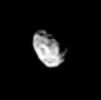
Hyperion-PIA06623.jpgHyperion from 1,7 MKM55 visiteCaption NASA originale:"The rugged surface of Saturn's irregular (and "tumbling") moon Hyperion is revealed in this Cassini image. Hyperion is 266 Km (approx. 165 miles) across.
The image was taken in visible light with the Cassini spacecraft narrow-angle camera on Feb. 23, 2005, at a distance of approx. 1,7 MKM (such as approx. 1 MMs) from Hyperion and at a Sun-Hyperion-spacecraft, or phase, angle of 42°. Resolution in the original image was 10 Km (approx. 6 miles) per pixel. The image has been contrast-enhanced and magnified by a factor of 3 to aid visibility".
|
|
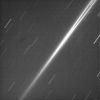
The Rings-PIA06627.jpgThe G-Ring and "Star-Trails"55 visiteCaption NASA originale:"Cassini's ability to remain sharply pointed at its targets allowed this image of Saturn's faint, dusty G-Ring to be made. The thin streaks visible here are "Star-Trails", which are created during long exposures, when the spacecraft remains locked onto a single target. The camera shutter was open for 3 and 1/2 minutes during this particular exposure. A long exposure was required to see details of this quite tenuous Ring.
The feature inside the G-Ring, at upper right, is also a star trail.
The image was taken in polarized visible light with the Cassini spacecraft narrow-angle camera on March 7, 2005, at a distance of approx. 1,2 MKM (such as approx. 750.000 miles) from Saturn. The image scale is approx. 10 Km per pixel".
|
|
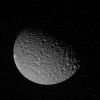
Mimas-N00032567.jpgMimas, from approx. 93.000 Km55 visiteUn'immagine che potrebbe essere bellissima, ma che invece è resa inguardabile - o quasi... - da un'infinità di artefatti fotografici. Resta comunque un frame importante - ed è per questo che lo proponiamo ugualmente - sia per ciò che riesce a mostrarci di Mimas, sia perchè ci permette di familiarizzare ancora di più con questi difetti delle immagini che in tantissimi frangenti possono essere e/o diventare causa di sviste e malintesi.
|
|
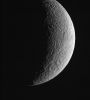
Tethys-PIA06633.jpgTethys (ultraviolet vision) from 200.000 Km55 visiteCaption NASA originale:"This view of Saturn's moon Tethys shows the contrast between the more heavily cratered region near the top and the more lightly cratered (and presumably younger) plains toward the bottom part of the image and near the limb. Some of the larger craters in the latter region appear to be somewhat subdued or filled in. This view shows principally the anti-Saturn hemisphere on Tethys; North is up and tilted 20° to the left.
The image was taken with the Cassini spacecraft narrow-angle camera on March 9, 2005, through a filter sensitive to wavelengths of ultraviolet light centered at 338 nnmts. The view was obtained at a distance of approximately 200.000 Km from Tethys and at a phase angle of 120°. Resolution in the image is 1 Km (approx. 0,6 mile) per pixel".
|
|

The Rings-PIA07513.jpgWatching "through" the Rings...55 visiteGli Anelli di Saturno, come questo frame dimostra ampiamente, non sono affatto spessi, anzi...
Dietro il sottilissimo strato di detriti, ghiaccio e polveri, infatti, il profilo del Gigante Gassoso occhieggia in maniera netta e definita mentre la Sonda Cassini 'scivola' al di sotto del piano degli Anelli e scatta questa superba istantanea che, a nostro parere, rappresenta una delle più belle mai ottenute nella Storia dell'Esplorazione delle Regioni più esterne del Sistema Solare.
Caption NASA originale:"In this fabulous close-up, Cassini peers directly through regions of the A, B and C-Rings (from top to bottom) to glimpse shadows of the very same Rings cast upon the Planet's atmosphere. Near the top, shadows cast by ringlets in the Cassini division (center) look almost like a photo negative. This type of image helps scientists probe the Rings' structure in detail and provides information about the density of their constituent particles. The image was taken from a distance of 2,3 MKM from Saturn".
|
|

Prometheus-PIA07540.jpgThe "double night" of Prometheus55 visiteCaption NASA originale:"Saturn's moon Prometheus is seen here emerging from the darkness of Saturn's shadow. This shepherd moon, like most of Saturn's moons, always keeps the same face pointing toward the Planet. An observer on the moon's Saturn-facing side would never see the Sun directly overhead at noon, for the Planet would always be in the way (creating an eclipse). Instead, the Sun would rise in the east, but as noon approached the eclipse would begin, bringing darkness a second time. Night comes twice on Prometheus.
This image was taken in visible light with the Cassini spacecraft narrow-angle camera on June 3, 2005, at a distance of approx. 2,1 MKM (such as 1,3 MMs) from Saturn. The image scale is 13 Km (such as 8 miles) per pixel".
|
|

Prometheus-PIA07541.jpgPrometheus55 visiteCaption NASA originale:"Saturn's shepherd moon Prometheus hovers between the A and F-Rings as if suspended on an invisible thread, while bright clouds drift in Saturn's atmosphere approximately 130.000 Km(such as about 81.000 miles) beyond. It is noteworthy that such clouds are visible here in the shadows cast by the Rings.
The image was taken in visible light with the Cassini spacecraft narrow-angle camera on June 3, 2005, at a distance of approximately 2,1 MKM (1,3 MMs) from Saturn. The image scale is 13 Km (approx. 8 miles) per pixel. This view was processed to enhance fine details".
|
|

Enceladus-N00036954.jpgEnceladus fly-by (2) - from approx. 110.000 Km55 visitenessun commento
|
|
| 2245 immagini su 188 pagina(e) |
 |
|
|
|
|
151 | |
|
|
|
|





