| Piú viste - Saturn: the "Ringed Beauty" and His Moons |
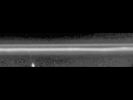
SATURN-F-RING-61900main_pia06351-516-387.jpgThe "F" Ring from Cassini-Huygens (2)90 visitenessun commento
|
|

Rhea-PIA07583.jpgRhea, from about 255.000 Km90 visiteSaturn's moon Rhea is an alien ice world, but in this frame-filling view it is vaguely familiar. Here, Rhea's cratered surface looks in some ways similar to our own Moon, or the planet Mercury. But make no mistake - Rhea's icy exterior would quickly melt if this moon were brought as close to the Sun as Mercury.
Instead, Rhea preserves a record of impacts at its post in the Outer Solar System.
For exemple, the large impact crater at center left (near the terminator), called Izanagi, is just one of the numerous large impact basins on Rhea.
This view shows principally Rhea's Southern Polar Region, centered on 58° South and 265° West.
The image was taken in visible light with the Cassini spacecraft narrow-angle camera on Aug. 1, 2005, at a distance of approx. 255.000 Km (such as about 158.000 miles) from Rhea and at a Sun-Rhea-spacecraft, or phase, angle of 62°.
The image scale is 2 Km (about 1,2 miles) per pixel.
|
|

Janus-PCF-LXTT.jpgJanus (Absolute Natural Colors; credits for the additional process. and color.: Dr Paolo C. Fienga - Lunexit team)90 visitenessun commentoMareKromium
|
|

Dione-PIA14628-PCF-LXTT-IPF.jpgLarge Rayed Crater on Dione (Absolute Natural Colors; credits for the additional process. and color.: Dr Paolo C. Fienga/Lunar Explorer Italia/Italian Planetary Foundation)90 visiteThe NASA - Cassini Spacecraft looks at an example of a Rayed Crater located on the Leading Hemisphere of the Saturnian moon Dione. The Rayed Crater is in the upper-left of the image and its Rays (made by Ejecta ---> such as by Rocky Material, belonging to Dione, that was lifted up and thrown away in every direction at the time of the Impact) show up as brighter material ("brighter" if compared to the Albedo of the Surface that surrounds it) which emanates from the Crater itself.
This view, as we said hereabove, looks toward the Leading Hemisphere of Dione (which is approx. 700 miles, such as about 1125 kilometers across). North on Dione is up and rotated 12 degrees to the left. The image was taken in Visible Light with the NASA - Cassini Spacecraft Narrow-Angle Camera on July 23, 2012. The view was acquired at a distance of approximately 260.000 miles (such as about 418.000 kilometers) from Dione and at a Sun-Dione-Spacecraft (or Phase) Angle of 5°. Image scale is about 2 miles (such as a little more than 3 kilometers) per pixel.
This frame (which is an Original NASA - Cassini Spacecraft image published on the NASA - Planetary Photojournal with the ID n. PIA 14628) has been additionally processed and then colorized in Absolute Natural Colors (such as the colors that a human eye would actually perceive if someone were onboard the NASA - Cassini Spacecraft and then looked outside, towards the Saturnian moon Dione), by using an original technique created - and, in time, dramatically improved - by the Lunar Explorer Italia Team. Different colors, as well as different shades of the same color, mean, among others, the existence of different Elements present on the Surface of Dione, each having a different Albedo (---> Reflectivity) and Chemical Composition.MareKromium
|
|

Saturn-North_Pole-Vortex-Cassini_1024-PCF-LXTT-IPF.jpgPeering into the Storm (Absolute Natural Colors - Credits for the additional process. and color.: Dr Paolo C. Fienga/Lunar Explorer Italia/Italian Planetary Foundation)90 visiteThe NASA - Cassini Spacecraft has been traveling the Saturnian System in a set of inclined, or "tilted", orbits that are giving to the mission scientists a vertigo-inducing view of Saturn's Polar Regions. This perspective has yielded images of roiling Storm Clouds and a swirling Vortex at the center of Saturn's famed North Polar Hexagon. This phenomenon mimic what Cassini found at Saturn's South Pole a few years ago. The Spacecraft has also seen several Storms circling Saturn's North Pole in the past, but only in InfraRed Wavelengths, since the North Pole was in complete darkness. But now, with the change of the Saturnian Season, the Sun has finally begun to creep over the Gas-Giant Planet's North Pole, which has therefore become visible even in the Wavelenghts of Visible Light. This particular image was taken on November, 27, 2012, with Cassini's Narrow-Angle Camera. The Camera, at the time the picture was obtained, was pointing toward Saturn from approximately 224.618 miles (such as about 361.488 kilometers) away.
This picture (which is an Original NASA - Cassini Spacecraft b/w frame identified by the n. IMG004677-br500) has been additionally processed and then colorized, according to an informed speculation carried out by Dr Paolo C. Fienga (LXTT-IPF), in Absolute Natural Colors (such as the colors that a human eye would actually perceive if someone were onboard the NASA - Cassini Spacecraft and then looked outside, towards the North Pole of Saturn), by using an original technique created - and, in time, dramatically improved - by the Lunar Explorer Italia Team. Different colors, as well as different shades of the same color, mean, among others, the existence of different Elements present in the Atmosphere of Saturn, each having a different Albedo (---> Reflectivity) and Chemical Composition. MareKromium
|
|

Rhea-PIA08239.jpgRhea behind the Rings (natural colors)89 visiteCaption NASA originale:"The Rings cannot hide the ragged, icy crescent of Rhea, here imaged in color by the Cassini spacecraft: The second-largest moon of Saturn shines brightly through gaps in the Rings.
Rhea lies beyond the dim, unlit side of the Rings. A diffuse clump of material lies in the F-Ring, on the side nearest to Cassini.
Images taken using red, green and blue spectral filters were combined to create this natural color view, which approximates the scene as it might appear to human eyes. The view was acquired with the Cassini spacecraft narrow-angle camera on July 1, 2006 at a distance of approx. 1,2 MKM (about 700.000 miles) from Rhea and at a Sun-Rhea-spacecraft, or phase, angle of 118°. Image scale is roughly 7 Km (about 4 miles) per pixel".
|
|

Saturn-N00080469-02.jpgShooting Star or Alien Spaceship in-transit? (extra detail mgnf)89 visiteNota: frame ORIGINALE NASA, colorizzato da Lunexit MA NON DIGITALMENTE RIPULITO.
Notate la "tessitura" dello streak luminoso: uniforme, alquanto spessa, molto densa, ben definita e cromaticamente omogenea (e ben diversa, quindi, dagli streaks tipici dei "raggi cosmici" così come dai "graffi" e dai photo-artifacts tipicamente derivanti da perdita di segnale).
|
|

Waves-N00123354-0.gifGravity Waves (GIF-Movie by Dr M. Faccin)89 visiteEd ecco, in una chiarissima e assai suggestiva versione GIF prodotta dal Dr Faccin, che cosa significa e come si presenta una "normale" Onda Gravitazionale (o Gravity Wave).
Guardatela bene e poi confrontatela con la "Super" Onda Gravitazionale che invece è sembrata caratterizzare il transito dell'Oggetto Anomalo nei pressi dell'Orbiter Cassini (nel GIF-Movie prodotto dal Dr Barca): non Vi sarà difficile notare che l'Onda Gravitazionale ordinaria corre, leggera e locale, fianco a fianco alla Luna Pastore (Epimeteo, Atlas, Giano o Prometeo, tanto per indicare le Maggiori - e più note - Lune Pastore di Saturno).
L'Onda "Anomala" che segue il transito del Corpo Errante prossimo a Cassini, invece, sembra provocare una variazione altissima del moto delle particelle che formano l'Anello "F" di Saturno. Una variazione che corrisponderebbe - se ragionassimo in termini musicali - ad un acuto, seguito da una serie di eco gravi e degradanti.
Ebbene, lo ripetiamo una volta per tutte, se una simile "onda" si fosse davvero abbattuta sull'Anello "F" (come su qualsiasi altro Anello) di Saturno, essa avrebbe provocato il disrupting dell'Anello stesso e la sua frammentazione (perchè le particelle dell'Anello che si trovano in Equlibrio Lagrangiano con Saturno possono tollerare - come, di fatto, tollerano - dei disturbi che comportano delle perturbazioni nel loro moto, a condizione che dette perturbazioni sìano TOLLERABILI e cioè: 1) Limitate (a bassa Intensità) e 2) Locali (ossìa circoscritte ad una specifica - e modesta - regione/sezione dell'Anello).
Qualora la Limitatezza e/o la Località del disturbo venisse/venissero meno, l'Equilibrio (stabile, ma delicato) dell'Anello verrebbe radicalmente e definitivamente compromesso (il che vuol dire che una parte dell'Anello precipiterebbe verso Saturno ed un'altra si andrebbe a perdere nello Spazio Esterno).
Ma questo NON E' AVVENUTO! Ergo, il disturbo che vediamo nel filmato GIF prodotto dal Dr Barca e che pare seguire il transito del Corpo Errante, NON HA - come invece SEMBRA - interessato l'Anello "F", bensì' la VISIONE dell'Anello "F" da parte delle camere di Cassini.
Morale: si tratta di un effetto ottico (distorsione gravitazionale e/o magnetica).
Causa: il transito del Corpo Errante nei pressi di Cassini.
Natura del Corpo Errante: sconosciuta.MareKromium
|
|

The_Rings-PIA10529.jpgThe "Good Shepherds"89 visiteCaption NASA:"The moons Pan and Daphnis cruise through the Encke and Keeler gaps, respectively.
The edge waves used to discover Daphnis can be seen here as the brightening on either side of the moon. And although the edge waves Pan raises in the Encke Gap are not visible here, the wakes caused by Pan's disturbance of the Rings are clearly visible.
The image was taken in visible light with the Cassini Spacecraft narrow-angle camera on Oct. 20, 2008 at a distance of approx. 1,2 MKM (such as about 742.000 miles) from Pan and at a Sun-Pan-Spacecraft, or Phase, Angle of 29°.
Image scale is roughly 7 Km (about 4 miles) per pixel".MareKromium
|
|

The_Rings-N00154525-37-EB-LXTT.gifThe Beautiful Rings of Saturn (a GIF-Movie by Elisabetta Bonora - Lunexit Team)89 visitenessun commentoMareKromium
|
|

Saturn-W00064795-5-6-EB-LXTT.jpgFather and Son n. 2 (An Image-Mosaic in Natural Colors; credits for the additional process. and color.: Elisabetta Bonora - Lunexit Team)89 visitenessun commentoMareKromium
|
|

Enceladus-MF-PCF-LXTT.jpgTiger Stripes (Absolute Natural Colors; credits for the additional process. and color.: Drr Marco Faccin and Paolo C. Fienga - Lunexit Team)89 visitenessun commentoMareKromium
|
|
| 2245 immagini su 188 pagina(e) |
 |
|
|
|
|
15 | |
|
|
|
|





