| Piú viste - Saturn: the "Ringed Beauty" and His Moons |

The_Rings-Shadow-N00127581.jpgEclipsing the Rings (2)56 visitenessun commentoMareKromium
|
|

Dione-N00080526~0.jpgDione (Natural Colors; credits: Lunar Explorer Italia)56 visitenessun commentoMareKromium
|
|
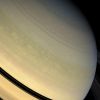
Saturn-PIA10578.jpgThe Northern Hemisphere of Saturn (Natural Colors; credits: NASA/JPL/Space Science Institute)56 visiteCaption NASA:"A chef's bounty of colors is represented in this full color view of Saturn's Northern Hemisphere.
Butternut, peach, and olive hues have replaced the azure blue of Winter. The blue of Saturn's Winter Hemisphere during the early Cassini Prime Mission still remains a puzzle. Over the course of time, the blue color has faded and has been replaced with bands of other hues (see also PIA11141).
This picture is a combination of images taken in red, green and blue light with the Cassini spacecraft wide-angle camera on Jan. 1, 2009. The view was obtained at a distance of approx. 1,1 MKM (such as about 680.000 miles) from Saturn and at a Sun-Saturn-Spacecraft, or Phase, Angle of 28°.
Image scale is roughly 65 Km (about 40 miles) per pixel".MareKromium
|
|

TheRings-PIA10581.jpgBright Spokes (Natural Colors; credits: Lunar Explorer Italia)56 visiteCaption NASA:"Signaling a return to the bright Spokes first encountered by the Cassini Spacecraft in 2005, three large white Spokes stretch out across the B-Ring. Throughout most of the last year, Cassini captured views of dark Spokes.
This image of bright Spokes was taken Jan. 14, 2009 in Visible Light with the Spacecraft's wide-angle camera.
The small moon Atlas (about 30 Km, or approx. 19 miles across) has been brightened by 30% but still appears as a faint dot between the A and F Rings in the top right quadrant of the image.
This view looks toward the sunlit side of the Rings from about 6° below the Ring-Plane. The view was acquired at a distance of approx. 551.000 Km (about 342.000 miles) from Saturn and at a Sun-Saturn-Spacecraft, or Phase, Angle of 155°. Image scale is roughly 29 Km (such as about 18 miles) per pixel".MareKromium
|
|
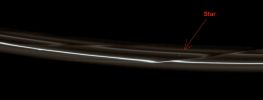
PIA10587.jpgThe "Fragile" F-Ring56 visiteCaption NASA:"Set starkly against the blackness of space are the F-Ring's delicate strands which are periodically gored by its shepherding moon, Prometheus.
Prometheus (approx. 86 Km, or about 53 miles across) and Pandora (approx. 81 Km, or about 50 miles across) both interact with the F-Ring but neither is visible here. Prometheus has the larger effect (see, for instance, PIA08397 for a movie of Prometheus creating a Streamer-Channel in the ring).
A star can be seen through the ring on the right side (Dx) of the image.
This view looks toward the unilluminated side of the Rings from about 33° above the Ring-Plane. The image was taken in visible light with the Cassini Spacecraft narrow-angle camera on Jan. 11, 2009.
The view was acquired at a distance of approx. 1 MKM (such as about 620,000 miles) from Saturn and at a Sun-Saturn-Spacecraft, or Phase, Angle of 37°.
Image scale is roughly 6 Km (about 4 miles) per pixel".MareKromium
|
|

Mimas-PIA10589.jpgSunshine v/s Saturnshine on Mimas (Natural Colors; credits: Lunar Explorer Italia)56 visiteCaption NASA:"The transition from light to dark takes place on two fronts in this image of Mimas. The two Terminators that stretch across the moon are created by Sunshine across the North and Saturn-shine in the East.
This view looks toward the Trailing Hemisphere of Mimas. North on Mimas is up and rotated 33° to the right.
The image was taken in Visible Light with the Cassini Spacecraft narrow-angle camera on Jan. 23, 2009. The view was acquired at a distance of approx. 508.000 Km (about 316.000 miles) from Mimas and at a Sun-Mimas-Spacecraft, or Phase, Angle of 152°.
Image scale is roughly 3 Km (a little less than 2 miles) per pixel".MareKromium
|
|

Moonlet-PIA11148-1.jpgTiny Moonlet within a G-Ring Arc56 visiteCaption NASA:"This sequence of three images, obtained by NASA's Cassini Spacecraft over the course of about 10 minutes, shows the path of a newly found moonlet in a bright arc of Saturn's faint G-Ring.
In each image, a small streak of light within the Ring is visible. Unlike the streaks in the background, which are distant stars smeared by the camera's long exposure time of 46", this streak is aligned with the G-Ring and moves along the ring as expected for an object embedded in the Ring.
Cassini scientists interpret the moving streak to be reflected light from a tiny moon half a kilometer (a third of mile) wide that is likely a major source of material in the arc and the rest of the G-Ring.
Debris knocked off this moon forms a relatively bright arc of material near the inner edge of the G-Ring, the most visible part of the Ring in these images. That arc, in turn, leaks material to form the entire Ring.
These images were captured by Cassini's narrow-angle camera on Oct. 27, 2008.
The first image (left) was taken in Visible Light, the second image (middle) was taken in Red Light, and the third image (right) in Near-InfraRed Light centered at a wavelength of 750 nanometers.
Image scale for the first image is roughly 7 Km (a little more than 4 miles) per pixel while the second and third were taken at reduced resolution.
These spatially compressed images were captured at 14 Km (about 9 miles) per pixel and then displayed at a size equal to the first image. This view looks toward the un-illuminated side of the Rings from about 5° above the Ring-Plane.
The view was acquired at a distance of approx. 1,2 MKM (such as about 751.000 miles) from Saturn and at a sun-Saturn-Spacecraft, or Phase, Angle of 23°".MareKromium
|
|
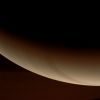
Saturn-PIA10591.jpgHigh Southern Latitudes (Natural Colors; credits: Lunar Explorer Italia)56 visiteCaption NASA:"Intricate curlicues and circular patterns of storms swirl through the High Latitudes near Saturn's South Pole in this image from the Cassini Spacecraft.
The view was obtained at a distance of approx. 588.000 Km (such as abpout 365.000 miles) from Saturn and at a Sun-Saturn-Spacecraft, or Phase, Angle of 140°. At this High Phase Angle, the Sun is illuminating the limb of the Planet from almost the opposite side of Saturn from the Spacecraft.The image was taken with the Cassini Spacecraft wide-angle camera on Jan. 5, 2009 using a spectral filter sensitive to wavelengths of near-InfraRed Light centered at 752 nanometers.
Image scale is roughly 32 Km (about 20 miles) per pixel".MareKromium
|
|

Dione-N00048330.jpgThe Marvelous Face of Dione (possible True Colors; credits: Dr M. Faccin & Lunar Explorer Italia)56 visitenessun commentoMareKromium
|
|

Saturn-W00051152.jpgSaturn: from b&w to Natural Colors (by Dr M. Faccin)56 visitenessun commentoMareKromium
|
|
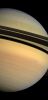
Saturn-PIA11453.jpgShadows (Natural Colors; credits: NASA/JPL/Space Science Institute)56 visiteCaption NASA:"Saturn's Rings cast a dramatic shadow separating the blues and greens of the Planet's Northern Hemisphere from the creamy pastels coloring the Southern Hemisphere.
This mosaic combines 6 images — 2 each of red, green and blue spectral filters — to create this Natural Color view. The images were obtained with the Cassini Spacecraft wide-angle camera on Dec. 30, 2008 at a distance of approx. 1,2 MKM (such as about 750.000 miles) from Saturn and at a Sun-Saturn-Spacecraft, or Phase, Angle of 30°.
Image scale is roughly 67 Km (about 42 miles) per pixel".MareKromium
|
|
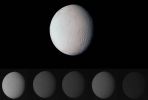
Enceladus_Approach.jpgApproaching Enceladus, from Voyager 256 visitenessun commentoMareKromium
|
|
| 2245 immagini su 188 pagina(e) |
 |
|
|
|
|
147 | |
|
|
|
|





