| Piú viste - Saturn: the "Ringed Beauty" and His Moons |
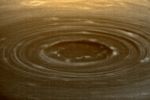
Saturn-SP-PIA11103.jpgSouthern Turbulence (natural colors; credits: Lunexit)56 visiteCaption NASA:"Shadows reveal the topography of Saturn's South Polar Vortex. At high resolution, a new, inner ring of isolated, bright clouds is seen. These clouds are localized regions of convective upwelling, an important clue to understanding how heat energy is transported in Saturn's Atmosphere.
See PIA11104 for a high-resolution Cassini view that looks more directly down onto the vortex, compared to this oblique perspective. Sunlight illuminates the scene from upper right, and the higher altitude rings of clouds surrounding the pole cast shadows toward lower left. North on Saturn is up.
The image was taken with the Cassini Spacecraft narrow-angle camera on July 15, 2008, with a combination of spectral filters sensitive to wavelengths of polarized infrared light centered at 746 and 938 nanometers. The grainy quality of the image is due primarily to the low signal-to-noise ratio of images taken with the 938 nanometer spectral filter, which is near the upper limit of the wavelength range the camera can see. "Signal-to-noise" is a term scientists use to refer to the amount of meaningful or useful information (signal) in their data versus the amount of background noise. A higher signal-to-noise ratio yields sharper, clearer views of features in the atmosphere.
The view was acquired from 24° below the Ring-Plane, at a distance of approx. 778.000 Km (about 483.000 miles) from Saturn.
The Sun-Saturn-Spacecraft, or Phase, Angle is about 30°.
Image scale is 4 Km (about 3 miles) per pixel".MareKromium
|
|
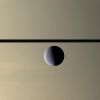
Rhea-IMG003277.jpgSliding Away... (natural colors; credits: NASA)56 visiteCaption NASA:"The Cassini Spacecraft looks toward Rhea's cratered, icy landscape with the dark line of Saturn's Ring-Plane and the Planet's murky atmosphere as a background.
Rhea is Saturn's second-largest moon, at about 1528 Km (approx. 949 miles) across.
This view looks toward the unilluminated side of the Rings from less than 1° above the Ring-Plane.
Images taken using red, green and blue spectral filters were combined to create this natural color view. The images were acquired with the Cassini spacecraft narrow-angle camera on July 17, 2007 at a distance of approx. 1,2 MKM (such as about 770.000 miles) from Rhea.
Image scale is roughly 7 Km (about 4,5 miles) per pixel"MareKromium
|
|
Enceladus-PIA10502.jpgIcy Plume in the Saturnshine! (natural colors; credits: Lunexit)56 visiteCaption NASA:"The active Surface Jets on Enceladus collectively form a brilliant, extended Plume that is made visible as sunlight scatters among the microscopic particles of ice.
The Plume is more easily seen with the Sun directly, or almost directly, behind Enceladus, as is the case here. The moon's surface is lit here by reflected light from Saturn.
The image was taken in visible light with the Cassini Spacecraft narrow-angle camera on Sept. 17, 2008. The view was obtained at a distance of approx. 235.000 Km (such as about 146.000 miles) from Enceladus and at a Sun-Enceladus-Spacecraft angle of 140°.
Image scale is approx. 1 Km (0,6 mile) per pixel".MareKromium
|
|

Enceladus-PIA11119.jpgEnceladus Oct. 9, 2008 Flyby56 visiteCaption NASA:"This image was taken during Cassini's extremely close encounter with Enceladus on Oct. 9, 2008.
The image was taken with the Cassini Spacecraft narrow-angle camera on Oct. 9, 2008, a distance of approx. 40.000 Km (such as about 25.000 miles) from Enceladus.
Image scale is approx. 477 meters (1566 feet) per pixel". MareKromium
|
|

MimasandPrometheus-N00121924-N00121943.gif"Space Runners" (GIF-Movie; credits: Dr G. Barca)56 visitenessun commentoMareKromium
|
|

The_Rings-AtoG-PIA10505.jpgThe Rings (natural colors; credits: Lunexit)56 visitenessun commentoMareKromium
|
|

Janus-PIA10507.jpgJanus: the RingMaster (natural colors; credits: Lunexit)56 visiteCaption NASA:"Saturn's battered moon Janus wears the record of its long history of impacts.
Janus (approx. 179 Km, or about 111 miles across) orbits just beyond the outer reaches of Saturn's "A" and "F" Rings, which are seen here.
This view looks toward the unilluminated side of the rings from about 4° above the Ring-Plane. The image was taken in Visible Light with the Cassini Spacecraft narrow-angle camera on Sept. 28, 2008.
The view was obtained at a distance of approx. 1,1 MKM (such as about 703.000 miles) from Janus and at a Sun-Janus-Spacecraft, or Phase, Angle of 28°.
Image scale is roughly 7 Km (about 4,5 miles) per pixel".MareKromium
|
|

StreamerChannel-PIA10509.jpgStreamer Channel56 visiteOk: quando Lunexit "chiama", la NASA...risponde! Pubblicata oggi (11 Novembre 2008) sul Planetary Photojournal, ecco la risposta NASA alla nostra illazione: la "vibrazione" dell'Anello "F" di Saturno è, effettivamente, uno Streamer Channel, provocato dalla Luna Pastore Prometheus.
L'effetto vibrazionale appare, nel filmato GIF del Dr Barca, più eclatante (e quindi fisicamente impossibile) solo perchè la ripresa - in quel primo contesto - era stata effettuata da una distanza inferiore ai 970.000 Km di questo frame.
Dunque nessuna "Onda Gravitazionale", ma solo uno Streamer Channel (ossìa un "canale" che viene scavato - letteralmente - da Prometheus quando attraversa l'Anello "F" di Saturno, e cioè una volta per orbita) particolarmente grande e ripreso da (relativamente) vicino.
Questa parte del Mistero, quindi, è risolta. Peccato che la NASA non ci abbia detto nulla, invece, dell'Oggetto Anomalo, ma chissà, magari in futuro...
Caption NASA:"The Cassini spacecraft focuses on a streamer-channel feature in Saturn's F-Ring.
These features are created by the moon Prometheus as it closely approaches the Ring once per orbit (see also PIA08397).
This view looks toward the unilluminated side of the Rings from about 36° above the Ring-Plane.The image was taken in Visible Light with the Cassini Spacecraft narrow-angle camera on Sept. 30, 2008.
The view was acquired at a distance of approx. 970.000 Km (such as about 602.000 miles) from Saturn and at a Sun-Ring-Spacecraft, or Phase, Angle of 45°.
Image scale is roughly 5 Km (about 3 miles) per pixel".
MareKromium
|
|

Helene-N00123958.jpgHelene56 visiteHelene is one of the named Minor Moons of Saturn. Also known as Saturn XII (or S12), Helene is an irregularly shaped (---> nonspherical) body measuring about 22 miles (such approx. 36 Km), by about 20 miles (approx. 32 Km), by about 18 miles (approx. 30 Km).
Helene orbits Saturn at a mean distance of about 234.500 miles (approx. 377.400 Km) and has an Orbital Period of 2,7369 Earth Days — the Rotational Period is unknown but is assumed to be the same as the Orbital Period (meaning that Helene shall always show the same side to Saturn - just like the Moon does to Earth).
Helene was discovered by French astronomers P. Laques and J. Lecacheaux in 1980 during ground-based observations of Saturn.
Another moon, Dione, is co-orbital with Helene: that is, Helene orbits Saturn at the same distance as Dione but precedes Dione by about 60°.
Before the present name was adopted, the moon was referred to as "Dione-B" or also "Electra".MareKromium
|
|

Enceladus-00063371.jpgHiding behind the Rings... (3D - credits: Dr M. Faccin)56 visitenessun commentoMareKromium
|
|

Helene-N00124458.jpgHelene and a "Bright Companion" (possible True Colors; credits: Lunar Explorer Italia)56 visiteCaption NASA:"N00124458.jpg was taken on November 24, 2008 and received on Earth November 25, 2008. The camera was pointing toward HELENE that, at the time, was approx. 68.171 Km away.
The image was taken using the CL1 and CL2 filters".
Nota Lunexit: Helene è senza dubbio affascinante, con il suo colore rosso-arancio (tipico di tanti Corpi Celesti Minori e, in questo caso, anche esaltato dalla luce rosa-salmone che deriva dal Gigante Saturno), ma noi Vi invitiamo a considerare il puntino luminoso che viene inquadrato dalla freccia. Ebbene, a nostro avviso NON si tratta di un image-artifact e non dovrebbe essere una stella che splende sullo sfondo (la quale sarebbe dovuta sparire, letteralmente ingoiata - tecn. "washed away" - dalla stessa luminostà di Helene).
Che cosa sarà mai? La nostra ipotesi è: forse (e ribadiamo FORSE!) si potrebbe trattare di un altro - minuscolo - Corpo Roccioso, non troppo distante da Helene.
Forse una "luna" di Helene stessa (un fenomeno decisamente raro, ma non impossibile: ricordate l'asteroide Ida ed il suo piccolissimo compagno Dactyl? Beh, questo potrebbe essere un fenomeno analogo...).MareKromium
|
|

TITAN-1.jpgCrescent Titan (possible True Colors; credits: Calvin J. Hamilton)56 visiteVi invitiamo a leggere, sul nostro blog TruePlanets, la prima parte della Monografia su Titano "Oltre la Nebbia", scritta dal Dr Paolo C. Fienga.
Un tentativo - si spera riuscito - di riassumere in un quantitativo ragionevole di pagine le ultime scoperte relative alla Luna Nebbiosa.
Nella prima parte, un pò di Storia, di Geografia e di Meteorologia, ed una serie di riflessioni dedicate ai "Colori di Titano" (perchè non esistono solo i "Colori di Marte"...).
In seguito (parte seconda), la Geografia di dettaglio di Titano, con cenni alla sua Storia Geologica ed alla possibile evoluzione; nella parte terza, infine - pubblicazione prevista nel Marzo 2009 - qualche ipotesi sugli scopi e le modalità di colonizzazione dello Spazio Profondo...
Buona Lettura!MareKromium
|
|
| 2245 immagini su 188 pagina(e) |
 |
|
|
|
|
146 | |
|
|
|
|





