| Piú viste - Saturn: the "Ringed Beauty" and His Moons |
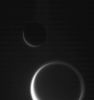
Tethys&Titan-PIA08124.jpgDancing in the dark55 visiteGhostly details make this dark scene more than just a beautiful grouping of two Saturn moons: Tethys and Titan.
In Titan's thick and inflated atmosphere, the detached high haze layer can be seen, as well as the complex Northern Polar "hood". Images like this one can help scientists make definitive estimates of the altitudes to which the high haze extends.
The faint vertical banded pattern is a type of noise that usually is removed during image processing.
Since this image was processed to enhance the visibility of details in Titan's atmosphere as well as in the faint G-Ring, the vertical noise was also enhanced.
This view was obtained in visible light with the Cassini spacecraft narrow-angle camera on Jan. 19, 2006, at a distance of approx. 2,4 MKM (such as about 1,5 MMs) from Titan and 1 MKM (about 600.000 miles) from Tethys. The image scale is 14 Km (about 9 miles) per pixel on Titan and 6 Km (about 4 miles) per pixel on Tethys.
|
|

Enceladus-PIA08128.jpgIn-transit over Saturn's Terminator...55 visiteEnceladus hangs like a single bright pearl against the golden-brown canvas of Saturn and its icy Rings. Visible on Saturn is the Region where daylight gives way to dusk (--> crepuscolo). Above, the Rings throw thin shadows onto the Planet.
Images taken using red, green and blue spectral filters were combined to create this natural color view.
The images were taken using the Cassini spacecraft wide-angle camera on Jan. 17, 2006 at a distance of approx. 200.000 Km (about 100.000 miles) from Enceladus.
The image scale is approx. 10 Km (about 6 miles) per pixel.
|
|
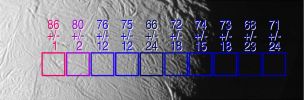
Enceladus-PIA07793.jpgEnceladus' surface temperatures (1)55 visiteThe exciting mystery of an active South Polar Region on Saturn's icy moon Enceladus continues to unfold as scientists make the correlation between geologically youthful surface fractures and unusually warm temperatures.
This view shows excess heat radiation from cracks near the moon's South Pole. These warm fissures are the source of plumes of dust and gas seen by multiple instruments on the Cassini spacecraft during its flyby of Enceladus on July 14, 2005, as described in a series of papers in the March 10, 2006, issue of the journal Science. This image shows two arrays of temperature readings across the surface of Enceladus, as measured by the Cassini Composite Infrared Spectrometer (CCIS), superimposed on images of the surface taken simultaneously by the Imaging Science Subsystem. Surface temperatures in Kelvin, derived from the intensity of infrared radiation detected by the composite infrared spectrometer, are shown along with their formal uncertainties, although true uncertainties for temperatures below about 75 Kelvin (minus 325 degrees Fahrenheit) are not easily described by a single number.
|
|

Enceladus&Rhea-PIA08133.jpgEnceladus and Rhea, divided by the Rings55 visiteCaption originale:"Rhea and Enceladus hover in the distance beyond Saturn's Ring-Plane. Enceladus (left, 505 Km - about 314 miles - wide), bathed in icy particles from Saturn's E-Ring, appears noticeably brighter than Rhea (right, 1528 Km - about 949 miles - wide).
The image was taken in visible light with the Cassini spacecraft narrow-angle camera on Feb. 8, 2006, at a distance of approx. 4,3 MKM (such as about 2,7 MMs) from Enceladus and 4,6 MKM (about 2,9 MMs) from Rhea.
The image scale is approx. 26 Km (roughly 16 miles) per pixel on Enceladus and about 28 Km (roughly 17 miles) per pixel on Rhea.
|
|

Mimas-PIA08135.jpgOverlapping Planets55 visiteCaption originale:"Mimas briefly slipped in front of Tethys while the Cassini spacecraft looked on and captured the event in this series of images.
The images were taken in visible light with the Cassini spacecraft narrow-angle camera on Feb. 11, 2006, at a distance of approx. 3,7 MKM (such as about 2,3 MMs) from Mimas and 4,1 MKM (such as about 2,5 MMs) from Tethys. Resolution in the original images was approx. 22 Km (about 14 miles) per pixel on Mimas and approx. 25 Km (about 16 miles) per pixel on Tethys.
The images have been magnified by a factor of two".
|
|

Saturn-N00054985.jpgThe "Sea of Clouds" near Saturn's Terminator55 visiteCaption originale:"N00054985.jpg was taken on March 13, 2006 and received on Earth March 15, 2006. The camera was pointing toward Saturn that, at the time, was approximately 2.562.202 Km away, and the image was taken using the RED and CL2 filters. This image has not been validated or calibrated".
|
|
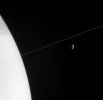
Rhea&Saturn-PIA08132.jpgCrescent Rhea55 visiteCaption NASA originale:"Shadow-striped Saturn and its exquisitely thin Rings occupy the near-field view in this Cassini image, while a crescent moon Rhea hangs in the distance.
A couple of bright pixels at the center of the image mark the location of the tiny moon Pan (only 26 Km, or 16 miles across).
The image was taken in visible light with the Cassini spacecraft narrow-angle camera on Feb. 3, 2006, at a distance of approx. 4,1 MKM (2,5 MMs) from Saturn and 4,6 MKM (2,9 MMs) from Rhea. The image scale is 28 Km (approx. 17 miles) per pixel on Rhea".
|
|

Saturn-N00055390.jpgWhat is rising? (1)55 visiteCaption NASA originale:"N00055390.jpg was taken on March 20, 2006 and received on Earth March 20, 2006. The camera was pointing toward Saturn that, at the time, was approximately 602.342 Km away.
This image was taken using the UV1 and CL2 filters and it has not been validated or calibrated".
|
|
Saturn-N00055391.jpgWhat is rising? (2)55 visiteCaption NASA originale:"N00055391.jpg was taken on March 20, 2006 and received on Earth March 20, 2006. The camera was pointing toward Saturn that, at the time, was approximately 601.921 Km away.
This image was taken using the UV2 and CL2 filters and it has not been validated or calibrated".
|
|

Epimetheus-N00055513.jpgThe Runners...Again!55 visiteCaption NASA originale:"N00055513.jpg was taken on March 20, 2006 and received on Earth March 20, 2006. The camera was pointing toward Epimetheus that, at the time, was approximately 452.867 Km away.
This image was taken using the CL1 and CL2 filters and it has not been validated or calibrated".
|
|
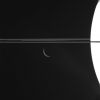
Rhea-W00014280.jpgSliding in the Darkness... (1)55 visiteUn trittico di immagini molto suggestive: Rhea, muovendosi nel silenzio dello spazio circum-saturniano, scivola verso l'ombra del Gigante Anellato e si immerge nella Notte di Saturno.
Commenti? Inutili...
|
|

Rhea-W00014306.jpgSliding in the Darkness... (2)55 visitenessun commento
|
|
| 2245 immagini su 188 pagina(e) |
 |
|
|
|
|
144 | |
|
|
|
|





