| Piú viste - Saturn: the "Ringed Beauty" and His Moons |

Janus-N00047441.jpgA "Hat-Trick" of Moons...55 visiteOriginal caption:"N00047441.jpg was taken on December 30, 2005 and received on Earth December 31, 2005. The camera was pointing toward JANUS that, at the time, was approximately 2.353.449 Km away and the image was taken using the CL1 and CL2 filters".
|
|

Saturn-N00047655.jpgWhite ice-clouds on Saturn's upper atmosphere (3)55 visiteOriginal caption:"N00047655.jpg was taken on January 02, 2006 and received on Earth January 03, 2006. The camera was pointing toward Saturn that, at the time, was approximately 2.732.667 Km away, and the image was taken using the CL1 and CL2 filters. This image has not been validated or calibrated".
|
|

Saturn-PIA07672.jpgSaturn's limb (enhanced - and yet natural - colors)55 visiteOriginal caption:"Twice as far from the Sun as Jupiter, Saturn's colder temperatures mean that clouds form lower in its atmosphere. As a result, the visible cloud patterns - so striking on Jupiter - occur deeper inside Saturn, reducing their visibility in natural color views.
This enhanced-color view uses exaggerated contrast and intensity in order to make Saturn's cloud bands easy to see.
The Latitude seen at the image center is approximately 60° South of the Equator.
Images taken in blue (BL2), green and red (CB1) polarized spectral filters were combined to create this enhanced-color view. The images were taken with the Cassini spacecraft narrow-angle camera on Dec. 7, 2005, at a distance of approximately 3,1 MKM (1,9 MMs) from Saturn. The image scale is about 36 Km (app.x 22 miles) per pixel".
|
|
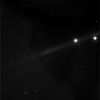
Saturn-E-Ring-W00012982.jpgOver-exposed Moons and the E-Ring55 visiteEscludendo che i due globi luminosi che vediamo in questo frame (in una posizione di quasi allineamento rispetto all'Anello E di Saturno) sìano dei photi-artifacts o degli UFO, la nostra sensibilità nell'analisi dei frames in arrivo dalla Sonda Cassini ci suggerisce l'idea che si tratti di due Lune di Saturno ampiamente sovraesposte.
Ma se ci chiedeste di quali Lune si tratta...Beh, non ci vergognamo di dire che questo proprio non lo sappiamo.
Caption originale:"W00012982.jpg was taken on January 11, 2006 and received on Earth January 12, 2006. The camera was pointing toward Saturn's E-Ring that, at the time, was approximately 2.048.891 Km away.
The image was taken using the CL1 and IRP90 filters and has not been validated or calibrated".
|
|

Dione&Co.-PIA07679.jpgProportions, dimensions, perspectives and distances...55 visiteOriginal caption:" Two of Saturn's battered, icy companions hover here, above the Ring-Plane.
To get a sense of the three-dimensional nature of the scene, note that the wide band of visible Rings is in between the two moons in this view from the Cassini spacecraft.
Mimas (397 Km, or 247 miles across, at left) is outside the far side of the Rings while Dione (1.126 Km, or 700 miles across) is outside the Rings and closer to Cassini.
The view is from just beneath the Ring-Plane and the image was taken in visible light, with the Cassini spacecraft narrow-angle camera on Dec. 18, 2005, at a distance of approx. 2,2 MKM (roughly 1,4 MMs) from Dione and 2,7 MKM (about 1,7 MMs) from Mimas. The image scale is 13 Km (about 8 miles) per pixel on Dione and 16 Km (about 10 miles) per pixel on Mimas".
|
|

Dione-N00048466.jpgSaturnshine over Dione55 visitenessun commento
|
|

Epimetheus-PIA07680.jpgSinking in a Sea of Darkness...55 visiteThe Cassini spacecraft captured this glimpse of icy Epimetheus just before the small moon disappeared behind the bulk of Saturn's atmosphere.
The image was taken in visible light with the Cassini spacecraft narrow-angle camera on Dec. 20, 2005, at a distance of approx. 2,3 MKM (about 1,4 MMs) from Epimetheus and 2,2 MKM (about 1,3 MMs) from Saturn. The image scale is roughly 14 Km (about 9 miles) per pixel on Epimetheus and approx. 13 Km (about 8 miles) per pixel on Saturn.
|
|

Rhea-PIA07689.jpgRhea55 visiteOriginal caption:"Scarred and battered Rhea fills the Cassini spacecraft's view. Notable here is the sharp relief of steep crater walls near the terminator.
Icy Rhea (1.528 Km --> 949 miles across) is Saturn's second-largest moon. This view shows terrain on Rhea's Trailing Hemisphere. North is up and rotated 22° to the left.
The image was taken in visible light with the Cassini spacecraft narrow-angle camera on Dec. 24, 2005 at a distance of approximately 267.000 Km (such as 166.000 miles) from Rhea and at a Sun-Rhea-spacecraft, or phase, angle of 59°. Image scale is 2 Km per pixel".
|
|

Dione-PIA07691.jpgDione's faulted surface (HR - enhanced colors)55 visiteCaption originale:"(...) To create this enhanced-color view, ultraviolet, green and infrared images were combined into a single black and white picture that isolates and maps regional color differences. This "color map" was then superposed over a clear-filter image.
The origin of the color differences is not yet understood, but may be caused by subtle differences in the surface composition or the sizes of grains making up the icy soil.
Even this view looks toward the Leading Hemisphere on Dione. North is up and rotated 20° to the right.
All the images were acquired with the Cassini spacecraft narrow-angle camera on Dec. 24, 2005 at a distance of approximately 151.000 Km(about 94.000 miles) from Dione and at a phase angle of 99°.
Image scale is approx. 896 mt (about 2.940 feet) per pixel".
|
|

Rhea-N00049540.jpgRhea and Companions (2)55 visiteOriginal caption:"N00049540.jpg was taken on January 27, 2006 and received on Earth January 29, 2006. The camera was pointing toward Rhea that, at the time, was approximately 3.012.654 Km away, and the image was taken using the CL1 and CL2 filters".
|
|

Enceladus-PIA07694.jpgThe "Young Face" of Enceladus55 visiteOriginal caption:"For Enceladus, wrinkles mean the opposite of old age. This view of a crescent Enceladus shows a transition zone between a wrinkled and presumably younger Region of terrain and an older, more heavily cratered Region. The moon's geologically active Southern Polar Region is seen on the left.
The lit terrain shown here is on the side of Enceladus that faces away from Saturn.
The image was taken in visible light with the Cassini spacecraft narrow-angle camera on Dec. 24, 2005 at a distance of approx. 108.000 Km (such as about 67.000 miles) from Enceladus, at a Sun-Enceladus-spacecraft angle of 102°.
Image scale is roughly 646 mt (about 2.118 feet) per pixel".
|
|

Tethys-PIA07698.jpgSmiling Tethys...55 visiteCaption originale:"The profile of Ithaca Chasma forms a great scar in the icy crescent of Tethys. The chasm stretches more than a 1.000 Km (about 620 miles) over Tethys' surface, from North to South.
The image was taken in visible light with the Cassini spacecraft narrow-angle camera on Dec. 25, 2005 at a distance of approximately 313.000 Km (about 195.000 miles) from Tethys and at a Sun-Tethys-spacecraft, or phase, angle of 151°. Image scale is about 2 Km (approx. 1 mile) per pixel".
|
|
| 2245 immagini su 188 pagina(e) |
 |
|
|
|
|
142 | |
|
|
|
|





