| Piú viste - Saturn: the "Ringed Beauty" and His Moons |

Mimas-N00041424.jpgMimas and the Rings55 visiteN00041424.jpg was taken on October 13, 2005 and received on Earth October 14, 2005. The camera was pointing toward MIMAS - distant approximately 710.721 Km away - and the image was taken using the CL1 and GRN filters. This image has not been validated or calibrated.
|
|

Mimas-N00041399.jpgMimas and Prometheus55 visiteN00041399.jpg was taken on October 13, 2005 and received on Earth October 14, 2005. The camera was pointing toward PROMETHEUS - distant approximately 769.213 Km away - and the image was taken using the CL1 and CL2 filters. This image has not been validated or calibrated.
|
|

Dione-N00041359.jpgHalf-Dione, in the darkness...55 visiteN00041359.jpg was taken on October 13, 2005 and received on Earth October 14, 2005. The camera was pointing toward DIONE - distant approximately 711.554 Km away - and the image was taken using the P120 and MT2 filters. This image has not been validated or calibrated.
Nota: lo Staff di Lunar Explorer, studiando le statistiche del Sito, ha notato che le immagini in arrivo da Saturno suscitano (se rapportate a Marte o alla Luna) un interesse davvero bassissimo. E' giusto che ogni Appassionato si dedichi a quello che ritiene più interessante e, spesso, ciò che appare più interessante è anche ciò che si trova "più vicino". La Luna e Marte, se questo approccio è esatto, sono esempi molto chiari.
Tuttavia, se ci consentite una parola sul Sistema di Saturno, vorremmo rammentarVi che, spesso, la comprensione di quello che si trova più vicino a noi (diremmo "a portata di mano"...) è semplificata dallo studio e/o (anche) dalla semplice osservazione di quello che - invece - si trova molto lontano...
|
|

Dione-PIA07745-1.jpgDione's horizon - HD (1)55 visiteOriginal caption:"As it departed its encounter with Saturn's moon Dione, Cassini sailed above an unreal landscape blasted by impacts. The rising Sun throws craters into sharp contrast and reveals steep crater walls.
At the far right, a medium-sized crater is bisected by a fracture, revealing a cross section of the impact site.
The seven clear-filter images in this mosaic were taken with the Cassini spacecraft narrow-angle camera on Oct. 11, 2005, at distances ranging from of 21.650 to 25.580 Km (about 13.450 to 15.890 miles) from Dione and at a Sun-Dione-spacecraft, or phase, angle of 154°. Resolution in the original images ranges from 126 to 154 mt (about 413 to 505 feet) per pixel. The images have been re-sized to have an image scale of about 100 mt (330 feet) per pixel. North on Dione is 140° to the left".
|
|

Dione-PIA07745-4.jpgDione's horizon - HD (4)55 visitenessun commento
|
|

Dione-PIA07746.jpgDione (full view - natural colors)55 visiteNoi siamo d'accordo sul fatto che Scienza e Tecnica (in questo campo specifico) si debbano costruire su basi "matematiche" (o, se preferite, su "elementi fattuali esatti ed incontrovertibili"); ciò su cui NON siamo d'accordo, però, è quella tendenza (ormai diffusa e radicata in tutti gli ambienti Scientifici, a cominciare dalle Università) che vuole costruire TUTTA la Scienza e la Tecnica su basi ESCLUSIVAMENTE matematiche (nel senso anzidetto). La Scienza, infatti, non può prescindere - per essere di vero aiuto all'Uomo - dall'Umanesimo. E dire Umanesimo non significa dire (solo) Letteratura. Umanesimo è "tutto ciò che fa parte dell'Uomo e che contribuisce al suo crescere ed al suo evolversi", secondo noi. Dunque l'Umanesimo comprende anche la Scienza (e la Tecnica), ma NON viceversa. Costruire Scienziati su basi esclusivamente matematiche, quindi, vuol dire - a nostro modesto parere - costruire degli 'Scienziati Incompleti'. Il che vuol anche dire formare degli 'Uomini Incompleti', con tutto ciò che segue.
|
|
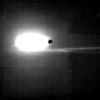
The Rings-N00042087.jpgThe "G-Ring" and a "Dark Object" in the light...55 visiteOriginal caption:"N00042087.jpg was taken on October 24, 2005 and received on Earth October 25, 2005. The camera was pointing toward SATURN-G-RING at approximately 2.120.861 kilometers away and the image was taken using the IR2 and CL2 filters. This image has not been validated or calibrated".
Una simile immagine - un probabile photo-artifact, ma non si può esserne sicuri al 100% - l'avevamo già incontrata quando, diversi mesi fa, la Sonda Cassini si era avvicinata a Giapeto ed aveva effettuato due scatti che produssero un risultato visivo molto simile a questo. E Voi cosa dite? Stiamo guardando una Nave Spaziale Aliena che si "nasconde" nei raggi e nella luce di un Sole lontano - ma comunque brillante - oppure è solo un artefatto fotografico (una "distorsione" da sovraesposizione)?
|
|

Janus-PIA07615.jpgJanus and Epimetheus55 visiteOriginal caption:"Outside the soft edge of Cassini's F-Ring, Epimetheus and Janus negotiate their nearly-shared orbit. The two moons' orbits are typically about 50 Km (approx. 30 miles) apart, and the moons actually change orbits every few years: one moon becoming the innermost of the pair, the other becoming the outermost.
Epimetheus' diameter is 116 Km while Janus' diameter is 181 Km across.
The image was taken in visible light with the Cassini spacecraft narrow-angle camera on Sept. 8, 2005, at a distance of approx. 1,5 MKM (about 1 MMs) from Saturn. The image scale is about 11 Km (roughly 7 miles) per pixel on the two moons".
|
|

Japetus-N00042610.jpgJapetus, in the darkness...55 visiteOriginal caption:"N00042610.jpg was taken on November 04, 2005 and received on Earth November 05, 2005. The camera was pointing toward IAPETUS at approximately 1.433.927 Km away, and the image was taken using the CL1 and IR1 filters".
Note: un'immagine "inquietante" di Giapeto il quale, già in sè misterioso a causa della sua superficie - in parte - completamente nera, adesso ci appare anche curiosamente "schiacciato" ai poli. Si tratta, probabilmente, di un semplice effetto ottico sulla cui causa, tuttavia, non sapremmo che cosa dire. Bizzarra la configurazione assunta - in questo frame - dal picco centrale del grande cratere (l'Occhio di Giapeto) che domina il Polo Nord apparente di questo incredibile Corpo Celeste.
Inoltre, portando il frame sino al full-size, riuscirete a vedere tanti altri dettagli interessanti della superficie di Giapeto: un mondo - secondo noi - assolutamente affascinante ma ancora poco (almeno apparentemente...) considerato.
|
|

Space-N00042679.jpgThe "Space" of Saturn55 visitenessun commento
|
|

Japetus-N00042846.jpgApproaching Japetus55 visiteOriginal caption:"N00042846.jpg was taken on November 09, 2005 and received on Earth November 10, 2005. The camera was pointing toward Japetus at approx. 639.972 Km away, and the image was taken using the IR2 and CL2 filters. This image has not been validated or calibrated".
|
|

Japetus-N00042866.jpgApproaching Japetus55 visiteOriginal caption:"N00042866.jpg was taken on Nov. 11, 2005 and received on Earth Nov. 11, 2005. The camera was pointing toward Japetus at approx. 480.263 Km away and the image was taken using the CL1 and GRN filters".
Purtroppo, alla fine di questo passaggio (solo relativamente) ravvicinato, non avremo la possibilità di scrutare ancora nelle valli e dentro i crepacci di questa luna divisa a metà: una metà che ci ricorda, in tutto e per tutte, le altre lune del Sistema di Saturno ed i corpi celesti rocciosi "tipici" dello Spazio Esterno (o trans-Marziano). Un'altra metà, invece, completamente aliena, diversa e difficile da spiegare: una metà di Giapeto, infatti, è nera. Che si tratti di depositi di polveri è solo una speculazione e qualora si trattasse effettivamente di polveri, verrebbe naturale domandarsi "da dove" queste polveri provengano.
Ciò che sappiamo, oggi, è che Giapeto è un Corpo Celeste "bifronte" e, forse, dalla doppia natura: tutto il resto (e che NASA ed ESA ci perdonino) è "jargon"...
|
|
| 2245 immagini su 188 pagina(e) |
 |
|
|
|
|
140 | |
|
|
|
|





