| |

| Piú viste - Saturn: the "Ringed Beauty" and His Moons |

The_Rings-N00154377-91-EB-LXTT.gifThe Beautiful Rings of Saturn (a GIF-Movie by Elisabetta Bonora - Lunexit Team)92 visitenessun commentoMareKromium
|
|

Saturn-EB-MF-LXTT.jpgLight Shades of Color... (Natural Colors; credits for te additional process. and color.: Elisabetta Bonora - Lunexit Team)92 visitenessun commentoMareKromium
|
|

Hyperion-PIA17193-PCF-LXTT-IPF.jpgFarewell Hyperion! Part I (Absolute Natural Colors; credits for the additional process. and color.: Dr Paolo C. Fienga/Lunar Explorer Italia/Italian Planetary Foundation)92 visiteThe NASA - Cassini Spacecraft's Imaging Scientists processed this view of Saturn's so-called "spongy" moon Hyperion, which was taken during a close Fly-By that occurred on May 31, 2015. This Fly-By marks the Mission's Final Close Approach to this Saturnian highly irregularly shaped moon. North on Hyperion is up and rotated 37° to the right (Dx).
The image was taken with the NASA - Cassini Spacecraft's Narrow-Angle Camera - as we wrote herebefore - on May 31, 2015, by using a Spectral Filter which preferentially admits Wavelengths of Near-InfraRed Light, centered at 862 nanometers. The view was acquired at a distance of approx. 37.000 miles (such as about 59.545,58 Km) from Hyperion, and at a Sun-Hyperion-Cassini Spacecraft, or Phase, Angle of 20°. The Image Scale is roughly 1180 feet (such as approx. 359,664 meters) per pixel.
This frame (which is an Original NASA - CASSINI Spacecraft's b/w and NON Map-Projected image published on the NASA - Planetary Photojournal with the ID n. PIA 17193) has been additionally processed, contrast enhanced, magnified to help the visibility of the Surface details, Gamma corrected and then re-colorized - according to an educated guess (or, if you wish, an informed speculation) carried out by Dr Paolo C. Fienga - in Absolute Natural Colors (such as the colors that a human eye would actually perceive if someone were onboard the NASA - Cassini Spacecraft and then looked outside, towards the Saturnian moon "Hyperion"), by using an original technique created - and, in time, dramatically improved - by the Lunar Explorer Italia Team. Different colors, as well as different shades of the same color, mean, among other things, the existence of different Elements (Minerals) present on the Surface of Hyperion, each having a different Albedo (---> Reflectivity) and Chemical Composition.
Note: it is possible (but we, as IPF, have no way to be one-hundred-percent sure of such a circumstance), that the actual luminosity of Hyperion - as it is in this frame - would appear, to an average human eye, a little bit lower than it has been shown (or, better yet: interpreted) here.MareKromium
|
|
|
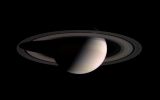
Saturn from 5.800.000 Km.jpgSaturn from about 5.800.000 Km91 visitenessun commento
|
|

Pandora-PIA07632.jpgBeautiful Pandora (false colors)91 visiteCassini's best close-up view of Saturn's F-Ring shepherd moon, Pandora, shows that this small ring-moon is coated in fine dust-sized icy material.
Craters formed on this object by impacts appear to be covered by debris, a process that probably happens rapidly in a geologic sense. The grooves and small ridges on Pandora suggest that fractures affect the overlying smooth material. The crisp craters on another Saturn moon, Hyperion, provide a contrasting example of craters on a small object.
Cassini acquired infrared, green and ultraviolet images on Sept. 5, 2005, which were combined to create this false-color view. The image was taken with the Cassini spacecraft narrow-angle camera at a distance of approx. 52.000 Km from Pandora and at a phase angle of 54°. Resolution in the original image was about 300 mt per pixel".
Nota: un'immagine stupenda e spettacolare e poi, per i più attenti, come non notare l'incredibile somiglianza (troppo grande per essere casuale...) di questa luna con Phobos?
|
|

UnusualObject-N00122114-3.jpgUnusually-looking "Object" in the Space of Saturn (edm n. 1, by Lorenzo Leone)91 visiteDal nostro Carissimo Amico e Partner, Lorenzo Leone, due edm dell'Oggetto Anomalo che, a quanto pare, sta affascinando moltissimi Appassionati.
La sua natura è, al momento, indeterminabile; tuttavia possiamo dire con certezza assoluta che NON si tratta di un Image-Artifact. E' un oggetto vero, reale. E' una realtà fisica, di un qualche tipo.
E questo è già molto.
E queste sono le annotazioni di Lorenzo Leone, che ringraziamo ed al quale facciamo - come sempre - Grandi Complimenti:"...sembra che l'oggetto, oltre che essere reale, quindi non image-artifact, abbiamo una forma esagonale.
La cosiddetta punta non è altro, a mio parere, che il bagliore della zona, forse metallica, sovraesposta alla luce, cosi come accade, con una forma più arrotondata, per quanto riguarda il suo lato dx.
La mia impressione, dopo varie analisi di filtro/colore che non ho inserito perchè non chiarissime, è che la struttura presenti una cavità. Ovvero un anello esagonale che tanto fa pensare ad una stazione orbitale ruotante.
Chissà...".MareKromium
|
|

The_Rings-N00154560-71-EB-LXTT.gifThe Beautiful Rings of Saturn (a GIF-Movie by Elisabetta Bonora - Lunexit Team)91 visitenessun commentoMareKromium
|
|

Enceladus-N00165273-75-EB-LXTT.jpgLights in the Saturnian Night (an Image-Mosaic in True Colors by Dr Marco Faccin - Lunexit Team)91 visitenessun commentoMareKromium
|
|

Enceladus-N00165329-30-31-EB-PCF-LXTT.jpgEnceladus (an Image-Mosaic in enhanced Absolute Natural Colors; credits for the additional process. and color.: Elisabetta Bonora - Lunexit Team)91 visitenessun commentoMareKromium
|
|

Saturn-Storm.jpgSaturnian Storm91 visiteCaption NASA:"Late last year, a new, remarkably bright storm erupted in Saturn's Northern Hemisphere. Amateur astronomers first spotted it in early December, with the Ringed Gas Giant rising in Planet Earth's predawn Sky.
Orbiting Saturn, the Cassini Spacecraft was able to record this close-up of the complex disturbance from a distance of about 1,8 MKM on December 24th, 2010.
Over time, the storm has evolved, spreading substantially in longitude, and now stretches far around the Planet. Saturn's thin Rings are also seen slicing across this space-based view, casting broad shadows on the Planet's Southern Hemisphere".MareKromium
|
|

Janus-PIA14667-PCF-LXTT-IPF.jpgJanus, from far away... (Absolute Natural Colors; credits for the additional process. and color.: Dr Paolo C. Fienga/Lunar Explorer Italia/Italian Planetary Foundation)91 visiteIn this frame, we can see that the NASA - Cassini Spacecraft has recently caught a glimpse of Janus: an irregularly-shaped Minor Saturnian moon. Lacking sufficient gravity to pull itself into a round shape, Janus (which is approx. 111 miles - such as about 178,63 - across) has had its lumpy primordial shape only slightly modified by impacts since its formation. A huge Impact Crater can be seen on the upper left corner of the illuminated side of Janus, jointly with other barely visible Surface Details. Furthermore, if you look carefully (after bringing the image to its full size), a few more Surface Details that are found of that part of Janus that lies in the shadows, beyond the Terminator Line, can be (even though just barely) seen, jointly with the outline of the moon.
This view looks toward the Trailing Hemisphere of Janus. North on Janus is up and rotated 44° degrees to the left. The image was taken in Visible Light with the NASA - Cassini Spacecraft Narrow-Angle Camera on April 28, 2013; the view was obtained at a distance of approximately 780.000 miles (such as about 1.255.285 Million KiloMeters) from Janus and at a Sun-Janus-Cassini Spacecraft (or Phase), Angle of 77°. The mage scale is roughly 5 miles (such as 8,04 Km) per pixel.
This frame (which is an Original NASA - Cassini Spacecraft b/w frame published on the NASA - Planetary Photojournal with the ID n. PIA 14667) has been additionally processed, contrast enhanced, magnified and then colorized in Absolute Natural Colors (such as the colors that a human eye would actually perceive if someone were onboard the NASA - Cassini Spacecraft and then looked outside, towards the Saturnian moon Janus), by using an original technique created - and, in time, dramatically improved - by the Lunar Explorer Italia Team. Different colors, as well as different shades of the same color, mean, among others, the existence of different Elements present on the Surface of Janus, each having a different Albedo (---> Reflectivity) and Chemical Composition.MareKromium
|
|
| 2245 immagini su 188 pagina(e) |
|
|
|
|
|
14 | |
|
|
|
|
|
|





