| Piú viste - Saturn: the "Ringed Beauty" and His Moons |

Tethys-PIA07736.jpgLandslides on Tethys (HR)55 visiteOriginal caption:"This view is among the closest Cassini images of Tethys' icy surface taken during the Sept. 24, 2005 flyby. This image is a clear-filter view and is the highest resolution image acquired by Cassini during the encounter. The two large craters at the right show evidence that landslides have modified their outlines and covered their floors with large quantities of debris. Linear depressions cutting across the terrain probably mark the surface expressions of faults or fractures.
This view is centered on terrain at approx. 4,2° South Latitude and 357° West Longitude on Tethys. The image has been rotated so that North on Tethys is up.
The view was obtained using the Cassini spacecraft narrow-angle camera at a distance of approx. 19.000 Km (about 11.800 miles) from Tethys and at a Sun-Tethys-spacecraft, or phase, angle of 17°.
Image scale is 110 mt (360 feet) per pixel".
|
|

Hyperion-PIA07741-1.jpgHyperion's unusual craters (1) - HR55 visiteOriginal caption:"This HR Cassini mosaic shows that Hyperion truly has a surface different from any other in the Saturn System. The mosaic is composed of 5 clear filter images taken during Cassini's close flyby of Hyperion on Sept. 26, 2005. The spacecraft passed approximately 500 Km(310 miles) above the moon's surface. Hyperion is 266 Km (about 165 miles) in diameter.
Scientists are extremely curious to learn what the dark material is that fills many craters on this oddball moon. Features within the dark terrain, including a 200-meter-wide impact crater surrounded by rays to the right of center (Sezione 3 del frame) and numerous bright-rimmed craters, indicate that the dark material may be only tens of meters (hundreds of feet) thick with brighter material beneath".
|
|

Pandora-PIA07602.jpgPandora55 visiteOriginal caption:"Saturn's moon Pandora is almost overwhelmed by the brightness of the F-Ring in this view. The F-Ring's bright core displays kinks and is flanked by fainter ringlets. Imaging scientists recently determined these fainter ringlets to be a single spiral ring that winds around the Planet. Pandora is faintly lit by "Saturnshine," or reflected light from the planet, and few features can be seen here. This image was acquired by Cassini exactly three hours after the spacecraft took the image seen in previous PIA07601, which showed Prometheus interior to the F-Ring.
The image was taken in visible light with the Cassini spacecraft narrow-angle camera on Aug. 21, 2005, at a distance of appx. 583.000 Km from Saturn and at a high Sun-Saturn-spacecraft angle of 136°. Resolution is about 3 Km per pixel".
Nota: osservate il frame PIA07530 e poi confrontate le due immagini di Pandora. A noi sembra che ci sia una "profonda" differenza e che il corpo celeste ripreso nei due frames NON sia lo stesso.
|
|

Dione-PIA07603.jpgDione: the "Aeneidian Moon", from 1,1 MKM55 visiteOriginal caption:"When naming features on other worlds, scientists like to follow themes, and Dione is no exception. Dione possesses numerous features with names from Virgil's 'Aeneid'. The prominent crater showing a central peak below the center is Dido, a 118-Km-wide (about 73-mile) crater named after the supposed founder of Carthage. The crater just above Dido is Antenor, an 82-Km-wide (about 51-mile) impact crater named after the nephew of Priam who founded the Italian city of Padua. At the upper right is the 97-Km-wide (about 60-mile) impact crater Turnus, which lies at the western end of Carthage Linea, a region of bright, fractured terrain. The sunlit terrain seen here shows some of the wispy markings on the Moon's trailing hemisphere. Cassini revealed that these markings are actually a complex system of fractures. North on Dione is up and rotated 25° to the left (...)".
|
|

Pandora-PIA07604.jpgOccultation!55 visiteOriginal caption:"Saturn's moon Pandora glides in front of the narrow F-Ring, making the moon's oblong outline visible. The image also shows the A-Ring, the Cassini Division, the B-Ring and part of the C-Ring. This view is from beneath the Ring plane. The image was taken in visible light with the Cassini spacecraft narrow-angle camera on Aug. 23, 2005, at a distance of approximately 1,6 MKM (about 1 MMs) from Pandora and at a Sun-Pandora-spacecraft, or phase, angle of 97°. Resolution in the original image was 9 Km (about 6 miles) per pixel".
|
|
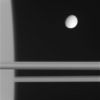
Tethys-N00040990.jpgTethys and the Rings55 visiteOriginal caption:"N00040990.jpg was taken on October 10, 2005 and received on Earth October 11, 2005. The camera was pointing toward TETHYS at approximately 1.258.610 Km away and the image was taken using the BL1 and CL2 filters".
|
|
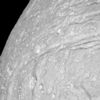
Tethys.jpgIcy cliffs, canyons and crevasses on Tethys (HR)55 visiteOriginal caption:"The surface of Saturn's moon Tethys is riddled with icy cliffs and craters. The most detailed images ever taken of Tethys were captured late last month as Cassini spacecraft swooped past the frozen ice moon. The above image was taken from from about 32.000 Km and shows a jagged landscape of long cliffs covered with craters. At the bottom of many craters appears some sort of unknown light-colored substance, in contrast to the unknown dark substance that appears at the bottom of Saturn's moon Hyperion. Tethys is one of the larger moons of Saturn, spanning about 1000 Km across and its density indicates a composition almost entirely of water ice. Tethys is thought to have been predominantly liquid sometime in its distant past, creating some of its long ice-cliffs as it cracked during freezing".
|
|

Dione-N00041174.jpgDione's Fly-By (7): from about 32.000 Km55 visitenessun commento
|
|

Dione-N00041221.jpgDione's Fly-By (10): from about 10.000 Km55 visitenessun commento
|
|

Dione-N00041239.jpgDione's Fly-By (14): from about 3.300 Km55 visitenessun commento
|
|

Dione-N00041240.jpgDione's Fly-By (15): from about 2.800 Km55 visitenessun commento
|
|

Telesto-N00041291.jpgTelesto55 visiteOriginal caption:"N00041291.jpg was taken on October 11, 2005 and received on Earth October 12, 2005. The camera was pointing toward TELESTO at approximately 12,230 kilometers away, and the image was taken using the CL1 and CL2 filters. This image has not been validated or calibrated".
Nota: ricordate il discusso Fly-By di Hyperion durante il quale questa piccola luna rimaneva completamente immobile durante l'avvicinamento di Cassini (vedi "Hyperion", di A. Feltri e P. C. Fienga su NEXUS)? Notate ora come Telesto, invece, cambi VISIBILMENTE posizione tra un frame e l'altro. Sarà perchè Telesto ruota su sè stesso molto più rapidamente di Hyperion o forse perchè Cassini ha diminuito la sua velocità di crociera?
O magari perchè queste immagini sono genuine e quelle del Fly-By di Hyperion non lo erano?...
Voi che dite?
|
|
| 2245 immagini su 188 pagina(e) |
 |
|
|
|
|
139 | |
|
|
|
|





