| Piú viste - Saturn: the "Ringed Beauty" and His Moons |

Rhea-PIA08886.jpgDrawing Out Details on Rhea55 visiteRhea displays a marked color contrast from North to South that is particularly easy to see in the extreme color-enhanced Cassini spacecraft view presented here.
A clear filter image is also presented (left) alongside the color composite (right).
To create the false-color view, ultraviolet, green and infrared images were combined into a single picture that isolates and maps regional color differences.
This "color map" was then superimposed over a clear-filter image that preserves the relative brightness across the body.
The combination of color map and brightness image shows how colors vary across the surface of Rhea. The origin of the color differences is not yet understood, but may be caused by subtle differences in the surface composition or the sizes of grains making up the icy surface material.
This view looks toward the Trailing Hemisphere on Rhea. The view shows southerly latitudes on Rhea, down to the South Pole. North is up and rotated 17° to the right.
The image was taken in visible light with the Cassini spacecraft narrow-angle camera on Jan. 17, 2007 at a distance of approx. 457.000 Km (about 284.000 miles) from Rhea.
Image scale is roughly 3 Km (a little less than 2 miles) per pixel.
|
|

The_Rings-PIA08887.jpgHeading to the Darkness55 visiteCaption NASA:"This strikingly crisp view shows Atlas heading into Saturn's shadow at upper left. The moon's basic, elongated shape is easy to detect here. Above Atlas, a bright clump in the F-Ring also heads toward the darkness. This view looks toward the unlit side of the Rings from about 30° above the Ring-Plane.
The image was taken in visible light with the Cassini spacecraft narrow-angle camera on Jan. 19, 2007 at a distance of approx. 1,2 MKM (about 700.000 miles) from Atlas. Image scale is roughly 7 Km (about 4 miles) per pixel".
|
|

Helene_Mimas-PIA08897.jpgCelestial Wonders around Saturn: Helene and Mimas55 visiteCaption NASA:"Mimas (397 Km, or 247 miles across) is seen here just before gliding in front of Helene (32 Km, or 20 miles across), which lays about 192.000 Km (approx. 119.000 miles) in the distance beyond the larger moon.
The limb of Mimas is flattened in the West, where the rim if the large crater Herschel lies.
This view looks toward the lit side of the Rings from about 3° below the Ring-Plane.
The image was taken in visible light with the Cassini spacecraft narrow-angle camera on Feb. 3, 2007 at a distance of approx. 1,3 MKM (about 800.000 miles) from Mimas and 1,5 MKM (approx. 1 MMs) from Helene.
Image scale is roughly 8 Km (approx. 5 miles) per pixel on Mimas and 9 Km (about 6 miles) per pixel on Helene".
|
|

The_Rings-PIA08900.jpgThe "beginnings" of the Rings55 visiteCaption NASA:"High above the streamers of cloud in Saturn's atmosphere the Planet's immense Ring System begins with faint, thin rings populated with dust-sized ice particles. Here, features in the D-Ring are visible, beginning at about 67.000 Km (approx. 42.000 miles) from the Planet's center.
Stars trail across the background during this exposure, timed to capture the faint light from these D-Ring features.
This view looks toward the unlit side of the Rings, from about 59° above the Ring-Plane.
The image was taken in visible light with the Cassini spacecraft narrow-angle camera on Feb. 9, 2007 at a distance of approx. 1,7 MKM (1,1 MMs) from Saturn.
Image scale is roughly 10 Km (about 6 miles) per pixel".
|
|

Saturn-W00027278.jpgNoise, Lack and/or Loss of signal from Saturn55 visiteEsempio di image-artifacts derivanti da "noise" ("rumore di fondo", ossìa disturbi di varia natura ed origine - macchie solari, gamma bursts, influenze elettromagnetiche et si.); "lack" of signal ("insufficienza/mancanza di segnale") e/o "loss" of signal (e cioè "perdita" di segnale).MareKromium
|
|

Saturn-PIA08932.jpgThe bluish Northern Latitudes of Saturn (natural colors - elab. NASA)55 visiteCaption NASA:"In Saturn's bluish North, day ends for the dreamy white clouds that stretch here into twilight.
This natural color scene shows middle latitudes in Saturn's North at excellent resolution, and with little detectable blur due to spacecraft motion.
North on Saturn is up and rotated 22° to the right.
Images taken using red, green and blue spectral filters were combined to create this color view. The image was taken with the Cassini spacecraft narrow-angle camera on April 1, 2007 at a distance of approx. 2 MKM (about 1,2 MMs) from Saturn and at a Sun-Saturn-spacecraft, or phase, angle of 86°.
Image scale is roughly about 12 Km (approx. 7 miles) per pixel".MareKromium
|
|

The_Rings-PIA08941.jpgDaphnis, Atlas and the Rings55 visiteCaption NASA:"Across the expanse of Saturn's Rings, the Cassini spacecraft spies 2 small moons in consort.
Atlas is seen exterior to the bright outer edge of the A-Ring. Daphnis, below Atlas in this view, orbits Saturn within the narrow Keeler Gap. The presence of Daphnis is revealed by the waves it raises in the ring material surrounding it on the edges of the gap. Daphnis and its waves moved between exposures taken to create this color view, resulting in their slight displacement in each color.
This view looks toward the unilluminated side of the Rings from about 18° above the Ring-Plane. Bright clumps are visible in the narrow F-Ring.
Images taken using red, green and blue spectral filters were combined to create this natural color view. The images were acquired with the Cassini spacecraft narrow-angle camera on April 13, 2007 at a distance of approx. 1,8 MKM (about 1,1 MMs) from Atlas.
Image scale is roughly 11 Km (about 7 miles) per pixel".MareKromium
|
|

Japetus-IMG002621-br500.jpgJapetus' "Bright Side" (natural colors - elab. NASA)55 visiteCaption NASA:"The Cassini spacecraft views terrain on the bright, Trailing Side of Iapetus in natural color. This side of Iapetus starkly contrasts with the much darker Leading Hemisphere, and some of the dark material seen here in association with craters near the Terminator is an extension of the Leading Hemisphere terrain.
This Region was previously imaged by the spacecraft at a much finer resolution - a spatial scale of less than 1 Km (0,6 miles) per pixel - during a Fly-By at the close of 2004. This terrain was then on the moon's night side at the time, and Cassini imaged it using weak, reflected light from Saturn.
The present view looks toward Iapetus (1468 Km or approx. 912 miles across) from about 24° above the moon's Equator.
Images taken using red, green and blue spectral filters were combined to create this natural color view. The images were taken with the Cassini spacecraft narrow-angle camera on April 15, 2007 at a distance of approx. 2,3 MKM (such as about 1,4 MMs) from Iapetus and at a Sun-Iapetus-spacecraft, or phase, angle of 66°.
Scale in the original images is roughly 13 Km (about 8 miles) per pixel.
The view has been magnified by a factor of three".
MareKromium
|
|
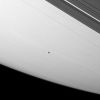
Janus-PIA08951.jpgFloating Janus55 visiteCaption NASA:"Janus floats above the meandering clouds of Saturn and a few of the large craters on the moon are just visible.
This view looks toward the unilluminated side of the Rings from about 18° above the Ring-Plane. Saturn's narrow F-Ring and outer A-Ring are pictured in the upper right.
The image was taken in visible light with the Cassini spacecraft narrow-angle camera on April 13, 2007 at a distance of approx. 1,7 MKM (a little more than 1 MMs) from Janus.
Image scale is roughly 10 Km (about 6 miles) per pixel".MareKromium
|
|

Enceladus-PIA08954.jpgIcy Emanations...55 visiteCaption NASA:"Peeking over the crescent of Enceladus, the Cassini spacecraft views the towering plume of ice particles erupting from the moon's South Polar Region.
Multiple components of the overall plume are visible in this view of Enceladus.
The image was taken in visible light with the Cassini spacecraft narrow-angle camera on April 24, 2007 at a distance of approx. 188.000 Km (such as about 117.000 miles) from Enceladus and at a Sun-Enceladus-spacecraft, or phase, angle of 153°.
Image scale is roughly 1 Km (about 0,6 miles) per pixel".MareKromium
|
|

Mimas-N00084762.jpgMimas: the "Egg-like Moon"55 visiteMimas ID:"Mimas is made primarily of water-ice. Its surface is heavily cratered, indicating that its impact features may date back to the time of the moon's creation.
One of the craters, named Herschel, is surprisingly large - nearly one-third the moon's entire diameter. Herschel is 10 Km (about 6 miles) deep, with a central mountain that rises 6 Km (about 3,7 miles) above the crater floor.
Traces of fracture marks can be seen on the opposite side of Mimas.
Mimas was discovered in 1789 by William Herschel; its mean distance from Saturn is approximately equal to 185.520 Km (such as about 115.277 miles); its mass is: 3.81 x 10¹⁹ Kg (such as 8.3 x 10¹⁹ lbs) and its dimensions are: 418 x 392 x 383 Km (260 x 244 x 238 miles)".
Period of Orbit around Saturn: 22.6 hoursMareKromium
|
|

The_Rings-IMG002648-0.jpgTransient Event(s) in the "F-Ring"? (context image)55 visiteCaption NASA:"The Cassini spacecraft spies an intriguing bright clump in Saturn's "F-Ring".
Also of interest is the dark gash that appears to cut through the Ring immediately below the clump. Scientists continue to monitor this ring for small, transient clumps of material, as well as the effects of the shepherd moon Prometheus.
This view looks toward the unilluminated side of the Rings from about 28° above the Ring-Plane.
The image was taken in visible light with the Cassini spacecraft narrow-angle camera on May 5, 2007 at a distance of approx. 2.1 MKM (about 1,3 MMs) from Saturn. Image scale is roughly 12 Km (about 8 miles) per pixel".
Nota: dopo aver effettuato una modesta analisi di questo frame in rapporto ad altri frames CASSINI i quali pure ci appaiono rappresentativi di quei fenomeni che la NASA chiama "clumps" (---> masse/grumi di materiale), la nostra sensazione è che la particolare (o meglio: eccezionale!) luminosità del "clump" ora in oggetto (anche iuna volta messa in correlazione con la striscia scura che vedete sulla sua Dx - striscia che costituisce un chiarissimo segnale del passaggio di qualcosa attraverso i filamenti di materiale che compongono l'Anello "F") potrebbe essere dovuta al verificarsi di una collisione occorsa all'interno dell'Anello "F" stesso, la quale è stata casualmente inquadrata da una delle fotocamere della Sonda.
Non pensiamo, quindi, nè ad un image-artifact da sovrasaturazione del frame, nè al possesso di particolari qualità e/o caratteristiche chimico/fisiche da parte del "clump" in oggetto. MareKromium
|
|
| 2245 immagini su 188 pagina(e) |
 |
|
|
|
|
136 | |
|
|
|
|





