| Piú viste - Saturn: the "Ringed Beauty" and His Moons |

The_Rings-IMG002648-0.jpgTransient Event(s) in the "F-Ring"? (context image)55 visiteCaption NASA:"The Cassini spacecraft spies an intriguing bright clump in Saturn's "F-Ring".
Also of interest is the dark gash that appears to cut through the Ring immediately below the clump. Scientists continue to monitor this ring for small, transient clumps of material, as well as the effects of the shepherd moon Prometheus.
This view looks toward the unilluminated side of the Rings from about 28° above the Ring-Plane.
The image was taken in visible light with the Cassini spacecraft narrow-angle camera on May 5, 2007 at a distance of approx. 2.1 MKM (about 1,3 MMs) from Saturn. Image scale is roughly 12 Km (about 8 miles) per pixel".
Nota: dopo aver effettuato una modesta analisi di questo frame in rapporto ad altri frames CASSINI i quali pure ci appaiono rappresentativi di quei fenomeni che la NASA chiama "clumps" (---> masse/grumi di materiale), la nostra sensazione è che la particolare (o meglio: eccezionale!) luminosità del "clump" ora in oggetto (anche iuna volta messa in correlazione con la striscia scura che vedete sulla sua Dx - striscia che costituisce un chiarissimo segnale del passaggio di qualcosa attraverso i filamenti di materiale che compongono l'Anello "F") potrebbe essere dovuta al verificarsi di una collisione occorsa all'interno dell'Anello "F" stesso, la quale è stata casualmente inquadrata da una delle fotocamere della Sonda.
Non pensiamo, quindi, nè ad un image-artifact da sovrasaturazione del frame, nè al possesso di particolari qualità e/o caratteristiche chimico/fisiche da parte del "clump" in oggetto. MareKromium
|
|

Tethys-W00030271.jpgTethys in the Saturn-shine (natural colors - elab. Lunexit)55 visitenessun commentoMareKromium
|
|

Tethys-N00085204.jpgTethys' surface, in the Saturn-shine (1 - natural colors - elab. Lunexit)55 visiteCaption NASA:"N00085204.jpg was taken on June 27, 2007 and received on Earth June 28, 2007. The camera was pointing toward Tethys that, at the time, was approx. 15.851 Km away. The image was taken using the CL1 and CL2 filters.
This image has not been validated or calibrated".MareKromium
|
|

Enceladus-N00085255.jpgEnceladus (1) - (natural colors - elab. Lunexit)55 visiteCaption NASA:"N00085255.jpg was taken on June 28, 2007 and received on Earth June 29, 2007. The camera was pointing toward Enceladus that, at the time, was approx. 287.050 Km away. The image was taken using the CL1 and CL2 filters.
This image has not been validated or calibrated".MareKromium
|
|

Tethys-PIA08974-1.jpgTethys (natural colors - elab. Lunexit)55 visiteCaption NASA:"Ithaca Chasma rips across Tethys from North to South near the center of this view. The moon's western limb is flattened, indicating the rim of the giant impact basin Odysseus.
The dark, East-West trending band often observed in this region (see PIA07571) is just visible here, but its contrast is reversed at these short, ultraviolet wavelengths -- it is bright against the already bright terrain.
North on Tethys (1071 Km, or about 665 miles across) is up and rotated 24° to the left. This view looks toward the moon's Saturn-Facing Hemisphere.
The image was taken with the Cassini spacecraft narrow-angle camera on May 27, 2007 using a combination of spectral filters sensitive to wavelengths of light centered at 298 and 338 nanometers. The view was obtained at a distance of approx. 267.000 Km (about 166.000 miles) from Tethys and at a Sun-Tethys-spacecraft, or phase, angle of 13°.
Image scale is roughly 2 Km (5.236 feet) per pixel".MareKromium
|
|
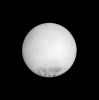
Enceladus-PIA08980.jpgThe South Polar "sulci" of Enceladus55 visiteCaption NASA:"Enceladus appears as a rather bland orb in this far-off snapshot, but the dark markings near its South Pole belie that assumption.
The markings, called "sulci", are long, roughly parallel fractures from which a spray of icy particles escapes into the void, forming Saturn's E-Ring.
This view looks toward the Saturn-facing Hemisphere on Enceladus. North is up.
The image was taken with the Cassini spacecraft narrow-angle camera on May 27, 2007 using a spectral filter sensitive to wavelengths of infrared light centered at 930 nanometers.
The view was acquired at a distance of approx. 615.000 Km (such as about 382.000 miles) from Enceladus and at a Sun-Enceladus-spacecraft, or phase, angle of 3°.
Image scale is roughly 4 Km (a little more than 2 miles) per pixel".MareKromium
|
|

Helene-N00086688.jpgJust like Phobos: Helene (2)55 visitenessun commentoMareKromium
|
|

Helene-N00086687.jpgJust like Phobos: Helene (1)55 visitenessun commentoMareKromium
|
|

Helene-N00086698.jpgJust like Phobos: Helene (4)55 visitenessun commentoMareKromium
|
|

Helene-N00086694.jpgJust like Phobos: Helene (3)55 visitenessun commentoMareKromium
|
|

Dione-N00086773.jpgCrossing the Rings (2)55 visiteCaption NASA:"N00086773.jpg was taken on July 22, 2007 and received on Earth July 23, 2007. The camera was pointing toward DIONE that, at the time, was approx. 710.911 Km away.
The image was taken using the CL1 and GRN filters and it has not been validated or calibrated".MareKromium
|
|

Enceladus-N00086994.jpgSpace Encounter: Enceladus and Tethys (3)55 visitenessun commentoMareKromium
|
|
| 2245 immagini su 188 pagina(e) |
 |
|
|
|
|
131 | |
|
|
|
|





