| Piú viste - Saturn: the "Ringed Beauty" and His Moons |

Daphnis-PIA07809-1.jpgDaphnis and Keeler (context image)55 visiteCaption NASA originale:"Daphnis, the tiny moon that inhabits the Keeler Gap in the outer edge of Saturn's A-Ring, is captured here in remarkable detail with its entourage of waves.
The edge waves are especially bright in places where Ring material piles up, a characteristic that has been seen in computer simulations of the interactions between gap-embedded moons and the surrounding ring particles.
The 7 Km-wide (about 4,3 mile) moon appears to have an unusual shape in this image. It is not simply a bright dot, but instead exhibits a dimmer component immediately to its left. Though it is far from certain, this component may be Ring material caught in the act of accreting onto Daphnis, a process currently being studied by imaging scientists.
The image was taken in visible light with the Cassini spacecraft narrow-angle camera on Sept. 9, 2006, at a distance of approx. 422.000 Km (such as about 262.000 miles) from Saturn. Image scale is roughly 2 Km (a little more than 1 mile) per pixel".
|
|

Saturn-W00018094.jpgOverexposed F-Ring, a few Stars and some Image-Artifacts55 visitenessun commento
|
|
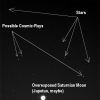
Saturn-W00017983.jpgWhat do these images show? (1)55 visitenessun commento
|
|
Earth-PIA08324-2.jpgEarth, from Saturn's Space (2)55 visiteThis magnified view of the image taken through the clear filter (monochrome) shows the Moon as a dim protrusion to the upper left of Earth. Seen from the Outer Solar System through Cassini's cameras, the entire expanse of direct human experience, so far, is nothing more than a few pixels across. Earth no longer holds the distinction of being our Solar System's only "water world", as several other bodies suggest the possibility that they too harbor liquid water beneath their surfaces. The Saturnian moon, Enceladus, is among them, and is also captured on the left in this image, with its plume of water ice particles and swathed in the blue E-Ring which it creates. Delicate fingers of material extend from the active moon into the E-Ring. The narrow and tenuous G-Ring and the Main Rings are seen at the right. The view looks down from about 15° above the un-illuminated side of the Rings.
Images taken using red, green and blue spectral filters were combined to create this view. The image was taken by the Cassini spacecraft wide-angle camera on Sept. 15, 2006, at a distance of approx. 2,1 MKM (about 1,3 MMs) from Saturn and at a sun-Saturn-spacecraft angle of almost 179°.
Image scale is roughly 129 Km (about 80 miles) per pixel.
At this time, Cassini was nearly 1,5 BKM (about 930 MMs) from Earth.
|
|

Saturn-W00018153.jpgSunshine on Saturn...55 visitenessun commento
|
|

Saturn-W00018136.jpgFrom "A" to "E"!55 visitenessun commento
|
|

Janus-N00066626.jpgMoments of "Janus" (1)55 visitenessun commento
|
|

Janus-N00066645.jpgMoments of "Janus" (3)55 visitenessun commento
|
|
Enceladus-PIA08276.jpgEnceladus55 visiteCaption NASA originale:"Cassini spies the wrinkled, fractured and remarkably crater-poor terrain of Enceladus. Scientists are working to understand what causes the moon's surprising geologic activity (see also PIA07759).
North on Enceladus is up and rotated 20° to the left.
The image was taken in visible light with the Cassini spacecraft narrow-angle camera on Sept. 8, 2006 at a distance of approx. 560.000 Km (about 348.000 miles) from Enceladus and at a Sun-Enceladus-spacecraft, or phase, angle of 103°. Image scale is roughly 3 Km (a little less than 2 miles) per pixel".
|
|

The Rings-PIA08277.jpgThe "Encke Gap" in detail55 visiteCaption NASA:"Although the embedded moon Pan is nowhere to be seen, there is a bright clump-like feature visible here, within the Encke Division.
Also discernable are periodic brightness variations along the outer (right side) gap edge. (...)
The view looks toward the sunlit side of the rings from about 17° below the Ring-Plane.
The image was taken in visible light with the Cassini spacecraft narrow-angle camera on Sept. 9, 2006 at a distance of approx. 421.000 Km (about 261.000 miles) from Saturn. Image scale on the sky at the distance of Saturn is roughly 2 Km (1,4 miles) per pixel".
|
|

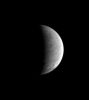
Mimas-PIA08278.jpgHerschel Crater on Mimas55 visiteCaption NASA:"The great basin that interrupts the contours of this moon's crescent identifies the satellite unmistakably as Mimas. The giant crater Herschel (about 130 Km, or 80 miles wide) is this moon's most obvious feature.
North on Mimas (approx. 397 Km, or 247 miles, across) is up and rotated 23° to the left.
The image was taken in visible light with the Cassini spacecraft narrow-angle camera on Sept. 8, 2006 at a distance of approx. 534.000 Km (about 331.000 miles) from Mimas and at a Sun-Mimas-spacecraft, or phase, angle of 115°. Image scale is roughly 3 Km (about 1,9 miles) per pixel".
|
|
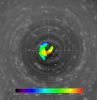
Saturn-PIA08334.jpgThe temperature of Saturn's "Stormy" South Pole55 visiteThe Cassini data presented in this view appear to confirm a region of warm atmospheric descent into the eye of a hurricane-like storm locked to Saturn's south pole. The view shows temperature data from the Cassini spacecraft composite infrared spectrometer overlaid onto an image from the imaging science subsystem wide-angle camera.
The composite infrared spectrometer data refer to a depth in Saturn's upper stratosphere where the pressure is 0.5 millibars (324 kilometers above the 1-bar level), a region higher than that imaged by the imaging camera and visual and infrared spectrometer during the same observation period. The composite infrared spectrometer data show a very small hot spot over the pole, similar in size to the "eye" of the storm seen in the imaging science subsystem images. See also Looking Saturn in the Eye and Saturn's Surprisingly Stormy South for related images.
The color scale at the bottom indicates the temperature in Kelvin corresponding to the colors of the temperature map. Numbers on the grid correspond to lines of latitude and longitude on the planet.
Infrared images taken through the Keck I telescope by ground-based observers had previously shown the south polar spot to be warm. Cassini's composite infrared spectrometer has confirmed this with higher resolution temperature maps of the area (like the map displayed here) and sees a temperature increase of about 2 Kelvin (4 degrees Fahrenheit) at the pole.
The temperatures are in the stratosphere and higher up than the clouds seen by the Cassini imaging and visual and infrared mapping spectrometer instruments, but they suggest that the atmosphere sinks over the south pole. Because the pressure increases with depth, the descending atmosphere compresses and heats up. The warmer temperatures over the south pole also indicate that the vortex winds are decaying with height in the stratosphere. The descent implied by the temperatures nicely supports the lower cloud altitudes observed by the imaging camera and visual and infrared spectrometer instruments at the pole.
The image and atmospheric data were acquired on Oct. 11, 2006, when Cassini was approximately 340,000 kilometers (210,000 miles) from Saturn. The wide-angle camera image was taken using a spectral filter sensitive to wavelengths of infrared light centered at 752 nanometers. The image has been contrast enhanced using digital image processing techniques. The unprocessed image shows an oblique view toward the pole, and was reprojected to show the planet from a perspective directly over the south pole. Scale in the original image was about 17 kilometers (11 miles) per pixel.
|
|
| 2245 immagini su 188 pagina(e) |
 |
|
|
|
|
128 | |
|
|
|
|





