| Piú viste - Saturn: the "Ringed Beauty" and His Moons |

Enceladus-PIA11120.jpgEnceladus Oct. 9, 2008 Flyby56 visiteCaption NASA:"This image was taken with the Cassini Spacecraft narrow-angle camera on Oct. 9, 2008, from a distance of approx. 26.000 Km (16,000 miles) from Enceladus. Image scale is 312 meters (1024 feet) per pixel".MareKromium
|
|

Enceladus-PIA11119.jpgEnceladus Oct. 9, 2008 Flyby56 visiteCaption NASA:"This image was taken during Cassini's extremely close encounter with Enceladus on Oct. 9, 2008.
The image was taken with the Cassini Spacecraft narrow-angle camera on Oct. 9, 2008, a distance of approx. 40.000 Km (such as about 25.000 miles) from Enceladus.
Image scale is approx. 477 meters (1566 feet) per pixel". MareKromium
|
|

The_Rings-AtoG-PIA10505.jpgThe Rings (natural colors; credits: Lunexit)56 visitenessun commentoMareKromium
|
|
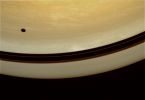
Saturn-PIA10512.jpgLonely Shadow... (possible True Colors; credits: Lunexit)56 visiteCaption NASA:"The shadow of Tethys drifts across the face of Saturn. Nearby, shadows of the Planet's Rings form a darkened band above the Equator. This view looks toward Saturn from a vantage point 63° North of the Equator.
The image was taken in visible green light with the Cassini Spacecraft wide-angle camera on Oct. 1, 2008. The view was acquired at a distance of approx 615.000 Km (about 382000 miles) from Saturn.
Image scale is roughly 37 Km (approx. 23 miles) per pixel".MareKromium
|
|
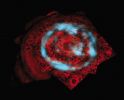
Saturn-PIA11396.jpgSouth Polar Aurora on Saturn56 visiteCaption NASA:"This image of the North Polar Regions of Saturn shows both the Aurora and underlying Atmosphere, seen at 2 different wavelengths of IR light as captured by NASA's Cassini spacecraft.
Energetic particles, crashing into the Upper Atmosphere cause the Aurora, shown in blue, to glow brightly at 4 microns (six times the wavelength visible to the human eye). The image shows both a bright ring, as seen from Earth, as well as an example of bright Auroral Emission within the Polar Cap that had been undetected until the advent of Cassini.
This Aurora, which defies past predictions of what was expected, has been observed to grow even brighter than is shown here. Silhouetted by the glow (cast here to the color red) of the hot interior of Saturn (clearly seen at a wavelength of 5 microns, or seven times the wavelength visible to the human eye) are the clouds and haze that underlie this Auroral Region. For a similar view of the Region beneath the Aurora see PIA09185.
This image is a composite captured with Cassini's Visual and Infrared Mapping Spectrometer. The aurora image was taken in the near-infrared on Nov. 10, 2006, from a distance of about 1 MKM (such as about 659.000 miles), with a phase angle of 157° and a sub-Spacecraft Planetocentric Latitude of 52° North.
The image of the clouds was obtained by Cassini on June 15, 2008, from a distance of approx. 602.000 Km (such as about 374.000 miles) and a sub-Spacecraft Planetocentric Latitude of 73° North".MareKromium
|
|
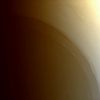
Saturn-PIA10513.jpgThe South Pole of Saturn (natural colors; credits: Lunexit)56 visiteCaption NASA:"Long streamers of cloud encircle the South Polar Region of Saturn. Farther poleward, or toward lower left, faint, deeper atmospheric structures lurk beneath the haze.
This image was acquired from a vantage point 74° South of the Planet's equator.
The view was taken with the Cassini spacecraft wide-angle camera on Oct. 2, 2008 using a spectral filter sensitive to wavelengths of IR light centered at 728 nanometers. The view was obtained at a distance of approx. 369.000 Km (such as about 229.000 miles) from Saturn.
Image scale is roughly 19 Km (about 12 miles) per pixel".MareKromium
|
|

Mimas-N00121934-3D-MF.jpgMimas and the Rings (Hi-Def-3D; credits and Copyright: Dr M. Faccin and Lunar Explorer Italia)56 visitenessun commentoMareKromium
|
|

Helene-N00123958.jpgHelene56 visiteHelene is one of the named Minor Moons of Saturn. Also known as Saturn XII (or S12), Helene is an irregularly shaped (---> nonspherical) body measuring about 22 miles (such approx. 36 Km), by about 20 miles (approx. 32 Km), by about 18 miles (approx. 30 Km).
Helene orbits Saturn at a mean distance of about 234.500 miles (approx. 377.400 Km) and has an Orbital Period of 2,7369 Earth Days — the Rotational Period is unknown but is assumed to be the same as the Orbital Period (meaning that Helene shall always show the same side to Saturn - just like the Moon does to Earth).
Helene was discovered by French astronomers P. Laques and J. Lecacheaux in 1980 during ground-based observations of Saturn.
Another moon, Dione, is co-orbital with Helene: that is, Helene orbits Saturn at the same distance as Dione but precedes Dione by about 60°.
Before the present name was adopted, the moon was referred to as "Dione-B" or also "Electra".MareKromium
|
|

Enceladus-00063371.jpgHiding behind the Rings... (3D - credits: Dr M. Faccin)56 visitenessun commentoMareKromium
|
|

Helene-N00124458.jpgHelene and a "Bright Companion" (possible True Colors; credits: Lunar Explorer Italia)56 visiteCaption NASA:"N00124458.jpg was taken on November 24, 2008 and received on Earth November 25, 2008. The camera was pointing toward HELENE that, at the time, was approx. 68.171 Km away.
The image was taken using the CL1 and CL2 filters".
Nota Lunexit: Helene è senza dubbio affascinante, con il suo colore rosso-arancio (tipico di tanti Corpi Celesti Minori e, in questo caso, anche esaltato dalla luce rosa-salmone che deriva dal Gigante Saturno), ma noi Vi invitiamo a considerare il puntino luminoso che viene inquadrato dalla freccia. Ebbene, a nostro avviso NON si tratta di un image-artifact e non dovrebbe essere una stella che splende sullo sfondo (la quale sarebbe dovuta sparire, letteralmente ingoiata - tecn. "washed away" - dalla stessa luminostà di Helene).
Che cosa sarà mai? La nostra ipotesi è: forse (e ribadiamo FORSE!) si potrebbe trattare di un altro - minuscolo - Corpo Roccioso, non troppo distante da Helene.
Forse una "luna" di Helene stessa (un fenomeno decisamente raro, ma non impossibile: ricordate l'asteroide Ida ed il suo piccolissimo compagno Dactyl? Beh, questo potrebbe essere un fenomeno analogo...).MareKromium
|
|

EncelalusPIA11137.jpgRelict Tiger Stripe56 visitenessun commentoMareKromium
|
|

The_Rings-Shadow-N00127581.jpgEclipsing the Rings (2)56 visitenessun commentoMareKromium
|
|
| 2245 immagini su 188 pagina(e) |
 |
|
|
|
|
126 | |
|
|
|
|





