| Piú viste - Saturn: the "Ringed Beauty" and His Moons |
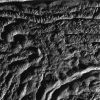
Enceladus-PIA11109.jpgCairo Sulcus56 visiteCaption NASA:"This image is the 4th skeet-shoot footprint taken during Cassini's very close flyby of Enceladus on Aug. 11, 2008. Cairo Sulcus is shown crossing the upper left portion of the image. An unnamed fracture curves around the lower right corner.
The image was taken with the Cassini Spacecraft narrow-angle camera on Aug. 11, 2008, a distance of approx. 3027 Km (such as about 1881 miles) above the surface of Enceladus.
Image scale is approximately 20 meters (66 feet) per pixel". MareKromium
|
|

PHOEBE-PIA06064_modest.jpgPhoebe (Extremely Ehnanced and Saturated Natural Colors; credits: Lunexit Team)56 visitenessun commentoMareKromium
|
|
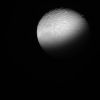
Rhea-N00118975.jpgRhea's Eclipse56 visiteCaption NASA:"N00118981.jpg was taken on August 19, 2008 and received on Earth August 21, 2008. The camera was pointing toward RHEA that, at the time, was approx. 455.227 Km away; the image was taken using the CL1 and CL2 filters. This image has not been validated or calibrated".MareKromium
|
|

Rhea-PIA10464.jpgSouthern View of Rhea56 visiteCaption NASA:"Rhea's bright ray crater features prominently in this southern view. The feature is surrounded by bright ejecta — material thrown outward by the impact that formed the crater.
The view looks toward High Southern Latitudes on Rhea from a perspective 49 degrees below the icy moon's Equator. Rhea's South Pole is at bottom center.
The image was taken in visible green light with the Cassini Spacecraft narrow-angle camera on July 29, 2008. The view was acquired at a distance of approx. 413,000 Km (such as about 257.000 miles) from Rhea and at a Sun-Rhea-Spacecraft, or Phase, Angle of 44°.
Image scale is roughly 2 Km (a little more than 1 mile) per pixel".MareKromium
|
|

Dione-N00119793.jpgCross-Worlds! (9)56 visitenessun commentoMareKromium
|
|

Dione-N00119790.jpgCross-Worlds! (6)56 visitenessun commentoMareKromium
|
|

SaturnSpace-N00115343-N00115349.gifThrough the "Eyes" of Cassini... (GIF-Movie; credits: Dr G. Barca)56 visiteSuggestivo, affascinante e, alla fine - semplicemente -, bello!MareKromium
|
|
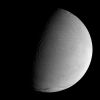
Enceladus-PIA10483.jpgThe Leading Hemisphere of Enceladus56 visiteCaption NASA:"During a distant flyby encounter with Enceladus, Cassini imaged the moon's wrinkled Leading Hemisphere.
At the scale visible here, this region of the surface is generally devoid of impact craters, suggesting that the terrain has been modified and renewed during the moon's history.
To the North lies a heavily cratered and presumably older Region. The sinuous boundary of the geologically active South Polar Region is seen at bottom. North on Enceladus is toward the top of the image.
The image was taken in visible green light with the Cassini Spacecraft narrow-angle camera on Sept. 30, 2007. The view was acquired at a distance of approx. 108.000 Km (such as about 67.000 miles) from Enceladus and at a Sun-Enceladus-Spacecraft, or phase, angle of 75°.
Image scale is 644 meters (2111 feet) per pixel".MareKromium
|
|
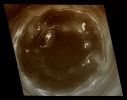
Saturn-SP-PIA11104.jpgSouthern Turbulence (False Colors; credits: Lunexit)56 visiteCaption NASA:"This detailed Cassini view of the monstrous vortex at Saturn's South Pole provides valuable insight about the mechanisms that power the Planet's Atmosphere.
This view is 10 times more detailed than any previous image of the Polar Vortex. See PIA11103 for a more oblique, wide-angle view that provides context for this close-up.
Previous images revealed an outer ring of high clouds surrounding a Region previously thought to be mostly clear air interspersed with a few puffy clouds that circulate around the center. This new image shows that what looked like puffy clouds at lower resolution are actually vigorous convective storms that form yet another distinct, inner ring. In other words, they are deep convective structures seen through the atmospheric haze. One of the deeper structures (at the 10 o'clock position) has punched through to a higher altitude and created its own little vortex. The ring is similar to the eyewall of a terrestrial hurricane, but much larger. The clear air there is warm, like the eye of a terrestrial hurricane, but on Saturn it is locked to the pole, whereas a terrestrial hurricane drifts around.
Convective structures are small regions of intense upwelling air, but the clear air of the vortex eye indicates that this is generally an area of downwelling. Convection is an important part of the planet's energy budget because the warm upwelling air carries heat from the interior. In a terrestrial hurricane, the convection occurs in the eyewall. Here it seems to occur in the eye as well. The camera filter used for this image captures light at wavelengths where atmospheric gases like Methane are fairly transparent, allowing for detailed views of deep cloud features. Other filters (see PIA09859) use light that is strongly absorbed by Methane gas; the light bounces off the high clouds, making them visible, but gets absorbed before it reaches the low clouds. Such "Methane-Band" images of the South Polar Vortex reveal that the convective clouds do not reach up to the base of the stratosphere, as convective clouds on Earth do. This view was acquired from 56° below the Ring-Plane. The image has been digitally reprojected to show the scene as it would appear to an observer positioned directly above the Pole.
The image was taken with the Cassini Spacecraft narrow-angle camera on July 14, 2008, using a combination of two spectral filters sensitive to wavelengths of polarized visible light centered at 617 and infrared light centered at 750 nanometers. The view was obtained at a distance of approx. 392.000 Km (243.000 miles) from Saturn and at a Sun-Saturn-Spacecraft, or Phase, Angle of 60°.
Image scale is roughly 2 Km (a little more than 1 mile) per pixel".MareKromium
|
|

Dione-PIA10496.jpgThe Bright Canyons of Dione56 visiteCaption NASA:"Dione's defining feature, the fractures on its Trailing Side, shine brilliantly in this Cassini Spacecraft view.
The view was acquired from a position 33° South of the moon's Equator. Lit terrain seen here is on the Trailing Side of Dione (approx. 1123 Km, or about 698 miles across). North is up and rotated 8° to the right.
The image was taken in visible light with the Cassini spacecraft narrow-angle camera on Sept. 11, 2008. The view was obtained at a distance of approximately 833,000 kilometers (517,000 miles) from Dione and at a Phase Angle of 67°. Image scale is about 5 Km (a little more than 3 miles) per pixel.
The image was taken with the Cassini Spacecraft wide-angle camera on Aug. 26, 2008 using a spectral filter sensitive to wavelengths of infrared light centered at 752 nanometers.
The view was acquired at a distance of approx. 397.000 Km (about 246.000 miles) from Saturn.
Image scale is roughly 20 Km (about 13 miles) per pixel".MareKromium
|
|
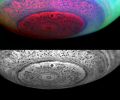
Saturn-SouthPole_cassini_big.jpgBeneath the South Pole of Saturn56 visiteCaption NASA:"What clouds lurk beneath Saturn's unusual South Pole?
To help find out, the robotic Cassini Spacecraft currently orbiting Saturn imaged the nether region of the gigantic ringed orb in infrared light.
There thick clouds appear dark as they mask much of the Infrared Light emitted from warmer regions below, while relatively thin clouds appear much lighter. Bands of clouds circle Saturn at several latitudes, while dark ovals indicate many dark swirling storm systems. Surprisingly, a haze of upper level clouds visible towards Saturn's Equator disappears near the Pole, including over Saturn's strange Polar Vortex.
Cassini entered orbit around Saturn in 2004, and recorded the above image last year (2007)". MareKromium
|
|

Dione-PIA10500.jpgCross-Worlds: the Answer!56 visiteRicordate la sequenza (intitolata, appunto, Cross-Worlds) che pubblicammo qualche settimana fa (era il 14 Settembre 2008, per l'esattezza) e che ci mostrava (ovviamente nell'ottica di CASSINI) Dione mentre eclissava un'altra Luna non identificata?
Noi ipotizzammo che si potesse trattare di Mimas o di Encelado. La NASA, oggi, tramite il suo Planetary Photojournal, ci ha risposto: si trattava di Encelado.
Un grazie alla NASA (che, quando vuole, sa anche rispondere) ed un 6+ a noi perchè, anche se non siamo riusciti ad identificare con sicurezza assoluta la seconda luna "misteriosa" in transito, siamo stati comunque abbastanza bravi dal ridurre la rosa dei "candidati" a due soli Corpi Celesti.
Insomma...Non male!MareKromium
|
|
| 2245 immagini su 188 pagina(e) |
 |
|
|
|
|
125 | |
|
|
|
|





