| |

| Piú viste - Saturn: the "Ringed Beauty" and His Moons |
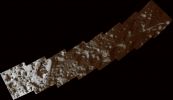
Japetus-PIA08380.jpgThe "Transition Region of Japetus" (possible natural colors - elab. Lunexit)56 visiteSoaring above the alien, icy wastelands of Saturn's moon Japetus, NASA's Cassini spacecraft captured a series of HR images of the Transition Region from dark to bright terrain at Southern Middle Latitudes that have been mosaicked together in this view.
An important characteristic of the terrain in the boundary region is that the isolated bright patches are mainly found on slopes facing toward the bright Trailing Hemisphere or toward the South Pole. The same polarity is found within the bright terrain, where the dark material can be seen at the bottom of craters and on Equator-facing slopes. These indicate that thermal effects are at play in painting the surface of Japetus.
The mosaic consists of 8 image footprints across the surface of Japetus. The view is centered on terrain near 38,6° South Latitude, 171,3° West Longitude. Image scale is approx. 52 meters (171 feet) per pixel.
The clear spectral filter images in this mosaic were obtained with the Cassini spacecraft narrow- angle camera on Sept. 10, 2007, at a distance of approx. 5,000 Km (about 3.100 miles) from Japetus.
MareKromium
|
|

Japetus-N00091967-1.jpgImage-Artifact or a New Tower on Japetus?56 visiteUn nuovo e bellissimo esempio di quanto sia importante avere degli Amici Lettori i quali non si limitano a "guardare", ma che "cercano": in questo frame CASSINI, infatti, il bravissimo Antonio Fedele ha individuato due dettagli sui quali ha chiesto il nostro parere. Ebbene, se il dettaglio visibile sulla Dx del frame è, a nostro avviso, la traccia di un semplice Raggio Cosmico, il dettaglio di Sx è MOLTO più intrigante!
Osservate bene: nel frame originale NASA in b/n, la carenza di contrasto e la scarsa raffinazione del frame non permettevano grandi osservazioni; ma nel frame risultante da nostro coloring ed additional processing, il Sig. Fedele ha visto qualcosa che a noi era completamente sfuggita: ha visto un qualcosa che sembra essere una sorta di "Torre". Noi, allora, abbiamo ripreso il frame originale e tentato una verifica: ebbene la "Torre" non è il prodotto del nostro additional processing: essa, infatti, era già (sia pure solo appena) visibile nel frame di partenza.
Che cos'è? E' il Secondo Monolito di Giapeto (il primo venne individuato, ci pare, dal Prof. Hoagland, qualche anno fa)?
E' una Struttura Colonnare affine alle Blair Cuspids? E' qualcosa di simile al Monolito di Phobos? O forse è una Struttura Effimera o, magari, solo un image-artifact?
A noi non sembra un image-artifact (anche se non possiamo escluderlo al 100%). Poi, per quanto attiene la natura di questo (se reale) incredibile rilievo Giapetiano, non ci sentiamo di esprimerci: abbiate pazienza, ma gli elementi che abbiamo sono davvero troppo pochi e l'immagine, in sè, non è sufficiente per risolvere i nostri dubbi.
Un GRANDE complimento al Sig. Fedele e, per il resto, provate Voi stessi a guardare, analizzare e speculare...Se volete. Noi siamo qui, per condividere e commentare le Vostre (eventuali) scoperte!MareKromium
|
|
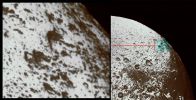
Japetus-SquaredTerrain.jpgSquares on Japetus?56 visiteUno splendido, inquietante ed...illusorio profilo individuato dal sempre bravissimo Marco Faccin. Strutture squadrate su Giapeto? Evidenze di "artificialità"?...
Ovviamente no: questo frame (e relativo detail mgnf) rappresentano solo un modo per vedere - e per far vedere! - come, volendo, si possono trovare "strutture regolari" su altri Corpi Celesti.
Illusioni determinate dalla distanza, dall'angolo di ripresa, dalla qualità del frame e dalla voglia di vedere "segni tangibili di intelligenza (passata o presente) altrove": trovare queste strutture (che appartengono alla Classe delle Strutture "Effimere") è un gioco; evidenziarle è una curiosità; spiegarle per quello che sono (senza costruirci sopra delle eso-archeo-baggianate) è, secondo noi, un dovere.
Un grazie di cuore (ed un grande BRAVO!) al Dr Faccin per aver individuato un dettaglio (comunque) intrigante e per lo spunto di riflessione che, con esso, ci ha voluto dare.MareKromium
|
|
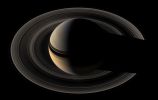
Saturn-PIA08388.jpgLooking at the Giant56 visiteSaturn sits nested in its rings of ice as Cassini once again plunges toward the graceful giant. This natural color mosaic was acquired by the Cassini spacecraft as it soared 39° above the unilluminated side of the Rings.
Little light makes its way through the Rings to be scattered in Cassini's direction in this viewing geometry, making the Rings appear somewhat dark compared to the reflective Planet. The view can be contrasted with earlier mosaics designed to showcase the Rings rather than the Planet, which were therefore given longer exposure times.
Bright clouds play in the blue-gray skies of the North. The Ring shadows continue to caress the Planet as they slide farther South toward their momentary disappearance during Equinox in 2009.
The Rings' reflected light illuminates the Southern Hemisphere on Saturn's night side.
The scene is reminiscent of the parting glance of NASA's Voyager 1 as it said goodbye to Saturn in 1981 (see PIA00335). Cassini, however, will continue to orbit Saturn for many years to come.
Three of Saturn's moons are visible in this image: Mimas (about 397 Km across) at the 2 o'clock position, Janus (about 181 Km across) at the 4 o'clock position and Pandora (about 84 Km across) at the 8 o'clock position. Pandora is a faint speck just outside the narrow F-Ring.
This mosaic was constructed from wide-angle camera images taken just before the narrow-angle camera mosaic PIA08389.
The view combines 45 images -- 15 separate sets of red, green and blue images -- taken over the course of about two hours, as Cassini scanned across the entire Main Ring System.
The images in this view were obtained on May 9, 2007, at a distance of approx. 1,1 MKM (about 700.000 miles) from Saturn.
Image scale is about 62 Km (approx. 39 miles) per pixel. MareKromium
|
|

Tethys-PIA08400.jpgOdysseus is looking up!56 visiteThe vast expanse of the crater Odysseus spreads out below Cassini in this mosaic view of Saturn's moon Tethys.
The crater (about 450 Km or approx. 280 miles across) is a remarkably well-preserved example of an ancient multi-ringed impact basin: the outer ring is defined by steep, cliff-like walls that descend to generally broad internal terraces. The inner ring is formed by a prominent, crown-shaped, 140-Km (88-mile) diameter circular band of icy mountains. Multi-ring basins are seen on rocky bodies as well as icy ones.
The complex internal structure and multi-ringed nature of these very large basins are believed to arise from the rebound of intense shock waves that penetrated the body at the time of impact.
This mosaic was assembled from four clear filter, narrow-angle camera images. The view is an orthographic projection centered on 3° South Latitude, 119° West Longitude and has a resolution of 572 meters (0,35 mile) per pixel. An orthographic view is most like the view seen by a distant observer looking through a telescope. North is up.
The view was obtained by the Cassini spacecraft on Aug. 30, 2007, from a distance of approximately 97.000 Km (about 60.000 miles) and at a Sun-Tethys-Spacecraft, or phase, angle of 51°.MareKromium
|
|
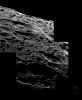
Japetus-PIA08403.jpgMiddle Northern Latitudes of Japetus56 visiteCassini soars above the many pits and basins in the rolling landscape of Saturn's moon Japetus. This mosaic view looks out onto an area close to the Northern bright/dark boundary, but still within the Dark Region, Cassini Regio.
Near upper left is a large crater with terraced walls, a mostly flat floor and a prominent group of peaks in its center. The sharp features make this likely one of the youngest craters in this area of Japetus. Cassini imaged another similarly flat-floored and relatively fresh crater during its Dec. 2004 Japetus flyby.
The mosaic consists of 3 image footprints across the surface of Japetus. The view is centered on terrain near 43,3° North Latitude, 138° West Longitude. Image scale is approx. 75 meters (246 feet) per pixel.
The clear spectral filter images in this mosaic were obtained with the Cassini spacecraft narrow-angle camera on Sept. 10, 2007, at a distance of approx. 13.500 Km (about 8.400 miles) from Japetus and at a Sun-Japetus-Spacecraft, or phase, angle of 139°.MareKromium
|
|
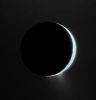
Enceladus-PIA09761.jpgThe "Fountains" of Enceladus (again)56 visiteCaption NASA:"With Enceladus nearly in front of the Sun from Cassini's viewpoint, its icy jets become clearly visible against the background.
The view here is roughly perpendicular to the direction of the linear "tiger stripe" fractures, or sulci, from which the jets emanate. The jets here provide the extra glow at the bottom of the moon. The general brightness of the sky around the moon is the diffuse glow of Saturn's E-Ring, which is an end product of the jets' material being spread into a "torus", or doughnut shape, around Saturn.
North on Enceladus is up and rotated 20° to the left.
The image was taken in visible light with the Cassini spacecraft narrow-angle camera on Sept. 30, 2007. The view was obtained at a distance of approx. 187.000 Km (such as about 116,000 miles) from Enceladus and at a Sun-Enceladus-spacecraft, or phase, angle of 157°.
Image scale is about 1 Km (apprx. 0,6 mile) per pixel".MareKromium
|
|
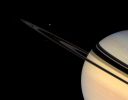
Saturn-PIA09776.jpgJust like the Solar System!56 visiteCaption NASA:"Saturn's icy satellites wheel about the colorful Giant Planet, while the Rings shine dimly in scattered sunlight. The Ringed Planet is, in many ways, a laboratory for investigating the history of our Solar System and how planets form around other stars. There are 4 moons visible in this view. Tethys (1071 Km, or 665 miles across), largest in the scene, is on the far side of the Ring-Plane. Mimas (397 Km, or 247 miles across), is the one on the near side of the Rings, below Tethys. Janus (181 Km, or 113 miles across), is left of the Rings' edge. Pandora (84 Km, or 52 miles across) is a speck below the Rings' edge, between Janus and Mimas. Mimas casts a shadow onto Saturn's bluish Northern Hemisphere.
This view looks toward the unilluminated side of the Rings from about 2° above the Ring-Plane. Images taken using red, green and blue spectral filters were combined to create this natural color view. The view was acquired with the Cassini spacecraft wide-angle camera on Oct. 30, 2007.
The view was taken at a distance of approx. 2,6 MKM (such as about 1,6 MMs) from Saturn.
Image scale is roughly 153 Km (about 95 miles) per pixel on the Planet".MareKromium
|
|

Dione-PIA09801.jpgWhite Scars...56 visiteCaption NASA:"The Cassini spacecraft catches a glimpse of the bright fractures that adorn the Trailing Side of icy Dione.
North on Dione (1126 kilometers, or about 700 miles across) is up.
The image was taken in visible light with the Cassini spacecraft narrow-angle camera on Nov. 18, 2007. The view was obtained at a distance of approx. 1 MKM (such as about 623.000 miles) from Dione and at a Sun-Dione-spacecraft, or phase, angle of 45°.
Image scale is roughly 6 Km (about 4 miles) per pixel".MareKromium
|
|

Dione-PIA09821.jpgDione (HR)56 visiteCaption NASA:"The Cassini spacecraft surveys the Southern Hemisphere on Dione's anti-Saturn side, spying a broad impact basin near bottom.
Most of the medium-sized craters visible here have pointed central peaks, owing to the rebound of material following the craters' initial formation.
(in this picture) North on Dione is up.
The image was taken in visible light with the Cassini spacecraft narrow-angle camera on Dec. 19, 2007. The view was obtained at a distance of approx. 240.000 Km (such as about 149.000 miles) from Dione and at a Sun-Dione-spacecraft, or phase, angle of 44°.
Image scale is roughly 1 Km (about 0,6 mile) per pixel".MareKromium
|
|
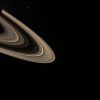
The_Rings-PIA09824.jpgThe Golden Rings of Saturn and some of His Moons... - (natural colors; credits: NASA)56 visiteCaption NASA:"A color portrait of Saturn's sunlight-scattering Rings hosts a group of several moons.
Enceladus (505 Km, or 314 miles across) is visible at top. At bottom, in increasing distance from the Rings, are Pandora (84 Km, or 52 miles across), Janus (181 Km, or 113 miles across) and Mimas (397 Km, or 247 miles across).
This view looks toward the unilluminated side of the Rings from about 10° above the Ring-Plane. Saturn's shadow can be seen on the Rings at upper left.
Images taken using red, green and blue spectral filters were combined to create this composite color view.
The images were taken with the Cassini spacecraft wide-angle camera on Dec. 22, 2007. The view was acquired at a distance of approx. 1,8 MKM (such as about 1,1 MMs) from Saturn. Image scale is about 110 Km (approx. 68 miles) per pixel". MareKromium
|
|
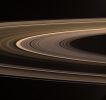
The_Rings-PIA09860.jpgRings Aglow (natural colors; credits: NASA)56 visiteCaption NASA:"Saturn's softly glowing Rings shine in scattered Sunlight. The B-Ring presents a remarkable difference in brightness between the near and far arms (bottom and top of the image, respectively). The strong variation in brightness could be due to the presence of wake-like features in the B-Ring.
This view looks toward the unilluminated side of the Rings from about 5° above the Ring-Plane. Images taken using red, green and blue spectral filters were combined to create this natural color view. The images were acquired at a distance of approx. 574.000 Km (about 357.000 miles) from Saturn.
At the center of the image, the Sun-Ring-Spacecraft Angle - or Phase Angle - is 114°, and the image scale is roughly 34 Km (about 21 miles) per pixel in the radial, or outward from Saturn, direction".
Nota Lunexit: ATTENZIONE! La NASA, riteniamo con questo frame, ha finalmente iniziato a fornire qualche dettaglio in più allorchè vengono comunicate al Pubblico delle info le quali, in sè, e laddove non adeguatamente precisate, finivano con il dire poco: si tratta del punto di riferimento del frame considerato per il calcolo dell'Angolo di Fase (che è il suo centro) e la direzione di riferimento del frame in ordine alla Scala pixel/Km. Non male, considerato che avevamo iniziato proprio noi, circa tre anni fa, a dare informazioni contestuali di supporto a svariati frames NASA-CASSINI (non queste info, comunque).MareKromium
|
|
| 2245 immagini su 188 pagina(e) |
|
|
|
|
|
123 | |
|
|
|
|
|
|





