| Piú viste - Saturn: the "Ringed Beauty" and His Moons |

Mimas-PIA08264.jpgMimas56 visiteCaption NASA originale:"Mimas plows along in its orbit, its pockmarked surface in crisp relief. The bright, steep walls of the enormous crater, Herschel (130 Km, or 80 miles wide), gleam in the Sunlight.
The lit terrain seen here is on the Leading Hemisphere of Mimas (about 397 Km, or 247 miles across). North is up.
The image was taken in visible light with the Cassini spacecraft narrow-angle camera on Aug. 16, 2006 at a distance of approx. 221.000 Km (about 137.000 miles) from Mimas and at a Sun-Mimas-spacecraft, or phase, angle of 80°.
The image scale is roughly 1 Km (about 0,6 mile) per pixel".
|
|

Saturn-PIA08734.jpgInner Warmth, Hidden Light...56 visiteCaption NASA originale:"This false-color image of Saturn shows Ring shadows running across the upper portion of the Planet, and sunlight illuminating the lower portion of the Planet.
The upper area, in the Ring shadow, would be black in visible light but glows red in infrared because Saturn is warm inside. This light shines out through the clouds, giving scientists a look at some of Saturn's interesting atmospheric structure.
This image was taken on June 30, 2006, with Cassini's VIMS. It was constructed from images taken at wavelengths of 0,91 microns (blue); 2,25 microns (green) and at 5,01 (red).
The distance from Cassini to Saturn's center in this image is aspprox. 335.000 Km (about 208.159 miles)".
|
|

Helene-PIA08269.jpgMoments of "Helene"56 visiteCaption NASA originale:"This set of images exposes details on small and crumpled-looking Helene. Large portions of this Trojan moon of Dione appear to have been blasted away by impacts.
Cassini passed within 50.000 Km (about 31,000 miles) of Helene (which is about 32 Km - or 20 miles across) on Aug. 17, 2006, when these images were acquired.
The views were obtained over the course of an hour and are presented here in reverse order (i.e.: the leftmost image was taken latest).
The images were taken in visible light with the Cassini spacecraft narrow-angle camera. As presented here, the views were acquired at distances ranging from about 62.000 to 51.000 Km (such as about 39.000 to 32.000 miles) from Helene and at a Sun-Helene-spacecraft, or phase, angle of 111 to 120°. Image scale is roughly 375 to 300 meters (approx. 1.230 to 984 feet) per pixel, from left to right".
|
|

Japetus-PIA08273.jpgDuotone Moon56 visiteCaption NASA originale:"The many impact scars borne by Japetus are made far more conspicuous in the Region of Transition from its dark Hemisphere to its bright one.
In this terrain, the dark material that coats Cassini Regio accentuates slopes and crater floors, creating a land of stark contrasts.
The image was taken in visible light with the Cassini spacecraft narrow-angle camera on Sept. 6, 2006 at a distance of approx. 2,2 MKM (about 1,4 MMs) from Japetus and at a Sun-Japetus-spacecraft, or phase, angle of 26°. Image scale is roughly 13 Km (about 8 miles) per pixel".
|
|

Janus-N00066626.jpgMoments of "Janus" (1)56 visitenessun commento
|
|

Janus-N00066645.jpgMoments of "Janus" (3)56 visitenessun commento
|
|
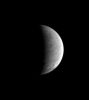
Enceladus-PIA08276.jpgEnceladus56 visiteCaption NASA originale:"Cassini spies the wrinkled, fractured and remarkably crater-poor terrain of Enceladus. Scientists are working to understand what causes the moon's surprising geologic activity (see also PIA07759).
North on Enceladus is up and rotated 20° to the left.
The image was taken in visible light with the Cassini spacecraft narrow-angle camera on Sept. 8, 2006 at a distance of approx. 560.000 Km (about 348.000 miles) from Enceladus and at a Sun-Enceladus-spacecraft, or phase, angle of 103°. Image scale is roughly 3 Km (a little less than 2 miles) per pixel".
|
|

The Rings-PIA08277.jpgThe "Encke Gap" in detail56 visiteCaption NASA:"Although the embedded moon Pan is nowhere to be seen, there is a bright clump-like feature visible here, within the Encke Division.
Also discernable are periodic brightness variations along the outer (right side) gap edge. (...)
The view looks toward the sunlit side of the rings from about 17° below the Ring-Plane.
The image was taken in visible light with the Cassini spacecraft narrow-angle camera on Sept. 9, 2006 at a distance of approx. 421.000 Km (about 261.000 miles) from Saturn. Image scale on the sky at the distance of Saturn is roughly 2 Km (1,4 miles) per pixel".
|
|

Mimas-PIA08278.jpgHerschel Crater on Mimas56 visiteCaption NASA:"The great basin that interrupts the contours of this moon's crescent identifies the satellite unmistakably as Mimas. The giant crater Herschel (about 130 Km, or 80 miles wide) is this moon's most obvious feature.
North on Mimas (approx. 397 Km, or 247 miles, across) is up and rotated 23° to the left.
The image was taken in visible light with the Cassini spacecraft narrow-angle camera on Sept. 8, 2006 at a distance of approx. 534.000 Km (about 331.000 miles) from Mimas and at a Sun-Mimas-spacecraft, or phase, angle of 115°. Image scale is roughly 3 Km (about 1,9 miles) per pixel".
|
|

Saturn-PIA08732.jpgThe clouds of Saturn56 visiteThis false-color mosaic of Saturn shows deep-level clouds silhouetted against Saturn's glowing interior. The image was made with data from Cassini's VIMS, which can image the Planet at 352 different wavelengths. This mosaic shows the entire Planet, including features like Saturn's Ring shadows and the Terminator, the boundary between day and night.
The data were obtained in February 2006 at a distance of 1,6 MKM (about 1 MMs) from directly over the plane of Saturn's Rings, which appear here as a thin, blue line over the equator. The image was constructed from images taken at wavelengths of 1,07 microns (blue), 2,71 microns (green) and 5,02 microns (red).
The blue-green color (lower right) is Sunlight scattered off clouds high in Saturn's atmosphere and the red color (upper left) is the glow of thermal radiation from Saturn's warm interior, easily seen on Saturn's night side (top left), within the shadow of the Rings and with somewhat less contrast on Saturn's day side (bottom right). The darker areas within Saturn show the strongest thermal radiation. The bright red color indicates areas where Saturn's atmosphere is relatively clear. The great variety of cloud shapes and sizes reveals a surprisingly active planet below the overlying sun-scattering haze.
The brighter glow of the northern hemisphere versus the southern indicates that the clouds and hazes there are noticeably thinner than those in the south. Scientists speculate that this is a seasonal effect, and if so, it will change as the northern hemisphere enters springtime during the next few years.
|
|
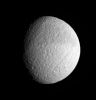
Tethys-PIA08291.jpgTethys56 visiteCaption NASA:"Tethys has a crater-saturated surface, where older, larger basins have been completely overprinted by newer, smaller impacts. This state is what scientists expect to see on a very old surface, where small impactors have struck more frequently than larger ones over several billion years. Larger impacts were more common events in the early history of the Solar System.
This view looks toward the Leading Hemisphere of Tethys (1.071 Km, or about 665 miles across). North is up. The great scar of Ithaca Chasma is seen at right.
The view was captured in visible light with the Cassini spacecraft narrow-angle camera on Sept. 25, 2006 at a distance of approx. 449.000 Km (such as about 279.000 miles) from Tethys and at a phase angle of 49°. Image scale is roughly 3 Km (about 2 miles) per pixel".
|
|
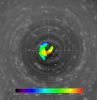
Saturn-PIA08334.jpgThe temperature of Saturn's "Stormy" South Pole56 visiteThe Cassini data presented in this view appear to confirm a region of warm atmospheric descent into the eye of a hurricane-like storm locked to Saturn's south pole. The view shows temperature data from the Cassini spacecraft composite infrared spectrometer overlaid onto an image from the imaging science subsystem wide-angle camera.
The composite infrared spectrometer data refer to a depth in Saturn's upper stratosphere where the pressure is 0.5 millibars (324 kilometers above the 1-bar level), a region higher than that imaged by the imaging camera and visual and infrared spectrometer during the same observation period. The composite infrared spectrometer data show a very small hot spot over the pole, similar in size to the "eye" of the storm seen in the imaging science subsystem images. See also Looking Saturn in the Eye and Saturn's Surprisingly Stormy South for related images.
The color scale at the bottom indicates the temperature in Kelvin corresponding to the colors of the temperature map. Numbers on the grid correspond to lines of latitude and longitude on the planet.
Infrared images taken through the Keck I telescope by ground-based observers had previously shown the south polar spot to be warm. Cassini's composite infrared spectrometer has confirmed this with higher resolution temperature maps of the area (like the map displayed here) and sees a temperature increase of about 2 Kelvin (4 degrees Fahrenheit) at the pole.
The temperatures are in the stratosphere and higher up than the clouds seen by the Cassini imaging and visual and infrared mapping spectrometer instruments, but they suggest that the atmosphere sinks over the south pole. Because the pressure increases with depth, the descending atmosphere compresses and heats up. The warmer temperatures over the south pole also indicate that the vortex winds are decaying with height in the stratosphere. The descent implied by the temperatures nicely supports the lower cloud altitudes observed by the imaging camera and visual and infrared spectrometer instruments at the pole.
The image and atmospheric data were acquired on Oct. 11, 2006, when Cassini was approximately 340,000 kilometers (210,000 miles) from Saturn. The wide-angle camera image was taken using a spectral filter sensitive to wavelengths of infrared light centered at 752 nanometers. The image has been contrast enhanced using digital image processing techniques. The unprocessed image shows an oblique view toward the pole, and was reprojected to show the planet from a perspective directly over the south pole. Scale in the original image was about 17 kilometers (11 miles) per pixel.
|
|
| 2245 immagini su 188 pagina(e) |
 |
|
|
|
|
122 | |
|
|
|
|





