| Piú viste - Saturn: the "Ringed Beauty" and His Moons |

The_Rings-PIA11504.jpgGravity-induced "Ondulations"57 visiteCaption NASA:"Saturn's moon Daphnis gives a scalloped look to the edge of the A-Ring as the moon orbits within the Keeler Gap.
Daphnis is the bright spot in the narrow gap near the center of the image. Since the gap is not much larger than the moon, the small moon's gravity is great enough to perturb the particles in the Ring and create the wavelike patterns seen here. See also PIA09850 to learn more.
This view looks toward the unilluminated side of the Rings from about 61° above the Ring-Plane. The image was taken in Visible Light with the Cassini Spacecraft narrow-angle camera on April 30, 2009. The view was acquired at a distance of approx. 1,5 MKM (such as about 932.000 miles) from Daphnis and at a Sun-Daphnis-Spacecraft, or Phase, angle of 73°.
Image scale is roughly 9 Km (a little less than 6 miles) per pixel".MareKromium
|
|

Daphnis_and_Rings-PIA11656-2.JPGWavy Shadows (edm)57 visiteCaption NASA:"Never-before-seen tall vertical structures created by Saturn's moon Daphnis rise above the Planet's otherwise flat, thin disk of Rings to cast long shadows in this Cassini image.
Daphnis, approx. 8 Km (about 5 miles) across, occupies an inclined orbit within the about 42-Km (approx. 26-mile) wide Keeler Gap in Saturn's outer A-Ring. Recent analyses by imaging scientists published in the Astronomical Journal illustrate how the moon's gravitational pull perturbs the orbits of the particles forming the Gap's edge and sculpts the edge into waves having both vertical and horizontal components.
Measurements of the shadows in this and other images indicate that the vertical structures range between one-half to 1,5 Km tall (about 1/3rd to one mile), making them as much as 150 times as high as the Ring is thick. The main A, B and C-Rings are only about 10 meters (about 30 feet) thick. Daphnis itself can be seen casting a shadow onto the nearby Ring".MareKromium
|
|

Dione-PIA11532.jpgWispy Dione57 visiteCaption NASA:"The Cassini Spacecraft looks toward the wispy, fractured terrain of the Trailing Hemisphere of the moon Dione.
To learn more about Dione's "Wisps", see also PIA08960.
Lit Terrain seen here is on the Trailing Hemisphere of Dione (about 1123 Km, or approx. 698 miles across). North on Dione is up and rotated 29° to the right.
The image was taken in visible light with the Cassini Spacecraft narrow-angle camera on May 26, 2009. The view was acquired at a distance of approx. 1,3 MKM (about 808.000 miles) from Dione and at a Sun-Dione-Spacecraft, or Phase, Angle of 35°.
Image scale is roughly 8 Km (about 5 miles) per pixel".MareKromium
|
|

The_Rings-PIA11539.jpgShadowing the "Gap"...57 visiteCaptin NASA:"The shadow of the moon Tethys is cast onto Saturn's "A"-Ring, almost blanketing the Enke Gap.
The novel illumination geometry created as Saturn approaches its August 2009 Equinox allows moons orbiting in or near the plane of Saturn's equatorial rings to cast shadows onto the Rings.
These scenes are possible only during the few months before and after Saturn's Equinox which occurs only once in about 15 Earth years. To learn more about this special time and to see a movie of a moon's shadow moving across the rings, see PIA11651 and PIA11660.
This view looks toward the sunlit side of the Rings from about 29° below the Ring-Plane. The image was taken in Visible Light with the Cassini Spacecraft narrow-angle camera on May 25, 2009. The view was acquired at a distance of approx. 759.000 Km (about 472.000 miles) from Saturn and at a Sun-Saturn-spacecraft, or Phase, angle of 56°.
Image scale is roughly 4 Km (about 2,5 miles) per pixel".MareKromium
|
|

The_Rings-PIA11544.jpgShadows on the "B"-Ring (Natural Colors; credits: Lunar Explorer Italia)57 visiteCaption NASA:"The shadow of the moon Epimetheus stretches across the B-Ring in this image taken by Cassini as Saturn approaches its 2009 Equinox. The novel illumination geometry created as Saturn approaches its August 2009 Equinox allows moons orbiting in or near the plane of Saturn's Equatorial Rings to cast shadows onto the Rings.
These scenes are possible only during the few months before and after Saturn's Equinox, which occurs only once in about 15 Earth years.
This view looks toward the sunlit side of the rings from about 42° below the Ring-Plane.
The image was taken in Visible Light with the Cassini Spacecraft narrow-angle camera on June 8, 2009. The view was obtained at a distance of approx. 700.000 Km (about 435.000 miles) from Saturn and at a Sun-Saturn-Spacecraft, or Phase, Angle of 129°.
Image scale is roughly 4 Km (about 2,5 miles) per pixel".MareKromium
|
|

Japetus-big.jpgJapetus (Natural Colors; credits: Lunexit)57 visiteDa "NASA - Picture of the Day", del giorno 9 Agosto 2009:"What has happened to Saturn's moon Japetus? Vast sections of this strange world are dark as coal, while others are as bright as ice. The composition of the dark material is unknown, but InfraRed Spectra indicate that it possibly contains some dark form of carbon.
Japetus also has an unusual equatorial ridge that makes it appear like a walnut. To help better understand this seemingly painted moon, NASA directed the robotic Cassini Spacecraft orbiting Saturn to swoop within 2000 Km in 2007.
Pictured above, from about 75.000 Km out, Cassini's trajectory allowed unprecedented imaging of the hemisphere of Japetus that is always trailing.
A huge impact crater seen in the South spans a tremendous 450 Km and appears superposed on an older crater of similar size. The dark material is seen increasingly coating the easternmost part of Japetus, darkening craters and highlands alike.
Close inspection indicates that the dark coating typically faces the moon's Equator and is less than a meter thick. A leading hypothesis is that the dark material is mostly dirt leftover when relatively warm but dirty ice sublimates. An initial coating of dark material may have been effectively painted on by the accretion of meteor-liberated debris from other moons.
This and other images from Cassini's Japetus flyby are being studied for even greater clues".MareKromium
|
|

The_Rings-N00140429.jpgRings and "noise"57 visitenessun commentoMareKromium
|
|
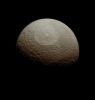
Tethys-PIA11572.jpgOdysseus Crater (Natural Colors; credits: Lunexit)57 visiteCaption NASA:"The Odysseus Crater sprawls across the Mid-Latitudes of the Northern Hemisphere of the moon Tethys.
The Odysseus Crater is about 450 Km across. Lit Terrain seen here is on the anti-Saturn side of Tethys (about 1062 Km, or approx. 660 miles across). This view looks down on the moon's North Pole, which lies on the Terminator about a quarter of the way inward from the top edge of the moon in the image.
The image was taken in Visible Light with the Cassini Spacecraft narrow-angle camera on July 11, 2009.
The view was acquired at a distance of approx. 577.000 Km (about 359.000 miles) from Tethys and at a Sun-Tethys-Spacecraft, or Phase, Angle of 65°.
Image scale is roughly 3 Km (a little less than 2 miles) per pixel".MareKromium
|
|

Janus-N00141745to56.gifIn the shadow of Saturn... (GIF-Movie; credits: Dr M. Faccin)57 visitenessun commentoMareKromium
|
|
The_Rings-N00139376_to_97.gifSurfing through the Rings... (GIF-Movie; credits: Dr M. Faccin)57 visitenessun commentoMareKromium
|
|

Rhea-PIA11550.jpgRhea (Natural Colors; credits: Lunexit)57 visiteCaption NASA:"The battered features of the moon Rhea, seen at low phase, appear washed out by the Sun.
This view looks toward the Saturn-facing side of Rhea at a Sun-Rhea-Spacecraft, or Phase, Angle of 15°. To see Rhea at an even lower phase angle -- near opposition -- see PIA10542.
North on Rhea is up and rotated 7° to the left.
The image was taken in Visible Light with the Cassini spacecraft narrow-angle camera on May 26, 2009. The view was obtained from a distance of approx. 1,4 MKM (such as about 870.000 miles) from Rhea.
Image scale is roughly 9 Km (approx. 5,5 miles) per pixel".MareKromium
|
|
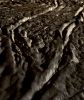
Enceladus-PIA12208.jpgPerspective view of Baghdad Sulcus, Enceladus (Natural Colors; credits: Lunexit)57 visiteThis perspective view of Baghdad Sulcus was generated using high resolution images of Enceladus acquired in August 2008 at 12 to 30 meters (40 to 100 feet) resolution, together with a new topographic map of the region produced by Dr. Paul Schenk (http://www.lpi.usra.edu/lpi/schenk/) at the Lunar and Planetary Institute in Houston, TX. Lower resolution images to either side were acquired at 50 to 80 meter (165 to 260 feet) resolution.
Baghdad Sulcus is one of several prominent linear structures, dubbed “Tiger Stripes”, within the geologically active South Polar Region of Enceladus. This view shows a wedge-shaped area between two prominent branches of Baghdad Sulcus. Each branch consists of two large parallel ridges up to 2 Km (approx. 1,2 mile) across separated by a deep V-shaped medial trough.
The ridges are 80 to 100 meters (approximately 260 to 325 feet) high. The medial troughs between the ridges are 200 to 250 meters (650 to 820 feet) deep. The maximum separation between the two branches is about 12 Km (about 7.5 miles).
Troughs such as those shown here are probably the source of numerous jets making up the large active water vapor plume over the South Pole of Enceladus. The floors of the medial troughs are often broken up into smaller ridges. These could be blocks of crust that have slid down the walls of the trough or fractured blocks pushed up from below. Relief has been exaggerated by a factor of ~10 to enhance clarity.
The raw data from which this product was developed were retrieved from the Planetary Data System's Cassini archives. The Cassini-Huygens mission is a cooperative project of NASA, the European Space Agency and the Italian Space Agency. The Jet Propulsion Laboratory, a division of the California Institute of Technology in Pasadena, manages the mission for NASA's Science Mission Directorate, Washington, D.C. The Cassini orbiter and its two onboard cameras were designed, developed and assembled at JPL. The imaging operations center is based at the Space Science Institute in Boulder, Colo. (http://ciclops.org)MareKromium
|
|
| 2245 immagini su 188 pagina(e) |
 |
|
|
|
|
114 | |
|
|
|
|





