| Piú viste - Saturn: the "Ringed Beauty" and His Moons |

Dione-N00037544.jpgDione, from about 244.000 Km56 visiteUn'immagine troppo bella per fare dei commenti...
|
|
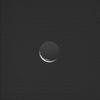
Tethys-N00037660.jpgCrescent Tethys56 visiteUn'immagine di Tethys, ripresa da una distanza di circa 840.000 Km, che ci mostra, alla luce di un Sole lontano, solo una sottilissima falce della sua rocciosa superficie.
Ben visibile, comunque - poichè illuminata dalla luce di Saturno - la parte di Tethys immersa nella notte.
A ridosso della Linea del Terminatore, due grandi crateri che, simili a degli occhi, sembrano scrutare le profondità del cielo.
|
|

Mimas-PIA06256.jpgMimas: spectacular overview56 visiteThe most detailed images ever taken of Saturn's moon Mimas show it to be one of the most heavily cratered Saturnian moons, with little (if any) evidence for internal activity. Mimas has been so heavily cratered that new impacts can only overprint or even completely obliterate other older craters. Mimas is about 397 Km across.
The moon displays an unexpected array of crater shapes. The highest crater walls tower 6 Km above the floors and show signs of material sliding down slope. Indeed, many of the large craters - more than 15 Km in diameter - appear to be filled in with rough-surfaced material, likely the result of landslides triggered by subsequent impacts elsewhere on Mimas' surface. Some of these deposits have craters superimposed on them, demonstrating that the landslides themselves may be quite old.
Grooves, some of which are over a Km deep, cut across the surface for more than 100 Km. These are some of the only indications that there might have once been internal activity under this ancient, battered surface.
|
|

Epimetheus.jpgEpimetheus, from approx. 87.000 Km56 visiteOriginal caption:"How did Epimetheus form? No one is yet sure. To help answer that question, this small moon has recently been imaged again in great detail by the robot spacecraft Cassini now orbiting Saturn. Epimetheus sometimes orbits Saturn in front of Janus, another small satellite, but sometimes behind. The above false-color image, taken during mid July, shows a surface covered with craters indicating great age. Epimetheus spans about 115 Km across. Epimetheus does not have enough surface gravity to restructure itself into a sphere".
|
|

Rhea-PIA07572.jpgRhea, from about 342.000 Km56 visiteCassini looks upward at the South Polar Region on Rhea during a recent distant encounter. Rhea's icy surface is so heavily saturated with impact craters that the moon's limb, or edge, has a rugged, bumpy appearance. The bright splotch seen here near the upper right is impact material (or ejecta) from a relatively fresh crater.
The image was taken with the Cassini spacecraft narrow-angle camera on July 14, 2005, at a distance of approx. 342.000 Km (about 212.000 miles) from Rhea and at a Sun-Rhea-spacecraft, or phase, angle of 36°. The image was obtained using a filter sensitive to wavelengths of infrared light centered at 298 nnmts. The image scale is 1,6 Km per pixel
|
|

Enceladus-Model1-PIA07725.jpg"Warm" Ice on Enceladus (Model 1)56 visiteOriginal NASA caption:"This graphic represents a possible model for mechanisms that could generate the water vapor and tiny ice particles detected by Cassini over the Southern Polar terrain on Enceladus. This Model shows sublimation of warmed surface ice. Sublimation is to cause to change directly from a solid to a gas, or from a gas to a solid, without becoming a liquid".
|
|

Enceladus-Model3-PIA07727.jpg"Warm" Ice on Enceladus (Model 3)56 visiteOriginal NASA caption:"This graphic represents a possible third model for mechanisms that could generate the water vapor and tiny ice particles detected by Cassini over the Southern Polar terrain on Enceladus.
This model shows sublimation of an "ammonia-water slush" (slush----> fanghiglia costituita da un mix di ammoniaca ed acqua) or "slurry" (slurry---->sin. di slush, ma anche 'combinazione') on the surface".
|
|
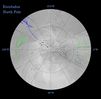
Enceladus-S-NP-PIA07721_modest.jpgEnceladus: Global Patterns of Fracture (Northern Polar Projection)56 visiteTerrain near the North Pole is among the most heavily cratered and oldest on the surface of Enceladus. The conspicuously fractured Southern Polar Region is nearly devoid of impact craters, making this terrain among the youngest on the Moon's surface.
A unique feature of the South Polar terrains is that broad networks of folded or kinked fractures can be found throughout the Region. A prominent "chain" of these fractures (marked in red in the South Polar Map) abruptly separates the youthful South Polar terrains from the older terrains that lie closer to the Equator and appears to encircle the South Pole near about 55° South Latitude.
The wavy boundary of the South Polar terrain is interrupted in numerous places by Y-shaped, or funnel-shaped, discontinuities that curve and taper northward. Well-developed examples of the funnel-shaped discontinuities appear to transition to systems of North-South trending surface cracks (marked in blue).
These north-south trending cracks are best explained as if they formed in response to tension stresses that are parallel to lines of latitude. Such extensional "hoop stresses" would be expected to develop if the equator became wider, perhaps in response to a change in the moon¿s spin rate.
Globally systematic patterns of fracture on Enceladus occur in ancient, cratered terrain as well as youthful terrain. Shown in green on the maps -- and particularly apparent in the northern hemisphere projection -- are roughly orthogonal (or perpendicular) systems of north-south and east-west trending fractures that formed quite close to the tidal axis of Enceladus. The moon¿s tidal axis is a line extending from 0-degrees longitude to 180-degrees longitude. Such orthogonal fractures might have formed in response to tidal stresses exerted on Enceladus by Saturn.
|
|

Rhea-PIA07575.jpgTirawa Impact Basin on Rhea56 visiteThe giant Tirawa impact basin straddles the day and night boundary on Saturn's moon Rhea in this view from the Cassini spacecraft. The ancient basin is 5 Km deep in places, as measured in NASA Voyager images. The whole basin is about 360 Km across.
The prominent bright splotch to the southeast of Tirawa is ejecta from a fairly fresh crater. This view of Rhea (1.528 Km, such as about 949 miles across) reveals terrain slightly to the East of a similar Cassini view, released earlier (see Diversity of Impacts). The sunlit surface in this view is principally on the leading hemisphere of Rhea. North is up and rotated 13° to the left.
The image was taken in visible light with the Cassini spacecraft narrow-angle camera on Aug. 13, 2005, at a distance of approx. 2 MKM (about 1,2 MMs) from Rhea and at a Sun-Rhea-spacecraft, or phase, angle of 50°. Resolution in the original image was 12 kilometers (7 miles) per pixel. The image has been contrast-enhanced and magnified by a factor of two to aid visibility.
|
|

Enceladus~1.jpgEnceladus' "Tiger Stripes"56 visiteDa "NASA - Picture of the Day" del 6 Settembre 2005:"The Tiger Stripes on Saturn's moon Enceladus might be active. Even today, they may be spewing ice from the Moon's icy interior into space, creating a cloud of fine ice particles over the Moon's South Pole and creating Saturn's mysterious E-Ring. Recent evidence for this has come from the Cassini spacecraft. Cassini detected a marked increase in particle collisions during its July flyby only 270 Km over a South Polar Region of Enceladus. Pictured above, a HR image of Enceladus is shown from the close flyby. The unusual surface features dubbed "Tiger Stripes" are visible on the left in false-color blue. Why Enceladus is active remains a mystery, as the neighboring moon Mimas, approximately the same size, appears quite dead".
|
|

Rings-PIA07716.jpgCan the "clumps" in the Rings be the TSP (Transient Saturnian Phoenomena)?56 visite"Scientists have long suspected that small moons hiding among Saturn's Rings strands might be producing some of the unusual structure observed in the F-Ring. While the shepherd moon Prometheus is the main culprit behind the strange behavior of Saturn's F-Ring, it cannot explain all observed features. The current dilemma facing scientists is that Cassini is detecting extended objects like those pictured here - that may be either solid moons or just loose clumps of particles within the Ring. This montage of 4 enhanced Cassini narrow-angle camera images shows bright clump-like features at different locations within the F-Ring.
Two objects in particular, provisionally named S/2004 S3 and S/2004 S6, have been repeatedly observed by Cassini over the past 13,5 months and 8,5 months, respectively. The orbits for these 2 objects have not yet been precisely determined, in part because perturbations from other nearby moons make the orbits of objects in this region complicated. Thus, scientists cannot be completely confident at the present time if they in fact have observed new sightings of S3 and S6, or additional transient clumps.
The upper two images show features that may be S6. From previous observations, S6 appears to have an orbit that crosses that of the main F ring. This unexpected behavior currently is a subject of great interest to ring scientists.
The upper left image was taken on June 21, 2005, and shows an object in the outer ringlets of the F ring. The radial (or lengthwise) extent of the feature is approximately 2,000 kilometers (1,200 miles). The radial resolution on the ring is about 13 kilometers (8 miles) per pixel.
The image at the upper right was taken on June 29, 2005, and shows a bright feature within the F ring's inner ringlets. The radial extent of the feature seen here is about 2,000 kilometers (1,200 miles); the radial resolution is 36 kilometers (22 miles).
The image at the lower left was taken on August 2, 2005, and shows a feature that may be S3. S3 has been found to have an orbital path that is tightly aligned with that of the main F ring. The radial resolution in the image is 3.5 kilometers (2.2 miles) per pixel.
The lower right image was taken on April 13, 2005, and has a radial resolution of 7 kilometers (4 miles) per pixel. This object does not appear to be either S3 or S6.
Structures like knots and clumps within the F ring often are transient, appearing and then disappearing within months. Repeated observation of the objects seen in this region hopefully will give scientists firm evidence about whether these features are actual moons that disturb the material around them or perhaps the short-lived products of interactions between the F ring and larger moons such as Prometheus.
|
|

Prometheus-PIA07582.jpgCrossing the Rings...56 visiteOriginal caption:"Prometheus has just passed - and gravitationally disturbed - some of the fine particulate material in the F-Ring, creating the sheared gap visible in the inner strands of the Ring. This view looks down from about 10° above the ringplane. Prometheus and the Rings are sunlit from below. At lower right lies the outermost part of the A-Ring, which grows suddenly brighter outside of the 42-Km-wide (such as about 26-miles) Keeler Gap.
The image was taken in visible green light with the Cassini spacecraft narrow-angle camera on Aug. 2, 2005, at a distance of approximately 632.000 Km (approx. 392.000 miles) from Prometheus and at a Sun-Prometheus-spacecraft, or phase, angle of 122°. Image scale is 4 Km (about 2 miles) per pixel".
|
|
| 2245 immagini su 188 pagina(e) |
 |
|
|
|
|
109 | |
|
|
|
|





