| Piú viste - Saturn: the "Ringed Beauty" and His Moons |

Epimetheus-PIA07531.jpgEpimetheus56 visiteCaption NASA originale:"Cassini continues to survey the small worlds that orbit near Saturn's Rings, capturing this view of Epimetheus.
The moon's lumpy, irregular topography can be seen here, along with several impact craters. The image was taken in visible light with the Cassini spacecraft narrow-angle camera on May 20, 2005, at a distance of about 345.000 Km from Epimetheus and at a phase angle of 26°.
Resolution in the original image was 2 Km per pixel.
The view was also magnified by a factor of two and contrast-enhanced to aid visibility of the moon's surface".
|
|
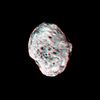
Hyperion-anagliph-PIA06244.jpgStereo-Hyperion! (from about 176.000 Km)56 visiteCaption NASA originale:"Saturn's moon Hyperion pops into view in this stereo anaglyph (or 3D view) created from Cassini images. Images taken from slightly different viewing angles allow construction of such stereo views, which are helpful in interpreting the moon's irregular shape.
Hyperion's unusual dimensions are 164 by 130 by 107 Km (such as 102 by 81 by 66 miles).
Craters are visible on the moon's surface down to the limit of resolution in this image, about 1 Km (0,6 mile) per pixel. The fresh appearance of most of these craters, combined with their high spatial density, makes Hyperion look something like a sponge. The moon's spongy-looking exterior is an interesting coincidence, as Hyperion's density seems to indicate that it is porous and much of its interior is filled with voids.
Dark material is concentrated in the bottoms of many craters visible here, perhaps resulting from the down slope movement of material, combined with sublimation of brighter ice".
|
|

Enceladus-N00036972.jpgEnceladus fly-by (4) - from approx. 66.000 Km56 visitenessun commento
|
|

Enceladus-N00037000.jpgEnceladus fly-by (9) - from approx. 38.000 Km56 visitenessun commento
|
|

Enceladus-N00037015.jpgEnceladus fly-by (12) - from approx. 29.000 Km56 visitenessun commento
|
|

Enceladus-N00037017.jpgEnceladus fly-by (13) - from approx. 27.000 Km56 visiteForse uno dei frames più belli del fly-by: espandendo il frame sino al full-size va guardata e studiata la "tessitura" dei canali che attraversano una gran parte della superficie di Encelado e la rendono - anche visivamente - profondamente enigmatica.
La sensazione, osservando con molta cautela (e con l'ausilio di un piccolo software), è che stiamo osservando diversi strati di canali, alcuni recenti e leggeri, altri molto più antichi, meno superficiali e decisamente profondi.
La tenue atmosfera che circonda Encelado (notate come il bordo del Pianeta è sempre - leggermente - offuscato) è indice del fatto che esiste ancora un'attività geologica residuale al suo interno la quale lo rende - se così possiamo dire - "vivo ed attivo".
Attività geologica a parte, comunque, quale possa essere la reale causa di questa fittissima ed estremamente diversificata rete di canali crediamo che resterà un mistero ancora per molto tempo.
|
|

Enceladus-N00037076.jpgGood-bye Enceladus! (1)56 visiteEncelado è ormai una splendida "falce" nel cielo e questo ci fa capire che la Sonda Cassini ha ormai superato il suo punto di maggior vicinanza a questo mondo di ghiaccio e di neve, i cui caratteri superficiali terranno impegnati Scienziati e Ricercatori per mesi (o forse anni...).
Cassini si allontana rapidamente ed ora si sta proiettando, ancora una volta, verso lo Spazio di Saturno.
Ma ritornerà...
|
|

Enceladus-N00037083.jpgGood-bye Enceladus! (3)56 visiteUna curiosità (valida anche per i frames precedenti): notate come si riescono a vedere bene anche quei rilievi di Encelado che, superata la linea del terminatore, sono ora immersi nella notte.
E' un peccato che la maggior parte dei frames ottenuti fra i 500 ed i 600 Km di distanza da Encelado sìano risultati, alla fine, completamente (o quasi) neri.
|
|

Prometheus_and_Pandora-PIA07544.jpgPrometheus and Pandora56 visiteSaturn's moons Prometheus and Pandora are captured here in a single image taken from less than 1° above the dark side of Saturn's Rings. Pandora is on the right and Prometheus is on the left. Prometheus is 102 Km (63 miles) across, while Pandora is 84 Km (52 miles) across.
The two moons are separated by about 69.000 Km (about 43.000 miles) in this view. The F-Ring, extending farthest to the right, contains a great deal of fine, icy material that is more the size of dust than the boulders thought to comprise the dense B-Ring.
These tiny particles are particularly bright from this viewing geometry, especially at right near the ansa, or edge.
At left of center, a couple of ringlets within the Encke gap (325 Km or 200 miles wide) can also be easily seen due to their fine dust-sized material. The other dark features in the Rings are density waves and bending waves. The image was taken in visible light from a mean distance of 1,85 MKM from the moons.
|
|

Saturn-PIA07545.jpgSaturn and Tethys56 visiteCaption NASA originale:"The majesty of Saturn overwhelms in this image from Cassini. Saturn's moon Tethys glides past in its orbit and the icy rings mask the frigid northern latitudes with their shadows. The image was taken in visible green light with the Cassini spacecraft wide-angle camera on June 10, 2005, at a distance of approx. 1,4 MKM (about 900.000 miles) from Saturn. The image scale is 80 Km (about 50 miles) per pixel".
|
|

Telesto~0.jpgThe Trojan Moons: Telesto, from 533.000 Km56 visiteCaption NASA originale:"This is Cassini's best look yet at the Trojan moon Telesto (24 Km, or 15 miles across), which orbits Saturn about 60° ahead of the much larger Tethys (1.071 Km, or 665 miles across). Calypso (22 Km, or 14 miles across) is the other Tethys Trojan and trails the larger moon by 60°. Trojan moons are found near gravitationally stable points ahead or behind a larger moon.
Cassini is able to partly resolve Telesto's shape in this view, but surface features are too small to be visible from this distance.
The image was taken in visible light with the Cassini spacecraft narrow-angle camera on May 20, 2005, at a distance of approx. 533.000 Km (331.000 miles) from Telesto. The image scale is 3 Km (about 2 miles) per pixel. This view of Telesto has been magnified by a factor of three and sharpened to aid visibility".
|
|

Enceladus-PIA06252.jpgEnceladus from about 208 Km56 visiteThe tortured southern polar terrain of Enceladus appears strewn with great boulders of ice in this fantastic view, one of the best HR images obtained so far by Cassini of any world.
Some smearing of the image due to spacecraft motion is apparent in this scene, which was acquired as Enceladus raced past Cassini's field of view near the time of closest approach. At the time, the imaging cameras were pointed close to the moon's limb, rather than directly below the spacecraft. This allowed for less motion blur than would have been apparent had the cameras pointed straight down. Thus, the terrain imaged here was actually at a distance of 208 Km from Cassini.
At this fine scale, the surface is dominated by ice blocks between 10 and 100 mt across. The origin of these icy boulders is enigmatic: scientists are interested in studying the sizes and numbers of the blocks in this bizarre scene and in understanding whether terrain covered with boulders is common on Enceladus.
|
|
| 2245 immagini su 188 pagina(e) |
 |
|
|
|
|
108 | |
|
|
|
|





