| Piú viste - Saturn: the "Ringed Beauty" and His Moons |

Janus-PIA06613.jpgJanus (close-up)56 visiteCaption NASA originale:"This close-up view of Saturn's moon Janus shows what appear to be two large craters near the boundary between day and night. The left side of the moon is lit feebly by reflected light from Saturn. Janus is 181 Km across.
The image was taken in visible light with the Cassini spacecraft narrow-angle camera on Feb. 18, 2005, at a distance of approximately 1,1 MKM from Janus and at a phase angle of 108°. Resolution in the original image was 7 Km (approx. 4 miles) per pixel. The image has been contrast-enhanced and magnified by a factor of three to aid visibility".
|
|
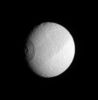
Tethys-PIA06625.jpgOdysseus: the "eye" of Tethys56 visiteCaption NASA originale:"Saturn's moon Tethys turns like a great eye as the enormous crater Odysseus (450 Km across) rotates into Cassini's view. The image was taken in visible light with the Cassini spacecraft narrow-angle camera on March 6, 2005, at a distance of approximately 1,7 MKM (approx. 1,1 MMs) from Tethys and from a Sun-Tethys-spacecraft, or phase, angle of 35°. The image scale is 10 Km (approx. 6 miles) per pixel. The image has been magnified by a factor of two and contrast- enhanced to aid visibility".
|
|

Phoebe-PIA06070.jpgThe "true shape" of Phoebe56 visiteCaption NASA originale:"This colorful graphic illustrates that despite Phoebe's bumpy, irregular topography, the moon has a fairly round shape. A digitally rendered shape model of Phoebe was constructed using Cassini imaging data obtained before and after the spacecraft's close flyby of the Saturnian moon on June 11, 2004.
The average diameter of Phoebe is about 214 Km. The four views of the model are each separated by a 90° rotation; the upper left is centered at 0° West longitude. The others show regions of the moon centered at 90, 180 and 270° West longitude, as labeled. The coloring of the models corresponds to the height of Phoebe's surface, relative to the lowest point - a range of about 16 Km - going from blue (low) to red (high). Interestingly, much of this range in height occurs in 1 large crater, visible in the 180° West view".
|
|

Enceladus-PIA06628.jpgEnceladus from 1,1 MKM56 visiteCaption NASA originale:"Saturn's bright moon Enceladus hovers here, in front of the Rings darkened by Saturn's shadow.
This view is from less than 1° beneath the Ring plane. If seen from directly beneath the Rings, the planet's giant shadow would appear as an elongated half-ellipse; the acute viewing angle makes the shadow look more like a strip here. The dark shadow first takes a bite out of the rings at the right, where the distant, outermost ring material appears to taper and fade. Ring features visible in this image from the outer ring edge inward include: the A-Ring, the Cassini Division and the B-Ring. The C-Ring is the darker region that dominates the Rings here. The 2 gaps visible near the center and below the left of the center are the Titan Gap, about 77.800 Km from Saturn and an unnamed gap about 75.800 Km from the planet. The image was taken in visible light with the Cassini spacecraft narrow-angle camera on March 7, 2005, at a distance of approx. 1,1 MKM from Enceladus, at a phase angle of 30°".
|
|

Tethys-PIA06632.jpgTethys (infrared vision) from approx. 1,4 MKM56 visiteCaption NASA originale:"In this infrared view, Saturn's cratered moon Tethys shows a faint, dark band across its equatorial region. North is up in this view.
The image was taken with the Cassini spacecraft narrow-angle camera on March 11, 2005, through a filter sensitive to wavelengths of infrared light centered at 930 nnmts. The view was acquired at a distance of approximately 1,4 MKM from Tethys and at a phase angle of 80°. Resolution in the original image was 8 Km per pixel.
The image has been contrast-enhanced and magnified by a factor of two to aid visibility".
|
|

Rhea-PIA06648.jpgWhite young crater on Rhea56 visiteCaption NASA originale:"Looking closely at Saturn's moon Rhea during a distant flyby, Cassini provides this view of what appears to be a bright, rayed and therefore relatively young crater. This crater was also observed by Cassini at much lower resolution in the fall of 2004 and in spring of 2005. For comparison, viewing the same crater near the terminator (the line between day and night) would highlight the crater's topography (vertical relief), compared to its brightness, which is highlighted in this view where the Sun is at a higher angle.
North on Rhea is up and rotated about 15° to the left. This view shows principally the leading hemisphere on Rhea".
Nota: guardate molto bene il bordo di Rhea e poi chiedeteVi se esso sembri di più il bordo di una 'sfera' o di uno 'sferoide'. Poi, se avete tempo e voglia, provate a rileggere i commenti del Prof. Hoagland sulla forma di Giapeto e sulle sue possibili cause ed implicazioni.
|
|

Radio-Saturn.jpgRadio waves and the size of the Rings' forming particles56 visiteQuali sono le dimensioni delle particelle che formano gli Anelli di Saturno? Per scoprirlo, Cassini ha trasmesso verso Terra una serie di onde radio (aventi lunghezze d'onda approssimative di 1, 3,5 e 13 cm) le quali, viaggiando verso di noi, hanno dovuto attraversare gli Anelli stessi. Ora, premesso che le particelle sensibilmente più grandi di un'onda 'riflettono' l'onda stessa, guardate la fotografia: essa è una ricostruzione digitale in falsi colori di Saturno e dei suoi Anelli "visti" dalle onde radio. Il color lilla indica regioni in cui le dimensioni medie delle particelle superano i 5 cm; il verde, invece, indica regioni in cui le loro dimensioni medie sono inferiori ad 1 cm. Il bianco - al centro dell'Anello B - ci dice che la densità di particelle, in quella regione, è troppo alta per consentire una adeguata definizione delle loro dimensioni. Infine, secondo stime fatte impiegando delle onde radio a banda molto larga, si è ipotizzato che in alcune regioni queste 'particelle' abbiano dimensioni di svariati metri.
|
|

Saturn-W00006821.jpgSpark in the Dark! (possible Anomaly)56 visiteCassini sta viaggiando nel cono d'ombra generato da Saturno e quindi, se il 'volto di Saturno' sta guardando il Sole, noi possiamo pure dire che Cassini è 'alle spalle' del Gigante Anellato.
Ciò premesso, riusciamo comunque a vedere una porzione dell'Anello F (ancora illuminato da Sole e davvero caratteristico ed inconfondibile per i suoi 'clumps'!) sull'estrema Dx dell'immagine mentre, proprio al centro del frame, distinguiamo chiaramente un corpo luminoso sferico e svariati altri puntini luminosi e svariati graffi. Sui 'puntini luminosi' ed i 'graffi', la nostra esperienza in campo di fotografia astronomica e spaziale ci dice che si tratta di semplici photo-artifacts. Il punto luminoso centrale, invece, secondo noi NON lo è.
Ora, dato che stiamo guardando in una regione immersa nell'ombra di Saturno (e dunque nel buio), quel punto - se effettivamente NON è un photo-artifact - NON può neppure essere una delle Lune Saturniane!
E allora che cos'è?
|
|

The Rings-N00034622.jpgSunshine and stars, through the F-Ring!56 visiteUn'immagine davvero molto bella e suggestiva; inutili altri commenti.
|
|

The Rings-PIA07512.jpgClose-up on the Rings!56 visiteCaption NASA originale:"This amazing close-up of Saturn's Rings reveals their incredible variety. In some regions there are wavelike structures, while in other places the Rings' structure appears to be more chaotic.
This image shows (from top to bottom) the A-Ring with the Encke gap, the Cassini Division, the B-Ring and the C-Ring.
The image was taken in visible light with the Cassini spacecraft narrow-angle camera on April 26, 2005, at a distance of approx. 2,3 MKM (such as 1,5 MMs) from Saturn. The image scale is 14 Km (approx. 8 miles) per pixel".
|
|

DioneandEpimetheus-PIA07525.jpgDione and Epimetheus56 visiteCaption NASA originale:"Cassini looks toward Saturn's night side in this view, capturing a glimpse of Dione's tortured surface in the foreground and a far-off view of Epimetheus, beyond Saturn. The spacecraft was just 1/10th of a degree above the ring-plane when this image was taken.
Parts of Dione's surface have been stretched and ripped apart by tectonic forces. Some of these faults are visible here, as is a large impact basin (not seen in NASA Voyager spacecraft images) near the moon's South Pole. Although this crater's diameter has not yet been measured by imaging scientists, it appears to be wider than 250 Km, which would make it the largest impact structure yet identified on this moon.
The image was taken in visible light with the Cassini spacecraft narrow-angle camera on May 5, 2005, at a distance of approx. 910.000 Km from Dione; 1,28 MKM from Epimetheus and 1,42 MKM from Saturn. The image scale is 5 Km per pixel on Dione and 9 Km per pixel on Epimetheus".
|
|

Pandora-PIA07530.jpgPandora: the closest view so far!56 visiteCaption NASA originale:"This is one of Cassini's closest views to date of Saturn's F-Ring shepherd moon Pandora. At least one crater is visible on the surface of this moon, which is thought to be an icy rubble pile, loosely bound together by gravity. Pandora is 84 Km across.
Several of Saturn's Ring moons, including Pandora, show elongated, oval-like shapes with their long axes oriented along the moon-Saturn line. In this view, Cassini is looking at the side of Pandora facing away from Saturn. The image shows the moon's leading hemisphere (although, as mentioned, Pandora is not actually round). To the right, much of the moon's surface is in shadow. The image was taken in visible light with the Cassini spacecraft narrow-angle camera on May 20, 2005, at a distance of approx. 346.000 Km from Pandora and at a Sun-Pandora-spacecraft, or phase, angle of 21°".
|
|
| 2245 immagini su 188 pagina(e) |
 |
|
|
|
|
107 | |
|
|
|
|





