| Piú viste - Saturn: the "Ringed Beauty" and His Moons |

Dione-N00028445.jpgDione and Titan56 visitenessun commento
|
|

Dione-N00028848.jpgDione and Rhea (3)56 visitenessun commento
|
|
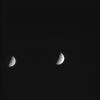
Dione-N00028856.jpgDione and Rhea (5)56 visitenessun commento
|
|

Rhea-N00028939.jpgRhea (from approx. 2,5 MKM) and Tethys56 visiteUn'altra immagine del "Carosello Planetario" costituito dalle Lune di Saturno che si inseguono e si incrociano, davanti agli occhi di Cassini. Forse ci sbagliamo, perchè - in fondo - viviamo in un mondo cui le "cose che interessano" sono altre... Tuttavia noi crediamo che un simile spettacolo riuscirebbe ad interessare ed affascinare chiunque!
|
|

Mimas-N00028872.jpgMimas and the Rings, from approx. 1.674.000 Km56 visitenessun commento
|
|

Mimas-PIA06591.jpg"Phase-locked" Mimas!56 visiteCaption NASA originale:"Cassini's ability to remain precisely and steadily pointed at targets, such as Saturn's moon Mimas (seen here) yields sharp images despite the relatively high speed at which the spacecraft moves.
Cassini was traveling at more than 13 Km per second when it acquired this view, which shows crisp detail on Mimas against the backdrop of Saturn's Northern Hemisphere. Shadows of the icy rings stretch across the atmosphere and appear to be blurred because of the spacecraft motion.
The part of Mimas visible here always faces away from Saturn as the moon orbits the Gas Giant. In scientific language (jargon...), Mimas is said to be "phase-locked".
The image has been rotated so that North on Mimas (and Saturn) is up. This view was obtained with the Cassini spacecraft narrow angle camera on Jan. 18, 2005, at a distance of approx. 1,25 MKM from Mimas and at a phase angle of 114°. The image was taken using filters sensitive to wavelengths of infrared and polarized light. Res. is 7 Km/pixel".
|
|

Enceladus_cassini_full.jpgEnceladus: the Paradise of "Interplanetary Skiers"56 visiteDa "NASA - Picture of the Day" del 24.02.2005:"Small, icy, inner moon of Saturn, Enceladus is only about 500 Km in diameter. But the distant world does reflect over 90% of the received sunlight, giving its surface about the same reflectivity as fresh snow. Seen here in a sharp view from the Cassini spacecraft's recent flyby, Enceladus shows a variety of surface features and very few impact craters - indicating that it has been an active world even though this tiny moon should have completely cooled off long ago. In fact, the resurfaced appearance of Enceladus could be the result of liquid water geysers or water volcanos. Since Enceladus orbits within the outer E-Ring of Saturn, the moon's surface may be kept snow-bright as it is continuously bombarded with icy ring particles. Eruptions on Enceladus itself would in turn supply material to the E-Ring. Would you like to ski there? Why not, but take note: Enceladus has only about 1/100th the surface gravity of Earth and a surface temperature of approx. - 200°C!".
|
|

Japetus-A-The-Wall-Mosaic-l.jpgThe "Wall" of Japetus56 visiteEffettivamente la configurazione esteriore della superficie di Giapeto non ci è proprio possibile definirla "convenzionale": in questa immagine ripresa dalla Sonda Cassini possiamo vedere un interessante rilievo superficiale che il Prof. Hoagland ha, secondo noi correttamente, definito "Wall": un muro.
Ora andiamo a vedere - con il prossimo frame - un detail mgnf di questo "muro"...
|
|

Japetus-A-W-Deathstar-27.jpgWhat is the "real shape" of Japetus?56 visiteSecondo noi su Giapeto è accaduto "qualcosa" e, molto probabilmente, su Giapeto esistono e sono visibili le tracce di un'attività NON NATURALE che si è svolta (e che, magari, si sta ancora svolgendo...) sulla sua superficie. Ma NON è il "Muro" di Giapeto che ci ha convinti, nè la sua "Torre", nè il "Pentagono", nè la sua presunta "Struttura Geodesica"! E' la "SOMMA di queste Singolarità" (queste ed altre di cui potrete leggere direttamente sull'articolo del Prof. Hoagland) che ci porta a credere che la razionalità e la Scienza Convenzionale DA SOLE non bastano a spiegare le fattezze di questo corpo celeste sino ad ora colpevolmente snobbato (almeno per quanto ne sappiamo...) dalle investigazioni "ufficiali"!
Noi non crediamo che ogni Singolarità/Anomalia possa avere una spiegazione convenzionale, così come non possiamo credere che ogni Anomalia/Singolarità sia, in realtà, una "Struttura Artificiale"! E' questa "volontà irrefrenabile" di dare una risposta a tutto che rende il lavoro del Prof. Hoagland...
|
|
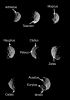
Phoebe-PIA06118.jpgThe Craters of Phoebe: names56 visitenessun commento
|
|
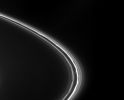
The F-Ring-PIA06600.jpgAttraction-Repulsion: the strange relationship between Prometheus and the F-Ring56 visiteCaption NASA originale:"Intriguing features resembling drapes and kinks are visible in this Cassini view of Saturn's thin F-Ring. Several distinct ringlets are present, in addition to the bright, knotted core of the ring.
The obvious structure in the ring and its strands has been caused by Prometheus, the inner F-Ring shepherd moon that recently swept past this region. (Prometheus is about 10° ahead of the F-Ring material in this image). These types of features were first seen in images taken just after Cassini entered into orbit around Saturn. The gravitational interaction of Prometheus (102 Km or 63 miles across) on the ring pulls material out the ring once every orbit (every 14,7 hours) as the moon gets close to the ring and its strands".
|
|
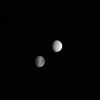
Tethys and Dione-N00029831.jpgTethys and Dione56 visiteUno dei tanti "incroci" fra le lune di Saturno, al quale la Sonda Cassini ha avuto l'onore di assistere da una distanza - per così dire... - ragionevole: in fondo, fra Cassini e Tethys, ci sono solo un milione e mezzo di km...
|
|
| 2245 immagini su 188 pagina(e) |
 |
|
|
|
|
105 | |
|
|
|
|





