| Piú viste - Saturn: the "Ringed Beauty" and His Moons |

Saturn-PIA07646.jpgThe limb of Saturn57 visiteOriginal caption:"This brooding portrait shows the South-Western limb of the cold gas giant and the thread-like cloud features lurking there. The limb appears smooth, but at the terminator (such as the boundary between light and dark) and at higher resolution, variations in cloud height can cause shadows that are visible to Cassini.
The image was taken in visible, red light with the Cassini spacecraft wide-angle camera on Oct. 30, 2005, at a distance of approx. 401.000 Km(such as about 249.000 miles) from Saturn and at a phase angle of 155°. Image scale is 20 Km (13 miles) per pixel. The image was contrast enhanced to improve visibility of features in the atmosphere".
|
|

Janus-N00044721.jpgJanus and Epimetheus (4)57 visitenessun commento
|
|

Saturn-N00044405.jpgPhotographic Defect, Photo-Artifact or UFO in-transit? (3)57 visitevedi il commento al frame precedente
|
|

The Rings & Rhea-PIA07655.jpgThe F-Ring and crescent Rhea57 visiteThe searing arc of light seen here is Saturn's icy F-Ring, seen nearly edge-on. In the background, Rhea is lit by reflected light from Saturn and the Rings, with only the slightest sliver of light at its bottom being from direct Sunlight.
The faint material surrounding the F-Ring likely lies in the Planet's equatorial plane, extending radially farther out and in from the main F-Ring core.
A smaller fraction of this material could be vertically extended, and Cassini's investigations should help to clarify this.
The image was taken in visible light with the Cassini spacecraft narrow-angle camera on Oct. 30, 2005, at a distance of approximately 689.000 Km (about 428.000 miles) from Saturn. The image scale is approximately 4 Km (2 miles) per pixel.
|
|

Hyperion-N00047056.jpgHyperion? (2)57 visiteOriginal caption:"N00047056.jpg was taken on December 23, 2005 and received on Earth December 23, 2005. The camera was pointing toward HYPERION that, at the time, was approximately 235.195 Km away.
The image was taken using the CL1 and CL2 filters".
|
|

Rhea-N00047118.jpgRhea57 visiteOriginal caption:"N00047118.jpg was taken on December 23, 2005 and received on Earth December 24, 2005. The camera was pointing toward RHEA that, at the time, was approximately 341.537 Km away.
The image was taken using the CL1 and CL2 filters".
|
|
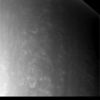
Saturn-N00047653.jpgWhite ice-clouds on Saturn's upper atmosphere (1)57 visiteOriginal caption:"N00047653.jpg was taken on January 02, 2006 and received on Earth January 03, 2006. The camera was pointing toward Saturn that, at the time, was approximately 2.732.201 Km away, and the image was taken using the CL1 and CL2 filters. This image has not been validated or calibrated".
|
|

Saturn-N00047654.jpgWhite ice-clouds on Saturn's upper atmosphere (2)57 visiteOriginal caption:"N00047654.jpg was taken on January 02, 2006 and received on Earth January 03, 2006. The camera was pointing toward Saturn that, at the time, was approximately 2.732.434 Km away, and the image was taken using the CL1 and CL2 filters. This image has not been validated or calibrated".
Note: anche questa seconda immagine (molto suggestiva) ci mostra che, negli strati superiori dell'atmosfera di Saturno, sembra esserci spazio per il passaggio di nuvole bianche - presumibilmente formate da ghiaccio d'acqua - le quali, nelle loro caratteristiche esteriori, ci ricordano i cirri ed i cirro-strati che, di tanto in tanto, vediamo anche nei nostri cieli.
Se, al di sotto di queste nuvole, piova o nevichi, non ci è dato saperlo ma, a quanto sembra, questa possibilità - già verificata per le nuvole di Giove - è tutt'altro che remota.
|
|
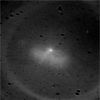
Enygma-W00012854.jpgEnygma (2)57 visiteOriginal caption:"W00012854.jpg was taken on January 05, 2006 and received on Earth January 06, 2006. The camera was pointing toward SKY, and the image was taken using the CL1 and RED filters. This image has not been validated or calibrated".
|
|
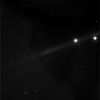
Saturn-E-Ring-W00012982.jpgOver-exposed Moons and the E-Ring57 visiteEscludendo che i due globi luminosi che vediamo in questo frame (in una posizione di quasi allineamento rispetto all'Anello E di Saturno) sìano dei photi-artifacts o degli UFO, la nostra sensibilità nell'analisi dei frames in arrivo dalla Sonda Cassini ci suggerisce l'idea che si tratti di due Lune di Saturno ampiamente sovraesposte.
Ma se ci chiedeste di quali Lune si tratta...Beh, non ci vergognamo di dire che questo proprio non lo sappiamo.
Caption originale:"W00012982.jpg was taken on January 11, 2006 and received on Earth January 12, 2006. The camera was pointing toward Saturn's E-Ring that, at the time, was approximately 2.048.891 Km away.
The image was taken using the CL1 and IRP90 filters and has not been validated or calibrated".
|
|

Rhea-PIA07686.jpgRhea (enhanced but real colors) from about 341.000 Km57 visiteOriginal caption:"This close view of Rhea prominently shows two large impact basins on the ancient and battered moon. The great age of these basins is suggested by the large number of smaller craters that are overprinted within them.
Terrain visible in this view is on the side of Rhea that faces away from Saturn. North on Rhea is up and tilted 30° to the left. This enhanced color view was created by combining images taken using filters sensitive to ultraviolet, visible green and infrared light.
The images were taken with the Cassini spacecraft narrow-angle camera on Dec. 23, 2005, at a distance of approximately 341.000 Km (approx. 212.000 miles) from Saturn and at a Sun-Saturn-spacecraft, or phase, angle of 42°. The image scale is approx. 2 Km (a little more than 1 mile) per pixel".
|
|

Rhea-PIA07689.jpgRhea57 visiteOriginal caption:"Scarred and battered Rhea fills the Cassini spacecraft's view. Notable here is the sharp relief of steep crater walls near the terminator.
Icy Rhea (1.528 Km --> 949 miles across) is Saturn's second-largest moon. This view shows terrain on Rhea's Trailing Hemisphere. North is up and rotated 22° to the left.
The image was taken in visible light with the Cassini spacecraft narrow-angle camera on Dec. 24, 2005 at a distance of approximately 267.000 Km (such as 166.000 miles) from Rhea and at a Sun-Rhea-spacecraft, or phase, angle of 59°. Image scale is 2 Km per pixel".
|
|
| 2245 immagini su 188 pagina(e) |
 |
|
|
|
|
103 | |
|
|
|
|





