| Piú viste - Deep Sky Objects |

NGC-3310.jpgNGC 3310 - Spiral Galaxy (HST)134 visite"...E' Dio che dovrebbe sedere sul Banco degli Imputati.
Lui, l'Altissimo, che siede dinanzi agli storpi, ai ciechi, agli infelici, ai malati senza speranza, agli sventurati che hanno perso ogni cosa, ai Martiri dell'odio razziale, della violenza e del rancore...
E' Dio che dovrebbe essere messo a giudizio, davanti ad una Giuria composta dai Suoi "figli non prediletti" e dalle Sue "pecore senza pascolo".
Una Giuria composta, ahimé, dalle Sue vittime...
(dal film "The Medusa Touch")
|
|

IC-1805-4.jpgIC 1805 - The "Heart" Nebula134 visite"...Nelle chiese abbandonate
Si preparano rifugi,
E nuove astronavi,
Per viaggi interstellari...
In una vecchia miniera,
Distese di sale
E un ricordo di Te:
Come un incantesimo..."
F. Battiato - "I Treni di Tozeur"
|
|

HD-44179-The_Red_Rectangle-PIA04533.jpgHD44179: The "Red Rectangle" - HST134 visite"I've never read a political poem that's accomplished anything. Poetry makes things happen, but rarely - if ever - what the poet wants"
Howard Nemerov
|
|

N63A-2-SR.jpgN63A - Supernova Remnant134 visiteWhat has this supernova left behind? As little as 2.000 years ago, light from a massive stellar explosion in the Large Magellanic Clouds (LMC) first reached planet Earth. The LMC is a close galactic neighbor of our Milky Way Galaxy and the rampaging explosion front is now seen moving out - destroying or displacing ambient gas clouds while leaving behind relatively dense knots of gas and dust. What remains is one of the largest supernova remnants in the LMC: N63A. Many of the surviving dense knots have been themselves compressed and may further contract to form new stars. Some of the resulting stars may then explode in a supernova, continuing the cycle. Pictured above is a close-up of one of the largest remaining knots of dust and gas in N63A taken by the orbiting Hubble Space Telescope. N63A spans over 25 light years and lies about 150.000 LY away toward the southern constellation of Dorado.
|
|

Fomalhaut-HST.jpgA ring of debris around Fomalhaut - HST133 visite"...Fra i diversi Strumenti per il Controllo di Massa di cui abbiamo parlato ce n'è uno che merita particolare attenzione e che si chiama "Deviatore".
Il suo funzionamento è semplicissimo; il rendimento, enorme.
L'uso del Deviatore viene precognizzato dal Trattato di T.W. Veerwaandt sul "Controllo degli Organismi Senzienti e degli Elementi Devianti" e già in quella fonte si prevede l'impiego, come Meccanismi Diffusori, della Televisione (primariamente) e della Letteratura Secondaria o Terziaria - detta anche "Letteratura Vile" - in misura minore.
Si tratta, detto in maniera davvero semplicissima, di far parlare e di far interagire con le Masse degli individui (che chiameremo "Testimonial") i quali non hanno, rispettivamente, nulla da dire né da trasmettere.
Il Deviatore ha il compito primario di distogliere l'attenzione delle Masse dalla focalizzazione dei loro interessi su talune problematiche di primario interesse Sociale, Culturale e Scientifico..."
P.C. Floegers - "Mind Numbing Methods"
|
|

Z machine_sandia_big-1.jpgThe Heart of a Star...On Earth: the Z Machine133 visiteWhy is this plasma so hot? Physicists aren't sure. What is known for sure is that the Z Machine running at Sandia National Laboratories created a plasma that was unexpectedly hot. The plasma reached a temperature in excess of two billion Kelvin (!), making it arguably the hottest human made thing ever in the history of the Earth and, for a brief time, hotter than the interiors of stars. The Z Machine experiment, pictured above, purposely creates high temperatures by focusing 20 million amps of electricity into a small region further confined by a magnetic field. Vertical wires give the Z Machine its name. During the unexpected powerful contained explosion, the Z machine released about 80 times the world's entire electrical power usage for a brief fraction of a second. Experiments with the Z Machine are helping to explain the physics of Solar flares, design more efficient nuclear fusion plants, test materials under extreme heat, and gather data for the computer modeling of nuclear explosions.
|
|

Rigel-1.jpgRigel133 visite"...Il pessimista e' uno che sa come andra' a finire..."
(Roberto Gervaso)MareKromium
|
|
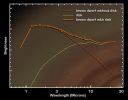
Graph-PIA07337.jpgOTS 44: another "failed" star132 visiteThis graph of data from NASA's SST shows that an extraordinarily low-mass brown dwarf, or "failed star," is circled by a disc of planet-building dust. The brown dwarf, called OTS 44, is only 15 times the mass of Jupiter, making it the smallest known brown dwarf to host a planet-forming disc.
SST was able to see this unusual disc by measuring its infrared brightness. Whereas a brown dwarf without a disc (red dashed line) radiates infrared light at shorter wavelengths, a brown dwarf with a disc (orange line) gives off excess infrared light at longer wavelengths. This surplus light comes from the disc itself and is represented here as a yellow dotted line. Actual data points from observations of OTS 44 are indicated with orange dots. These data were all acquired by using SST's infrared array camera.
|
|

SNR-Cassiopeia_A-SST.jpgCassiopeia A from Spitzer Space Telescope132 visite"...Words...Words like 'Infinity,' or 'God,' 'Eternity,' 'Spirit,' and so on, many others, for which equivalents exist in almost every language in the world, are not the expression of an Idea at all.
They simply express the effort to arrive at this Idea...They express the maximum possible effort to define a concept whose definition is impossible...."
(Traduzione)
"...Parole...Parole come 'Infinito', oppure 'Dio', 'Eternità', 'Spirito' e così via tante altre ancora, di cui esistono equivalenti in quasi tutte le lingue del Mondo, non sono affatto l'espressione di un'Idea.
Esse si limitano ad esprimere lo sforzo di arrivare, a questa Idea...Esse esprimono il massimo sforzo possibile per giungere a definire un concetto la cui definizione è impossibile..."
E.A. Poe - "Eureka"
|
|

30-Doradus and Tarantula Region.jpg30-Doradus, R-136 Star Cluster and the "Tarantula Region"132 visite"...Per alcuni, la Cultura si fa sottovoce, con la semplicità e la condivisione critica delle informazioni.
Per altri si fa strillando, con rabbia, e cercando di imporre agli altri una visione acritica delle informazioni.
Molti pensano che la Cultura, comunque, si possa - o si debba - fare solo attraverso le azioni e le dimostrazioni "pratiche".
Io credo che la Verità sia nel concetto di Cultura che ognuno di noi possiede e ritiene di trasmettere. Io, ad esempio, penso che la Cultura possa farsi solo usando la Parola..."
Paolo Catello Fienga
|
|

2-Milky Way - SST.jpgThe center of the Milky Way: what's behind the dust!132 visite"...Delere licebit quod non edideris; (sed) nescit vox missa reverti..."
(Orazio)
"…Si può cancellare tutto ciò che rimane inespresso; ma una volta che si è parlato, nulla di quanto detto potrà mai essere restituito al silenzio…"
("...Voce dal sen fuggita - Più richiamar non vale; - Non si rattien lo strale - Quando dall'arco uscì..." - Metastasio)
|
|

Beta_Pictoris~0.jpgBeta Pictoris132 visite
Oben am Himmel steht ein einsamer Stern,
Da wohnt unsere Liebe,
So weit entfernt...
Hab' dich lang nicht mehr gesehen,
Ich denk' auch gar nicht mehr an dich;
Ich kann schon wieder aufrecht gehen,
Das konnt' ich vor paar Wochen nicht...
Hast gesagt du hast 'nen andern
Hab' gesagt ist mir egal,
Du wirst endlos weiter wandern,
Und für mich war's freier Fall,
Ich kann ohne dich nicht leben...
Hab' ich gedacht das war nicht wahr,
Und oben am Himmel steht ein einsamer Stern:
Da wohnt unsere Liebe, so weit entfernt...
So wurde aus 'ner Sonne nur ein kalter Planet,
Der Lichtjahre weg (der Lichtjahre weg),
Am Nachthimmel steht (am Nachthimmel steht)...
Und schau' ich mal zum Himmel nach dem kleinen Stern,
Dann denke ich an dich ich tu'
Das immer noch gern...
Jeder Blick nach oben, erinnert mich daran;
Dass es Dinge gibt (Dass es Dinge gibt),
Die man nicht halten kann (die man nicht halten kann)...
Ich hab' gedacht ich müsste sterben,
Als du sagtest es ist aus;
Um mich herum nur'n Haufen Scherben,
Ich dacht' da komm' ich niemals raus...
Dabei fing mein ganzes Leben
Als du weggingst eigentlich an...
Und oben am Himmel steht ein einsamer Stern,
Da wohnt unsere Liebe, so weit entfernt;
So wurde aus 'ner Sonne nur ein kalter Planet,
Der Lichtjahre weg (der Lichtjahre weg),
Am Nachthimmel steht (am Nachthimmel steht)...
Und schau' ich mal zum Himmel nach dem kleinen Stern,
Dann denke ich an dich ich tu' das immer noch gern;
Jeder Blick nach oben, erinnert mich daran,
Dass es Dinge gibt (dass es Dinge gibt),
Die man nicht halten kann (die man nicht halten kann)...
So denke ich manchmal, still an dich,
Weil ganz vergessen kann, ich dich nicht,
Ein Stern ist ein Stern und kein schwarzes Loch,
Es wird immer so sein, es wird immer zu sein...
Verdammt ich lieb' dich noch!
Und oben am Himmel steht ein einsamer Stern,
Da wohnt unsere Liebe,
So weit entfernt,
So wurde aus 'ner Sonne nur ein kalter Planet,
Der Lichtjahre weg ,
Der Lichtjahre weg)...
Am Nachthimmel steht (am Nachthimmel steht)
Und schau' ich mal zum Himmel nach dem kleinen Stern,
Dann denke ich an dich ich tu' das immer noch gern,
Jeder Blick nach oben, erinnert mich daran
Dass es Dinge gibt (dass es Dinge gibt)
Die man nicht halten kann (die man nicht halten kann)...
By Matthias ReimMareKromium
|
|
| 1039 immagini su 87 pagina(e) |
 |
|
|
|
|
14 | |
|
|
|
|








