| Piú viste - Deep Sky Objects |

WhiteDwarf.jpgWhite Dwarf149 visite"...Urbes constituit aetas, hora dissolvit. Momento fit cinis, diu silva..."
(Seneca)
"…Un lungo tempo ci volle per creare le citta, un istante per distruggerle. Ed in un istante la secolare foresta, divenne cenere…"
(Una considerazione sul Tempo 'consumatore di tutte le cose' - incluse le grandi opere della Natura e dell'Uomo? Non pensiamo.
Secondo noi si tratta dell'efficace descrizione di una catastrofe, tanto subitanea, quanto inaspettata. Forse la cronaca delle conseguenze dell'impatto di una meteora? Forse Seneca ci racconta, a modo suo, di un'altra "Tunguska", occorsa più di duemila anni orsono...)
|
|

Spiral-HST.jpgA "Cosmic Spiral" from LL Pegasi 149 visite"...Personne n'ose renoncer à une habitude. Nombreux sont ceux qui, au bord du suicide, ont renoncé à passer à l'acte grâce au souvenir du café où ils se rendent chaque soir pour jouer aux cartes..."
(Traduzione)
"...Nessuno osa dire addio ad un'abitudine. Molti aspiranti suicidi si son fermati sulla soglia della morte per il ricordo del caffé dove vanno tutte le sere a fare la loro partita a carte..."
Honoré de BalzacMareKromium
|
|

Keyhole Nebula 1 - HST.jpgThe "Keyhole" Nebula - HST148 visite"...Cogitationis poenam nemo patitur..."
(Ulpiano)
"...Nessuno può essere punito per ciò che pensa..."
|
|

HD 107146 + AU Microscopii.jpgHD 107146 and AU Microscopii148 visite"...Nihil est tam difficile et arduum, quod non humana mens vincat et in familiaritatem perducat adsidua meditatio..."
(Seneca)
"...Non esiste mistero tanto complesso ed arduo che la Mente Umana non riesca, usando una costante riflessione, a sciogliere e comprendere..."
|
|

Mira~0.jpgMira (alias Omicron Ceti)148 visite"...If you want to find out what is happening in an age or in a Nation, find out what is happening to the Writers, the "Town Criers"..."
Ben Okri (On the death sentence passed on Ken Saro Wiwa)
|
|

Tachyons-1.jpgHow to contact "Them"? Tachyon Signal (1)148 visiteA Tachyon (or Tachyonic Particle) is a (not very much) hypothetical Particle that always travels faster than Light. Most physicists believe that faster-than-Light Particles cannot exist because they are not consistent with the known (note: so far "known"!) Laws of Physics. If such Particles did exist, and could send signals faster than light, then according to the Theory (note: "Theory"...) of Relativity, they would violate Causality, leading to logical paradoxes, like the "Grandfather Paradox!. Tachyons would also exhibit the unusual property of increasing in speed as their energy decreases, and would require infinite energy to slow down to the speed of Light. No experimental evidence for the existence of such Particles has been found. (note: false!)
In the 1967 paper that coined the term, Gerald Feinberg proposed that Tachyonic Particles could be made from excitations of a Quantum Field with imaginary mass. However, it was soon realized that Feinberg's model did not in fact allow for Superluminal (faster-than-light) speeds. Nevertheless, in modern Physics, the term Tachyon often refers to "imaginary" Mass fields rather than to "faster-than-light Particles".
Such (imaginary...) Fields have come to play a significant role in modern Physics.
The term comes from the Greek, where "tachy" means "fast". The complementary Particle types are called Luxons (which always move at the speed of light) and Bradyons (which always move slower than light); both of these Particle types are known to exist.MareKromium
|
|

NGC-2207_and_IC-2163.jpgNGC 2207 and IC 2163 (Colliding Galaxies)147 visite"...Dum fata sinunt vivite laeti..."
(Seneca)
"...Sinché le circostanze lo consentono, vivete felicemente..."
|
|
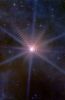
WR-140.jpgWR-140147 visiteLe Stelle di Wolf-Rayet (a sigla "WR", appunto) sono molto luminose, molto massicce e molto calde. Ultimamente il telescopio spaziale James Webb ne ha osservata una a circa 5.600 Anni Luce di distanza, chiamata WR 140, osservandone una caratteristica meravigliosa e regalandoci un'immagine impressionante.
In realtà questa Stella appartiene a un Sistema Binario allocato nella Costellazione del Cigno. L'interazione tra questi due astri produce eruzioni periodiche di polvere che si espandono creando un effetto ottico particolarissimo, con anelli di luce concentrici
La polvere è una forma di Carbonio, che assorbe la luce ultravioletta delle due stelle. Questo riscalda la polvere, facendola riemettere la Radiazione Termica, che è ciò che viene osservato da Webb nelle lunghezze d'onda dell'InfraRosso. Sono visibili circa 20 anelli, il che significa che nell'immagine Webb è possibile vedere circa 160 anni (???) di gusci di polvere. L'osservazione del James Webb fa parte di uno studio più ambio sulla natura del sistema e non è detto che non ci poterà a scoprire qualcosa di assolutamente nuovo su questa coppia di stelle.
§§§
Nota: questa "fotografia" sembra più il prodotto di una "Visione Artistica" dell'oggetto considerato e NON una immagine reale vera e propria (in altre parole, NON è un frame originale del JWST). Molti dettagli (che anche un dilettante noterebbe) lasciano supporre che non si tratti di una "vera" foto ma, qualora lo fosse, sarebbe (per me) inevitabile concludere che il frame originale sia stato largamente "rivisto e corretto".
Ovviamente sono pronto a scusarmi se avessi sbagliato. Attendo "lumi" (da Astronomi, Astrofisici o chi per essi).
Dr Paolo C. Fienga (PhD)MareKromium
|
|

RED RECTANGLE NEBULA.jpgProto-planetary "Red Rectangle" Nebula - HST146 visite"...Billy, wearing one of his beautiful new scarves, fell into the fire, burning to ashes.
Now, although the room is getting colder, I don't have the heart to stir up Poor Billy..."
(Traduzione)
"...Billy, con una delle sue belle sciarpe nuove, cadde nel fuoco, riducendosi in cenere.
Ora, sebbene la stanza sia sempre più fredda, non ho il coraggio di attizzare il Povero Billy..."
Harry Graham
|
|
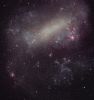
Large Magellan Cloud.jpgThe "Large Cloud of Magellan"146 visite"...Parlando dei viaggi nel tempo - a prescindere dal fatto che si possa o non possa arrivare a farli -, io credo che l'uomo che riesce a conoscere il suo futuro, finisca con il non aver più un futuro. Vivrà (se vivrà...) per fare o non fare quello che il suo "futuro", non più ignoto, gli avrà "suggerito" di fare o non fare.
E' così, credimi: se togli all'Uomo il "Mistero", non gli fai un favore: riesci solo a rubargli la Speranza..."
P.C. Floegers - "In the Paradox"
|
|
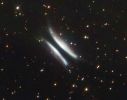
Gomez_s Hamburger - HST.jpgProtoplanetary Nebula - "Hamburger"145 visiteUn commento a questa immagine si impone: questa nebulosa protoplanetaria è stata chiamata "hamburger" - si, proprio come i panini di Mc Donald's... -. Un elevatissimo quantitativo di oggetti relativi allo spazio ed ai pianeti in generale ed a Marte in particolare viene quotidianamente battezzato usando una nomenclatura - quando va bene - "oscura" e, quando va male, "ridicola" sino ai limiti dell'offensivo. Ci siamo spesso chiesti il perchè di questo (per lo meno "curioso") approccio ai Misteri dell'Universo e, alla fine, ci siamo convinti che l'attribuzione di nomi ridicoli costituisca un modo di esorcizzare quello che non riusciamo a comprendere, in tutto o in parte, facendolo ricadere sotto una realtà che deve essere "nota" ed "innocua". Noi non sappiamo se questo modo di ragionare sia giusto o no, ma una cosa è certa: alle volte si esagera. La nebulosa "Hamburger", secondo noi, fa parte della casistica in cui si è esagerato nella semplificazione, ottenendo il risultato della "banalizzazione".
O no?!?..
|
|

M2-9 Planetary Nebula.jpgThe "M2-9 Planetary Nebula" (HST)145 visite"...Omnis feret omnia tellus..."
(Virgilio)
"...Ogni terra produrrà ogni specie di frutti..."
|
|
| 1039 immagini su 87 pagina(e) |
 |
|
|
|
|
10 | |
|
|
|
|








