| Piú viste - Messier Objects |

M-057-2.jpgM 57 - The "Ring Nebula" in Lyrae160 visite"...Se durante questa Vita non dovessi incontrarti, fa che almeno senta la Tua mancanza..."
(dal film "La sottile linea rossa")
|
|

M-101-4.jpgM 101 - Spiral Galaxy159 visite"...Dominum mundi flectere vota valent..."
(Marziale)
"...Le preghiere degli uomini possono piegare gli Dei..."
|
|

M-045-2.JPGM 45 - "The 7 Sisters" - Open Star Cluster in Pleiades (2)156 visite"...Cosa c'é? Ti vedo irrequieto...Hai visto qualcosa?"
"...Non saprei, ma mi è sembrato che qualcuno ci stesse spiando.
Ho visto qualcosa muoversi, dietro le Pleiadi..."
Paolo Catello Fienga
|
|

M-031~3.jpgNGC 206 and the Star Clouds of Andromeda (Credits: Bob and Janice Fera - Fera Photography) 156 visite"...Quando comincia una Guerra,
La Prima Vittima
E' sempre la Verità.
Quando la Guerra finisce,
Le bugie dei Vinti
Sono smascherate,
Quelle dei Vincitori
Diventano Storia..."
("A una ragazza del '43" - Arrigo Petacco)MareKromium
|
|

M-008-93.jpgM 8 - The "Lagoon Nebula"154 visite"...Certe cose che una Generezione considera lusso, per la Generazione successiva sono necessità..."
Anthony Crosland
MareKromium
|
|

M-016-3.jpgM 16 - The "Eagle Nebula" (detail mgnf) - possible Star Nursery - HST152 visite"...Discite, o miseri, et causas cognoscite rerum,
Quid sumus et quidnam victuri gignimur..."
(Persio)
"...Imparate, o uomini, la causa delle cose, quello che siamo, perché nasciamo e perché viviamo..."
|
|

M-045-4.jpgM 45 and April's Moon150 visite"Ignoranti quem portum petat, nullus suus ventus est"
(Seneca)
"Le navi degli indecisi non hanno mai il vento a favore"
|
|

M-016-94.jpgM 16 - Pillar Detail149 visite"...Mi sorprendo sempre quando mi accorgo che i ragazzini che stanno studiando qualche frammento scomposto della nostra Storia, guardano al Medio Evo e poi, con leggerezza e quasi con sollievo, parlano di "Secoli Bui": sorrido e vorrei offrir loro una candela, da tenere sempre con sé, pronti ad usarla durante il loro cammino, ma a che servirebbe?
Capirebbero quello che cerco di dire loro?
Essi sono solo viandanti, sperduti ed ormai quasi completamente ciechi, i quali non riescono a rendersi conto che la lontana oscurità di cui parlano è solo il riverbero di quella in cui loro stessi, sebbene rassicurati dalle suadenti voci di vicine ed ingannevoli sirene, stanno vagando..."
Paolo Catello Fienga
|
|

Messier_074-PIA13376.jpgM 74 - Spiral Galaxy, the Asteroid 3540 Protesilaos and an unsual resemblance...149 visiteCaption NASA:"It's a bird! It's a plane! Nope, it's an Asteroid tracking its way across the sky with a beautiful Spiral Galaxy in the background. In the center of this new mosaic image captured by NASA's Wide-field Infrared Survey Explorer (WISE) is the galaxy Messier 74, with its spiral arms seen face-on. The bright reddish object moving across the lower right part of the image is the much closer asteroid 3540 Protesilaos, seen at different points in its orbit around the Sun. WISE observed and detected this previously known Asteroid a total of ten times, although only a few of those frames were used in this mosaic.
Also known as NGC 628, the Messier 74 Galaxy is between 24,5 and 36 Million Light-Years away, and has a diameter of about 100.000 LY.
It is suspected to have a Black Hole at its center, with a mass equal to 10.000 Suns. It is one of only a handful of known Black Holes with masses intermediate between the relatively smaller ones that form from collapsing stars and the supermassive Black Holes millions of times more massive than the Sun, which are more typically found at the centers of Galaxies.
Although it is called a Messier Object, Messier 74 was actually discovered by Pierre Mechain in 1780, who then told his friend Charles Messier about it. As one of the dimmest of all Messier objects, this Galaxy is a challenge for amateur astronomers to see in Visible Light, but the WISE cameras captured it clearly in InfraRed Light.
The colors used in this image represent different wavelengths of IR Radiation. Blue and cyan represent light at 3,4 and 4,6 microns, respectively. These colors show both nearby stars inside the Milky Way Galaxy and the combined light of billions of stars that make up Messier 74. Green and red represent light from 12 and 22 microns, respectively. These colors show light from cooler objects and material. Dust in star-forming regions in Messier 74 traces its spiral structure. The coolest object in the picture is the asteroid 3540 Protesilaos.
This Asteroid was first seen in 1973 by the German astronomer Freimut Börngen, who discovered more than 500 Asteroids while he was researching galaxies. At the time that WISE observed 3540 Protesilaos, it was at a distance of about 772 MKM from Earth (approx. 480 million miles, or also approx. 43 Light-Minutes). It is classified as a Jupiter Trojan Minor Planet, which are small rocky bodies that share the same orbit around the Sun as the planet Jupiter. Based on the infrared observations, the WISE team estimates the Asteroid to be about 90 Km (approx. 56 miles) across and to reflect only a few percent of the light that lands on it, which makes it about as dark as coal.
By convention, Trojan Asteroids are named after the heroes from the Trojan War. In this case, asteroid 3540 is named after the hero Protesilaos. According to Greek Mythology, Protesilaos was the first Greek to set foot on Trojan land during the war.
Unfortunately for him, there was a prophecy that the first soldier in the war to step onto land from a battle ship would die. The prophecy quickly came true and Protesilaos was killed.
JPL manages the Wide-field Infrared Survey Explorer for NASA's Science Mission Directorate, Washington. The principal investigator, Edward Wright, is at UCLA. The mission was competitively selected under NASA's Explorers Program managed by the Goddard Space Flight Center, Greenbelt, Md. The science instrument was built by the Space Dynamics Laboratory, Logan, Utah, and the spacecraft was built by Ball Aerospace & Technologies Corp., Boulder, Colo. Science operations and data processing take place at the Infrared Processing and Analysis Center at the California Institute of Technology in Pasadena. Caltech manages JPL for NASA. More information is online at http://www.nasa.gov/wise and http://wise.astro.ucla.edu".MareKromium
|
|

M-020-7.jpgM 20 - different views of the "Trifid Nebula" - SST145 visite"...Ubi non est Pudor,
Nec cura Iuris, Pietas, Fides,
Instabile regnum est..."
(Seneca)
"...Il Regno in cui manchi il Pudore, la Certezza del Diritto, la Pietà (e) la Fede è (in verità) un Regno effimero..."
|
|
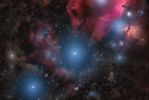
M_042_Orion.jpgOrion's Belt (Image Credits: Aygen Erkaslan)145 visite"Abstraction: A process through which principles are formulated by investigating a series of experimental data relating to a given phenomenon, identifying their common characteristics.
These are used as the basis for subsequent deductions, and their validity is confirmed if there is full agreement between the deductions themselves and the observational data."
(Traduzione)
Astrazione: procedimento attraverso il quale si giunge alla formulazione di principii partendo dall’indagine su una serie di dati sperimentali inerenti a un dato fenomeno, individuando ciò che vi è in essi di comune,
Questi vengono assunti a fondamento di successive deduzioni e la loro validità è confermata se vi è pieno accordo tra le deduzioni medesime e i dati dell’osservazione.MareKromium
|
|

M-016-98.jpgM 16 - Gaseous Pillars inside the "Eagle Nebula" - HST144 visite"...Felix qui potuit rerum cognoscere causas..."
(Virgilio)
"...Felice è colui che può (è capace di) riesce a capire il perché delle cose..."
|
|
| 359 immagini su 30 pagina(e) |
 |
3 | |
|
|
|
|
|
|
|
|








