| |

| Piú viste - Curiosity and the Exploration of Gale Crater |

SOL0050-MR0229011000E1_DXXX-2-GB-LXTT-IPF.jpgUnusually-looking bright Object near Curiosity - Sol 50 (Natural Colors; credits for the research and the additional process.: Dr Gianluigi Barca/Lunar Explorer Italia/Italian Planetary Foundation)153 visiteSi è parlato tanto, tantissimo (forse anche un tantino troppo ed anche un pò a sproposito - secondo noi) dell'oggetto "anomalo" ripreso dal Rover Curiosity nei suoi pressi durante i Soles andanti da 61 a 65, ma nulla è stato detto a proposito di quest'altro "oggetto anomalo" e ad "Albedo Elevata" che giace ad un 5/6 metri da Curiosity e che è stato immortalato durante il Sol 50 della Missione del nuovo Super-Rover a Gale Crater.
Si tratta dello stesso oggetto?
Diremmo proprio di no: questo è nettamente più grande e luccicante.
Si tratta di un pezzo del Rover o dei suoi rivestimenti? Può darsi, ma come potremmo mai esserne certi? Noi ricordiamo di un altro oggetto luccicante e dall'apparenza metallica che venne ripreso dal Rover Spirit durante i primi Soles della sua Missione a Gusev. Lo segnalammo alla NASA e, come ovvio, non ottenemmo risposte.
Ora, dopo la Scoperta fatta dai nostri Senior Partner, Elisabetta Bonora e Marco Faccin, della possibile Anomalia dei Soles 61-63, la NASA si è pronunciata ed ha detto: "Nulla di grave, nulla di preoccupante: la natura dell'oggetto è benigna. Si tratta, probabilmente, di un pezzo del rivestimento del Rover o del suo Robotic Arm".
Va bene. E di questo altro oggetto, che mi dite? Da dove si è staccato questo "frammento" di qualcosa? Viene dal Rover? Viene dallo Sky-Crane? Oppure è quelcosa che è sempre stata lì?
Purtroppo abbiamo un solo frame che lo riprende: questo. E non abbiamo risposte da darVi (solo la NASA sa rispondere sempre a tutto ed ha una risposta per tutto). Noi abbiamo solo domande. E dubbi.
Le Vostre opinioni su questa nuova Anomalia Marziana saranno apprezzate.MareKromium
|
|

SOL2666-3D.jpgSol 2666 - "Alien Backbone"? 3D (Credits for the additional process. and color.: Marco Faccin ed Elisabetta Bonora)153 visitenessun commento ulterioreMareKromium
|
|

SOL2609.jpgInteresting Rock - Sol 2609 (Credits for the additional process. and color.: Dr Marco Faccin and Elisabetta Bonora)153 visitenessun commentoMareKromium
|
|

SOL0738-1581_PIA25821-web.gif153 visiteNASA’s Perseverance Mars rover used one of its navigation cameras to take a series of images of drifting clouds just before sunrise on March 18, 2023, the 738th Martian day, or sol, of the mission.
Scientists on both the Perseverance mission and NASA's Curiosity rover mission are studying the formation process of Martian clouds.
A key objective for Perseverance's mission on Mars is astrobiology, including the search for signs of ancient microbial life. The rover will characterize the planet's geology and past climate, pave the way for human exploration of the Red Planet, and be the first mission to collect and cache Martian rock and regolith (broken rock and dust).
Subsequent NASA missions, in cooperation with ESA (European Space Agency), would send spacecraft to Mars to collect these sealed samples from the surface and return them to Earth for in-depth analysis.
The Mars 2020 Perseverance mission is part of NASA's Moon to Mars exploration approach, which includes Artemis missions to the Moon that will help prepare for human exploration of the Red Planet.MareKromium
|
|

SOL0192-MF-LXTT-IPF-3.jpgExtremely unusually-looking Surface Feature on the Surface of Gale Crater: "The Transparent Ring" - Sol 192 (EDMs - Credits: Research, additional process. and color.: Elisabetta Bonora and Marco Faccin/LXTT/IPF)152 visiteIl dettaglio qui evidenziato è semplicemente affascinante e, secondo noi, ASSOLUTAMENTE REALE. Ed inspiegabile, se non altro usando la Logica e gli approcci di Ricerca Scientifica "convenzionali". Un GRANDISSIMO COMPLIMENTO a Merco Faccin ed Elisabetta Bonora per questa loro ennesima Scoperta! Il Tempo, ne siamo convinti, ci riconoscerà quei meriti che l'attuale Comunità Scientifica (gretta ed arcaica, poichè ormai chiusa "a riccio" su posizioni che non esito a definire "Medioevali" - con tutto il rispetto che il Medio Evo merita...) non è neppure in grado di comprendere.MareKromium
|
|

SOL0710-0710MR0030150070402501E01_DXXX-000.jpgThe "Crab/Octopus-like Feature" (CTX Frame) - Sol 710152 visiteUn'immagine bella ma, apparentemente, insignificante per gli Anomaly Hunters. Eppure...
MareKromium
|
|

SOL0589-NRB_449790582EDR_F0310000NCAM00262M_.jpgBright Spark in the distance (Original NASA - Mer Curiosity Frame) - Sol 589152 visiteThis image from the Navigation Camera (Navcam) on NASA's Curiosity Mars rover includes a bright spot near the upper left corner. The sun is in the same direction, west-northwest, above the frame. Bright spots appear in images from the rover nearly every week. Typical explanations for them are cosmic rays hitting the light detector or sunlight glinting from rocks.
The right-eye camera of the stereo Navcam recorded this frame during the afternoon of the 589th Martian day, or sol, of Curiosity's work on Mars (April 3, 2014), from the site where the rover reached a waypoint called "the Kimberley" by that sol's drive. An image taken by the Navcam's left-eye camera within one second of the same time (http://mars.jpl.nasa.gov/msl/multimedia/raw/?rawid=NLB_449790582EDR_F0310000NCAM00262M_&s=589) does not include a bright spot of this type. A pair of Navcam images in the same direction from the previous afternoon has a bright spot similarly located in the right-eye image http://mars.jpl.nasa.gov/msl/multimedia/raw/?rawid=NRB_449700848EDR_F0301254NCAM00252M_&s=588) but not in the left-eye image (http://mars.jpl.nasa.gov/msl/multimedia/raw/?rawid=NLB_449700848EDR_F0301254NCAM00252M_&s=588).
One possible explanation for the bright spot in this image is a glint from a rock surface reflecting the sun. Another is a cosmic ray hitting the camera's light detector, a CCD (charge-coupled device). Cosmic ray patterns in Mars rover images vary from a dot to a long line depending on the angle at which the ray strikes the detector.
NASA's Jet Propulsion Laboratory, a division of the California Institute of Technology, Pasadena, manages the Mars Science Laboratory Project for NASA's Science Mission Directorate, Washington. JPL designed and built the project's Curiosity rover and the Rover's Navcam.MareKromium
|
|

SOL3048-1050_E-PIA24662-LXTT-IPF.jpgIridescent Clouds over Gale Crater - Sol 3048152 visiteCaption NASA Originale:"NASA’s Curiosity Mars Rover spotted these Iridescent, or “Mother of Pearl,” Clouds on March 5, 2021, the 3.048th Martian Day, or Sol, of the Mission. Seen here are five images stitched together from a much wider panorama taken by the rover’s Mast Camera, or Mastcam". MareKromium
|
|

SOL0174-PIA16804-PCF-LXTT-IPF.jpgSutton Inlier - Sol 174 (Absolute Natural Colors; credits for the additional process. and color.: Dr Paolo C. Fienga/Lunar Explorer Italia/Italian Planetary Foundation)151 visiteThis frame, which was taken by the Mast Camera (MastCam) onboard the NASA - Mars Exploration Rover (MER) - Mars Laboratory "Curiosity", shows us some very interesting colors which were found inside a Rock called "Sutton Inlier": a relatively small Rock that was broken by the Rover itself, while driving over it.
The MastCam took this image during the 174th Martian Day, or Sol, of the Rover's work at Gale Crater - Mars (such as January 31, 2013 on Earth). The Rock is about 5" - inches - (such as 12,7 centimeters) wide at the end closest to the camera. The inside of the Rock, which is found in the "Yellowknife Bay" area of Gale Crater, shows us a color that lies in between from a light gray to a very pale blue, and without traces of orange or red (the colors that, as you know, are the typical ones that characterize almost all the exposed - to the Martian Open Environment - Dusty and/or Rocky Materials and Surfaces).
This picture (which is an Original NASA - Mars Exploration Rover - Mars Laboratory "Curiosity" natural"color frame published on the NASA - Planetary Photojournal with the ID n. PIA 16804) has been additionally processed and then re-colorized in Absolute Natural Colors (such as the colors that a human eye would actually perceive if someone were near the NASA - Mars Exploration Rover (MER) - Mars Laboratory "Curiosity" and then looked ahead, towards the Rock dubbed "Sutton Inlier", which is located in front of the Rover), by using an original technique created - and, in time, dramatically improved - by the Lunar Explorer Italia Team. Different colors, as well as different shades of the same color, mean, among other things, the existence of different Elements (Minerals) present on the Surface of Gale Crater, each having a different Albedo (---> Reflectivity) and Chemical Composition.MareKromium
|
|

SOL0027-PIA16803-PCF-LXTT-IPF.jpgOn the Floor of Gale... - Sol 27 (Absolute Natural Colors; credits for the additional process. and color. Dr Paolo C. Fienga/Lunar Explorer Italia/Italian Planetary Foundation)151 visiteThis frame, taken by the Mast Camera (MastCam) onboard the NASA - Mars Exploration Rover (MER) - Mars Laboratory "Curiosity", shows to Planetary Researchers some very interesting colors, patterns and textures in this Unnamed Rock imaged during the 27th Martian Day, or Sol, of the Rover's work at Gale Crater - Mars (such as September, 2, 2012 on Earth). The Unnamed Rock is about 2,4" (such as approx. 6,096 centimeters) across and it shows a relatively dark gray-blue color overall, with lighter, whitish tones which are organized in patterns that may indicate/suggest the presence of distinct Crystals made of different Materials (---> Minerals) inside it.
Several Patches of very thin Dust, showing the usual (and let's say "dominant", on the Floor of Gale Crater) light brown-orange color, can also be seen all over the Rock and, in particular, on its very top as well as on to its, relatively, flat right side. Last, but not least, after a very careful observation of the lower Features of the Rock, we believe, as IPF, that the possibility where the Rock itself might be (even partially) empty (thus making it look like an irregular "bowl" or an "helmet", once it is turned upside-down) should also be considered.
This picture (which is an Original NASA - Mars Exploration Rover - Mars Laboratory "Curiosity" natural color frame published on the NASA - Planetary Photojournal with the ID n. PIA 16803) has been additionally processed and then re-colorized in Absolute Natural Colors (such as the colors that a human eye would actually perceive if someone were near the NASA - Mars Exploration Rover (MER) - Mars Laboratory "Curiosity" and then looked ahead, towards the Rock dubbed "Sutton Inlier", which is located in front of the Rover), by using an original technique created - and, in time, dramatically improved - by the Lunar Explorer Italia Team. Different colors, as well as different shades of the same color, mean, among other things, the existence of different Elements (Minerals) present on the Surface of Gale Crater, each having a different Albedo (---> Reflectivity) and Chemical Composition.MareKromium
|
|
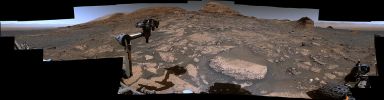
SOL3167.jpgFunny Sky... - Sol 3167151 visiteLa NASA ci dice che si tratta di "false colors" (od anche "white balanced"). Va bene. Ci credo. O forse no...
Caption NASA originale: "Images of knobbly rocks and rounded hills are delighting scientists as NASA’s Curiosity Rover climbs Mount Sharp, a 5-mile-tall (such as approx. 8-Km tall) mountain within the 96-mile-wide (such as about 154-Km wide) basin of Mars’ Gale Crater. The rover’s Mast Camera, a.k.a. MastCam, highlights those features in a panorama captured on July, 3rd, 2021 (i.e. the 3167th Martian Day, or Sol, of the Mission)".
This location is particularly exciting: Spacecraft orbiting Mars show that Curiosity is now somewhere between a Region enriched with clay minerals and one dominated by salty minerals called Sulfates. The mountain’s layers in this area may reveal how the ancient environment within Gale Crater dried up over time. Similar changes are seen across the planet, and studying this Region up close (---> da vicino) has been a major long-term goal for the mission.
"The rocks here will begin to tell us how this once-wet planet changed into the dry Mars of today, and how long habitable environments persisted even after that happened,” said Abigail Fraeman, Curiosity’s deputy project scientist, at NASA’s Jet Propulsion Laboratory in Southern California".
The "Dry Mars of today"... Mmmmmhhhhh.... Are we really sure about that?!? I am not. And You?!?MareKromium
|
|

SOL1492.jpgBright Panorama - Sol 1492 (Credits: Dr Marco Faccin and Elisabetta Bonora)150 visiteHey, NASA Guys: look at this! Can you do any better?!?MareKromium
|
|
| 261 immagini su 22 pagina(e) |
|
|
|
5 | |
|
|
|
|
|
|
|
|








