| Piú viste - Curiosity and the Exploration of Gale Crater |

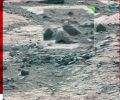
SOL0054-PIA14762-NASA-JPL-Caltech-MSSS.jpg"Bathurst Inlet" Rock - Sol 54 (Natural Colors; credts: NASA/JPL-Caltech, Malin Space Science Systems)93 visiteNASA's Mars Rover Curiosity held its Mars Hand Lens Imager (MAHLI) camera about 10,5" (---> inches, such as about 27 centimeters) away from the top of a Rock called "Bathurst Inlet" for a set of 8 images combined into this merged-focus view of the Rock. This context image covers an area that is roughly 6,5 by 5" (such as 16 by 12 centimeters). Resolution is about 105 microns per pixel.
MAHLI took the component images for this merged-focus view, plus closer-up images of Bathurst Inlet, during Curiosity's 54th Martian Day, or Sol (such as September 30, 2012). The instrument's principal investigator had invited Curiosity's science team to "MAHLI it up!" in the selection of Sol 54 targets for inspection with MAHLI and with the other instrument at the end of Curiosity's Arm: the Alpha Particle X-Ray Spectrometer.
The "Bathurst Inlet" Rock is dark gray and appears to be so fine-grained that MAHLI cannot resolve Grains or Crystals in it. This means that the Grains or Crystals, if there are any at all, are smaller than about 80 microns in size. Some windblown sand-sized Grains or Dust Aggregates have accumulated on the Surface of the Rock, but this Surface is clean (if compared, for example, to the pebbly substrate below the rock - upper left and lower right in this context image).
MAHLI can do focus merging onboard the MER and, in fact, the full-frame versions of the 8 separate images that were combined into this view were not even returned to Earth -- just the thumbnail versions. In other words, merging the images onboard reduces the volume of data that is supposed to be downlinked to Earth.MareKromium
|
|

SOL0058-EB-MF-LXTT-IPF-3.jpgGale's Surface - Sol 58 (an Image-Mosaic in Natural Colors; credits for the additional process. and color.: Elisabetta Bonora and Marco Faccin/Lunar Explorer Italia/Italian Planetary Foundation)93 visitenessun commentoMareKromium
|
|

SOL0528-PIA17931-PCF-LXTT-IPF-3.jpgBizarre-looking Rocks - Sol 528 (Absolute Natural Colors; credits for the additional process. and color. Dr Paolo C. Fienga/LXTT/IPF)93 visiteDue rocce decisamente curiose (specie quella posta alla Sx dell'Osservatore), le quali presentano una caratterizzazione superficiale assolutamente peculiare. Se Gale Crater, effettivamente ed in un'era remota, fu veramente un Lago, allora quello che si vede sulle due rocce potrebbe essere il residuo - fossile - di vegetazione sub-lacuale. E non solo! Sulla roccia di Sx, si vede NETTAMENTE l'esistenza di un foro il quale, come già ipotizzammo in passato - per un caso simile - potrebbe essere un Predatory Borehole.
Ovviamente la NASA, su questo ed altri rilievi similari, ha detto il solito. E cioè nulla. Voi che ne pensate?!?
p.s.: guardate la roccia "porosa", "irregolare" e "forata" a Dx ed osservate come essa sembra essere "parte integrante" della roccia stratificata sottostante. Sono tutt'uno? Sono l'una "appoggiata" all'altra? Si sono "incollate" nelle ere?.... Che ne dite?MareKromium
|
|

SOL3418-PIA25177.gifWInds... - Sol 3418 (GIF-Movie)93 visiteCaption NASA Originale:"NASA’s Curiosity Mars rover used one of its Hazard-Avoidance Cameras (Hazcams) to catch this dusty wind gust blowing overhead on March 18, 2022, the 3,418th Martian day, or sol, of the mission. Scientists believe it’s a wind gust rather than a dust devil since it doesn’t appear to have the trademark vorticity, or twisting, of a dust devil.
The series of images captured by the Hazcam is viewable in the top image; the bottom image shows the frames after they’ve been processed by change-detection software, which helps the viewer see how the wind gust moves over time.".MareKromium
|
|

SOL0014-EB-MF-LXTT-IPF.jpgClose-up at Gale: Salt? - Sol 14 (RAW Natural Colors; credits for the additional process. and color.: Elisabetta Bonora and Marco Faccin/Lunar Explorer Italia/Italian Planetary Foundation)92 visitenessun commentoMareKromium
|
|

SOL0130-PIA16562-PCF-LXTT-IPF-2.jpgOn the Edge of "Yellowknife Bay" - Sol 130 (an Image-Mosaic in Absolute Natural Colors; credits for the additional process. and color. Dr Paolo C. Fienga/Lunar Explorer Italia/Italian Planetary Foundation)92 visitenessun commentoMareKromium
|
|

SOL0126-2-GB-LXTT-IPF.jpgFeatures of Yellowknife Bay - Sol 127 (an Image-Mosaic in RAW Natural Colors; credits for the additional process. and color.: Dr Gianluigi Barca/Lunar Explorer Italia/Italian Planetary Foundation)92 visitenessun commentoMareKromium
|
|
SOL0198-MR1007040000E1_DXXX-EB-MF-LXTT-IPF-3.jpg"The Horned Mars"... - Sol 198 (High-Def-3D; credits for the additional process.: Elisabetta Bonora and Marco Faccin/Lunar Explorer Italia/Italian Planetary Foundation)92 visiteEd infine, nell'anaglifo ad Alta Definizione, ecco che il Rilievo Controverso (chi dice "una specie di corno" e chi "una sorta di verme") ci appare tanto chiaro ed evidente, quanto straordinario nella sua "Singolarità". Un GRANDISSIMO Complimento ancora a Marco Faccin (Titanio44) ed Elisabetta Bonora (2di7) per la loro incredibile (eppur vera) Scoperta!
Ed ora vediamo da chi ci verrà rubata e come la NASA (o chi per essa) la smonterà, dicendoci che un "Rilievo" simile è "assolutamente normale"....MareKromium
|
|

SOL3758-mars_nasa_gov_msl-raw-images_msss_03758_mcam_3758MR1036740021803144C00_DXXX.jpgPanorama (1) - Sol 375892 visitenessun commento (o magari "si", ma perché toglierVi il piacere di scoprire la "curiosità"?!?)MareKromium
|
|

SOL0016-NRA_398919544EDR_F0030078NCAM00300M_.jpgRover Tracks - Sol 16 (Absolute Natural Colors; credits for the additional process. and color.: Dr Paolo C. Fienga - Lunar Explorer Italia/Italian Planetary Foundation)91 visitenessun commentoMareKromium
|
|

SOL0127-1-GB-LXTT-IPF.jpgFeatures of Yellowknife Bay - Sol 127 (an Image-Mosaic in Calibrated Natural Colors; credits for the additional process. and color.: Dr Gianluigi Barca/Lunar Explorer Italia/Italian Planetary Foundation)91 visitenessun commentoMareKromium
|
|

SOL0139-PIA16706-PCF-LXTT-IPF.jpgSpherules at Gale Crater - Sol 139 (Absolute Natural Colors; credits for the additional process. and color.: Dr Paolo C. Fienga/Lunar Explorer Italia/Italian Planetary Foundation)91 visiteCaption NASA:"This image from the Right Mast Camera (MastCam) onboard the NASA - Curiosity Mars Exploration Rover shows roughly Spherical Features, which are VERY similar to the ones found by the Mars Exploration Rover Opportunity in the Meridiani Planum Region of Mars. These "Gale Crater's" Spherules are apparently common in this Stratigraphic Unit, informally "Sheepbed"; a Stratigraphic Unit which defines the lower part of the sequences of Strata exposed in the area known as "Yellowknife Bay". These Spherical Features have been interpreted as "Concretions": a definition which implies that they have formed in Water that percolated (---> the movement and filtering of fluids through porous materials) through the Sediment. Curiosity's MastCam obtained these images on the 139th Martian day, or Sol, of the Rover's Surface Operations at Gale Crater (such as December, 25th, 2012)". MareKromium
|
|
| 261 immagini su 22 pagina(e) |
 |
|
|
|
|
17 | |
|
|
|
|








