| Piú viste - Curiosity and the Exploration of Gale Crater |

SOL3694-mars_nasa_gov_msl-raw-images_proj_msl_redops_ods_surface_sol_03694_opgs_edr_ncam_NRB_725407718EDR_F0990188NCAM00560M_.JPGSol 3694 - What a Top!110 visitenessun commentoMareKromium
|
|

SOL0060-EB-MF-LXTT-IPF.jpgUnder My Wheels... - Sol 60 (Natural Colors; credits for the additional process. and color.: Elisabetta Bonora and Marco Faccin/Lunar Explorer Italia/Italian Planetary Foundation)109 visitenessun commentoMareKromium
|
|

SOL0052-PIA16204-PCF-LXTT-IPF.jpg"Rocknest" Site - Sol 52 (Absolute Natural Colors; credits for the additional process. and color.: Dr Paolo C. Fienga - Lunar Explorer Italia/Italian Planetary Foundation)109 visiteCaption NASA:"This patch of windblown Sand and Dust downhill from a cluster of Dark Rocks is the so-called "Rocknest" Site, which has been selected as the likely location for first use of the scoop on the Robotic Arm of NASA's Mars Exploration Rover Curiosity. This view is a mosaic of images taken by the telephoto right-eye camera of the Mast Camera (Mastcam) during the 52nd Martian Day, or Sol, of the mission (such as September, 28, 2012). Just 4 (four) Soles before, the Rover arrived at Rocknest. The "Rocknest" patch is about 8 by 16 feet (such as approx. 1,5 by 5 meters)".MareKromium
|
|

SOL0174-PIA16804.jpgSutton Inlier - Sol 174 (Absolute Natural Colors; credits for the additional process. and color.: NASA/JPL)109 visiteThe Mast Camera (MastCam) on NASA's Mars Rover Curiosity showed researchers interesting internal color in this rock called "Sutton_Inlier," which was broken by the Rover driving over it. The Mastcam took this image during the 174th Martian day, or sol, of the rover's work on Mars (Jan. 31, 2013). The rock is about 5" (12 cm) wide at the end closest to the camera. This view is calibrated to estimated "Natural" Color, or approximately what the colors would look like if we were to view the scene ourselves on Mars. The inside of the rock, which is in the "Yellowknife Bay" area of Gale Crater, is much less red than typical Martian dust and rock surfaces, with a color verging on grayish to bluish.
NASA's Jet Propulsion Laboratory, Pasadena, Calif., manages the Mars Science Laboratory Project and the mission's Curiosity rover for NASA's Science Mission Directorate in Washington. The rover was designed and assembled at JPL, a division of the California Institute of Technology in Pasadena.MareKromium
|
|

SOL0369-RRB_430259923EDR_F0130000RHAZ00311M_.jpgCosmic Ray? - Sol 369109 visitePossibile Raggio Cosmico a Dx del frame (pessimo, come gli altri). ATTENZIONE: in alto, in centro. Può essere una "prova" di "oggetto ignoto" che sorvola la zona oppure di errore nella trasmissione dei dati. Ma NON è un vizio delle lenti del Rover.
p.s.: se riuscite a vederla, la linea interrotta bianca in alto (e che va da Sx a Dx) è indicazione dell'esistenza di un file audio associato al frame.MareKromium
|
|
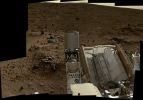
SOL0118-GB-LXTT-IPF-02.jpgCuriosity and the Distant Horizon of Gale Crater - Sol 118 (An Image-Mosaic in Calibrated Natural Colors; credits for the additional process. and color.: Dr Gianluigi Barca/Lunar Explorer Italia/Italian Planetary Foundation) 108 visitenessun commentoMareKromium
|
|

SOL0127-2-GB-LXTT-IPF.jpgFeatures of Yellowknife Bay - Sol 127 (an Image-Mosaic in Calibrated Natural Colors; credits for the additional process. and color.: Dr Gianluigi Barca/Lunar Explorer Italia/Italian Planetary Foundation)108 visitenessun commentoMareKromium
|
|

SOL0002-NLA_397681339EDR_F0020000AUT_04096M-PCF-LXTT-IPF.jpgThe Inner Rim of Gale Crater - Sol 2 (Calibrated Absolute Natural Colors; credits for the additional process. and color.: Dr Paolo C. Fienga - Lunar Explorer Italia - Italian Planetary Foundation)107 visiteThis image was taken by the Left A NavCam (NAV_LEFT_A) onboard the NASA - Mars Rover Curiosity on Sol 2 (such as August, 8, 2012 at 07:04:32 UTC) of the Rover Mission to Gale Crater. The distant Rim of Gale Crater appears "fuzzy" (---> out of focus, blurred) because of the presence of a certain amount of Fog (mostly suspended Microscopic Dust Particles and, maybe, some Microscopic Water-Ice Cristals) in the air (Lower Atmosphere); right in front of the Left A NavCam, the Surface is heavily disturbed and that fact was due to the action of the retrorockets which allowed Curiosity to make (always relatively speaking) a "Soft Landing".
"...Thrust from the rockets actually dug a one-and-a-half-foot-long [0.5-meter] trench in the Surface. It appears we can see Martian Bedrock on the bottom. Its depth below the Surface is valuable data we can use going forward..." said Dr John Grotzinger, Project Scientist for the Mission from the California Institute of Technology in Pasadena.MareKromium
|
|

SOL0369-RLB_430259923EDR_F0130000RHAZ00311M_.jpgWatch carefully! - Sol 369 107 visiteATTENZIONE ai "punti neri". Specialmente quello a Sx. NON si tratta di difetti delle lenti od image-artifacts.MareKromium
|
|

SOL0136-2-GB-LXTT-IPF~0.jpgHorizon, from Yellowknife Bay - Sol 136 (an Image-Mosaic in Calibrated Natural Colors; credits for the additional process. and color.: Dr Gianluigi Barca/Lunar Explorer Italia/Italian Planetary Foundation)106 visitenessun commentoMareKromium
|
|

SOL3339.jpgSol 3339 - Postcard from Gale106 visitenessun commentoMareKromium
|
|

SOL0000-RLA_397504876EDR_F0010000AUT_04096M_.jpgUp-Sun - Sol 0 (a b/w NASA-MER Curiosity Original Frame)105 visitenessun commentoMareKromium
|
|
| 261 immagini su 22 pagina(e) |
 |
|
|
|
|
13 | |
|
|
|
|








