| Piú viste - Curiosity and the Exploration of Gale Crater |

SOL0370-RLB_430346071EDR_F0130292RHAZ00311M_.jpgWatch carefully! - Sol 370116 visiteGuardate i due "punti neri". Quello a Dx è - probabilmente - un difetto dell'immagine. L'altro, più centrale, no. Perché? Semplice. L'immagine, in sè, fa schifo. Ma se la magnificate, noterete il classico effetto di sovra-saturazione, tipico di oggetti ad elevata Albedo (metallici o cristallini) che riflettono la luce del Sole. Perché è "nero", allora? Perché le immagini di questo tipo si propongono in ciò che chiamo "negativo parziale" (ossia: ciò che dovrebbe brillare, diventa scuro). Un "Dono" dei Fenomeni della NASA. Ma, forse, siamo più "fenomeni" noi.
Caption NASA Originale:"This image was taken by Rear Hazard Avoidance Camera (Rear Hazcam) onboard NASA's Mars Rover Curiosity on Sol 370 (2013-08-21 08:41:48 UTC)".MareKromium
|
|

SOL3072-4-PIA24646-Curiosity_Navigation_Cameras_Spot_Twilight_Clouds_on_Sol_3072.gifNoctilucent Clouds over Gale Crater - Sol 3072 (GIF-Movie)114 visiteCaption NASA Originale:"Using the Navigation Cameras on its Mast, NASA’s Curiosity Mars Rover took these images of clouds just after sunset on March 28, 2021, the 3.072nd Sol, or Martian Day, of the Mission. These Noctilucent, or Twilight Clouds, are made of Water Ice, such as ice crystals that reflect the setting Sun, allowing the detail in each cloud to be seen more easily".MareKromium
|
|
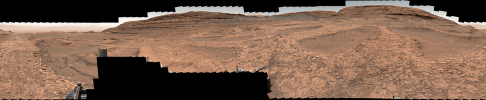
SOL4887-PIA26696_figA.pngNevado Sajama - Horizon114 visiteThe image was taken at a ridgetop site nicknamed “Nevado Sajama,” where Curiosity collected a rock sample using a drill on the end of its Robotic Arm.
Since May 2025, Curiosity has been exploring a region full of geologic formations called boxwork, which crisscross the surface for miles and look like giant spiderwebs when viewed from space.
The new panorama shows them as they really are: low ridges standing roughly 3 to 6 feet (1 to 2 meters) tall and about 30 feet (9 meters) across with sandy hollows in between.MareKromium
|
|

SOL0063-PIA16194-PCF-LXTT-IPF.jpgAnother "Scoop" at Gale - Sol 63 (Absolute Natural Colors; credits for the additional process. and color.: Dr Paolo C. Fienga/Lunar Explorer Italia/Italian Planetary Foundation)113 visiteCaption NASA:"In this image, the Scoop on NASA's Curiosity Mars Exploration Rover shows the larger Soil Particles that were too big to filter through a sample-processing "Sieve" that is porous only to Particles less than 0,006" (i.e.: about 150 microns) across. After a full-scoop sample had been vibrated over the Sieve, this held-back portion was returned to the Scoop to be accessible for inspection by the Rover's Mast Camera. The image is part of the first "decontamination" exercise by the Collection and Handling for "In-Situ" Martian Rock Analysis (CHIMRA) tool on the end of the Rover's Robotic Arm, which includes the Scoop, the Sieve and other minor components.
The decontamination exercise involved scooping some Soil, shaking it thoroughly inside the Sample-processing Chambers to scrub the internal surfaces, putting it through a Sieve, dividing it into the appropriate portions and then discarding the sample. This process will be repeated 3 (three) times. The rinse-and-discard cycles serve a quality-assurance purpose similar to a common practice in geochemical laboratory analysis on Earth.
This image was taken by Curiosity's right Mast Camera (Mastcam-100) on October, 10, 2012, such as the 64th Sol, or Martian Day, of operations".MareKromium
|
|

SOL0107-GB-LXTT-IPF-5.jpgThe Inner Rim and Sky above Gale Crater - Sol 107 (An Image-Mosaic in Calibrated Natural Colors; credits for the additional process. and color.: Dr Gianluigi Barca/Lunar Explorer Italia/Italian Planetary Foundation) 113 visitenessun commentoMareKromium
|
|

W-Martian_Clouds-00.gifClouds...113 visiteJust beautiful, what else to say?MareKromium
|
|

SOL0054-PIA14762-PCF-LXTT-IPF.jpg"Bathurst Inlet" Rock - Sol 54 (Absolute Natural Colors; credts for the additional process. and color.: Dr Paolo C. Fienga/Lunar Explorer Italia/Italian Planetary Foundation)112 visite...Solo per evidenziare agli Amici di Lunar Explorer Italia la differenza che esiste tra il color processing adottato dalla NASA/JPL-Caltech (in collaborazione con il Malin Space Science Systems) e quello adottato da noi. E attenzione: qui non si discute di "estetica", ma di "verosimiglianza"! Il color processing NASA (quello del frame che precede, tanto per intenderci), presuppone l'esistenza di una nebbia gialla FITTA E COSTANTE! Una nebbia che, laddove esistesse davvero, impedirebbe di vedere oltre i 5/8 metri! Ora, che su Marte esista una discreta Opacità Atmosferica nessuno ne dubita. E nessuno dubita che Marte abbia una Dominante Cromatica giallo/arancio.
Ma quello che le foto colorizzate "ufficiali" fanno vedere e vorrebbero rappresentare, secondo noi, è un Marte che - semplicemente - non esiste, se non a Pasadena e nella testa dei Signori del MSSS. Poi, giustamente, ognuno la può vedere come vuole. Ergo...Giudicate Voi!MareKromium
|
|

SOL0369-RRB_430254757EDR_F0120870RHAZ00305M_.jpgImage Artifacts - Sol 369112 visiteSvariati "puntini" bianchi nel Cielo di Marte. Nulla di reale. Solo difetti nella trasmissione dei dati.MareKromium
|
|
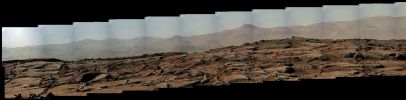
SOL0194-MF-EB-LXTT-IPF.jpgHorizons... - Sol 194 (an Image-Mosaic in "White Balanced" Colors; credits for the additional process. and color.: Elisabetta Bonora and Marco Faccin/Lunar Explorer Italia/Italian Planetary Foundation)111 visitenessun commentoMareKromium
|
|

SOL0001-673560main_msl5_full.jpgWelcome to Gale Crater! - Sol 1 (RAW Natural Colors; credits for the additional process. and color.: Dr Paolo C. Fienga - Lunexit Team/IPF)110 visiteCaption NASA:"About two hours after landing on Mars and beaming back its first image, NASA's Curiosity Rover transmitted a higher-resolution image of its new Martian home, Gale Crater. Mission Control at NASA's Jet Propulsion Laboratory in Pasadena, Calif., received the image, taken by one of the vehicle's lower-fidelity, black-and-white Hazard Avoidance Cameras (or "HazCams").
"Curiosity's Landing Site is beginning to come into focus", said John Grotzinger, Project Manager of NASA's Mars Science Laboratory mission, at the California Institute of Technology in Pasadena. "In the image, we are looking to the North/West. What you see on the Horizon is the Rim of Gale Crater. In the foreground, you can see a Gravel Field. The question is, where does this Gravel come from? It is the first of what will be many scientific questions to come from our new home on Mars".MareKromium
|
|

SOL0065-EB-MF-LXTT-IPF-02.jpgUnusually-looking bright Object near Curiosity - Sol 65 (an High-Def-3D EDM; credits for the research and the additional process. and color.: Elisabetta Bonora and Marco Faccin/Lunar Explorer Italia/Italian Planetary Foundation)110 visitenessun commentoMareKromium
|
|

SOL0107-NLA_406989232EDR_D0050388NCAM00522M-PCF-LXTT-IPF.jpgRocky Panorama - Sol 107 (RAW Natural Colors; credits for the additional process. and color.: Dr Paolo C. Fienga/Lunar Explorer Italia/Italian Planetary Foundation)110 visitenessun commentoMareKromium
|
|
| 261 immagini su 22 pagina(e) |
 |
|
|
|
|
12 | |
|
|
|
|








