| Piú viste - Mars from Orbit (from July 2009) |

Craters-Unnamed_Crater-PIA13182.jpgUnnamed Crater in Terra Sabaea (Natural Colors; credits: Dr Paolo C. Fienga - Lunexit Team)55 visitenessun commentoMareKromium
|
|
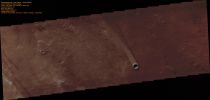
Windstreak-PIA13210.jpgWindstreak on Lava Flows (Absolute Natural Colors; credits for the additional process. and color.: Dr Paolo C. Fienga - Lunexit Team)55 visitenessun commentoMareKromium
|
|
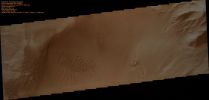
Dunes-Juventae_Chasma-PIA13218.jpgDunes in Juventae Chasma (Natural Colors; credits for the additional process. and color.: Dr Paolo C. Fienga - Lunexit Team)55 visitenessun commentoMareKromium
|
|

Marte_Vallis-PIA13249.jpgMarte Vallis (Natural Colors; credits for the additional process. and color.: Dr Paolo C. Fienga - Lunexit Team)55 visitenessun commentoMareKromium
|
|

Dunes-Terra_Cimmeria-PIA13274.jpgDunes in Terra Cimmeria (Natural Colors; credits for the additional process. and color.: Dr Paolo C. Fienga - Lunexit Team)55 visitenessun commentoMareKromium
|
|

Dunes-Kasei_Valles-PIA13311.jpgDunes in Kasei Valles (Natural Colors; credits for the additional process. and color.: Dr Paolo C. Fienga - Lunexit Team)55 visiteThis small group of dunes in located within Kasei Valles.
Orbit Number: 37716
Latitude: 25,887° North
Longitude: 297,492° East
Instrument: VIS
Captured: 2010, June, 15thMareKromium
|
|
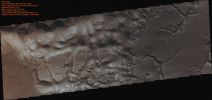
Eos_Chaos-PIA14282-PCF-LXTT.jpgFeatures of Eos Chaos (Absolute Natural Colors; credits for the additional process. and color.: Dr Paolo C. Fienga - Lunexit Team)55 visitenessun commentoMareKromium
|
|

Aeolian_Features-Windstreaks-PIA03932.jpgWindstreaks near Meroe Patera (Original NASA/2001 Mars Odyssey Orbiter b/w Frame)54 visiteCaption NASA originale:"These Windstreaks are located on the Lava Flows of Meroe Patera, Syrtis Major Planum Region".
Image information: VIS instrument
Latitude 5,7; Longitude 73,2 East (286,8 West)
36 meter/pixel resolution
|
|

Craters-Unnamed_Secondary_Crater-PIA04106.jpgPossible Secondary Crater (Original NASA/JPL/ASU b/w Frame)54 visitenessun commento
|
|
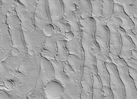
Dunes-PaleoDunes-1.jpgPaleodunes (1 - Original NASA/MGS/MSSS b/w Frame)54 visiteCaption NASA:"A pair of MGS-MOC images shows close-up views of a Sand Dunefield that was first detected by the Viking Orbiters in the late 1970's. What is surprising about the MOC images is that they reveal a dune field unlike any other thus far seen on Mars: this one has Impact Craters on its Surface, and LOTS of them! The field of parallel Ridges North of the Dunefield is a wind-eroded material named "Apollinaris Sulci". It is possible that the Dunefield shown here was once covered by this wind-eroded material and was later exhumed. Regardless, the Dunes were somehow hardened and have been exposed as hard rock on the Martian Surface long enough for many Impact Craters smaller than a few hundred meters (such as few hundred yards) across to form. These Dunes are therefore quite ancient: one might say that this is a 'fossilized' Dunefield".
|
|

Dunes-PaleoDunes-2.JPGPaleodunes (2 - Original NASA/MGS/MSSS b/w Frame)54 visiteCaption NASA:"A similar effect at a much smaller scale can be seen by examining some Sandstones and Siltstones on Earth (if conditions were right, ripples formed in either water or wind are preserved in such rocks). The first MOC view, labeled M03-00006, was taken on July 1, 1999. The second view, M07-05007, was acquired September 26, 1999. Both MOC images are illuminated from the left. The Dunefield is located East of the Apollinaris Patera volcano and North-East of Gusev Crater (at about 12,5° South Lat. and 181° West Long.)".
|
|

Dunes-PaleoDunes-3.JPGPaleodunes (3 - Original NASA/Viking 2 Project b/w Frame)54 visitenessun commento
|
|
| 1003 immagini su 84 pagina(e) |
 |
|
|
|
|
|
|
81 | |
|
|





