| Piú viste - Mars from Orbit (from July 2009) |
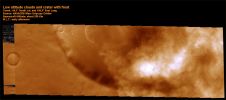
Craters-Unnamed_Crater_with_Frost-00-PCF-LXTT.JPGClouds over "Frosty" Crater (CTX Frame - False Colors; credits for the additional process. and color.: Dr Paolo C. Fienga - Lunar Explorer Italia)58 visiteIl dettaglio della nuvola che scivola sul cratere senza nome situato a Sud-Est del bacino di impatto denominato "Hellas" è molto bello, ma non fermiamoci al dettaglio artistico ed osserviamo il margine interno del cratere posto alla Vostra Sx: le tracce di brina sono evidenti.
E non è tutto: osservate il fondo del cratere. C'è qualcosa che lo "allaga", in parte? Sicuramente non si tratta solo di fango (è l'albedo del dettaglio che ce lo dice).
La nostra prima ipotesi è che, sul fondo di questo cratere senza nome, vi possa essere un discreto quantitativo di ghiaccio d'acqua il quale è talmente trasparente, da permetterci di riuscire a vedere anche i minuscoli crateri che giacciono al di sotto di esso.
La seconda ipotesi, meno immaginifica ma, forse, più realistica, è che sul fondo del cratere vi sia un deposito sottile, ma abbondante, di brina ghiacciata.
Caption NASA:"The dust storm season in the Southern Hemisphere of Mars is well underway. This image of an unnamed crater South-East of Hellas Basin shows the encroachment of a storm in the region".MareKromium
|
|
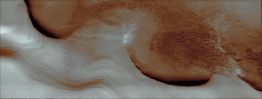
North_Polar_Features-PIA08694-01.jpgNorth Polar Landscape (Natural Colors; credits for the additional process. and color.: Dr Paolo C. Fienga - Lunexit Team)58 visitenessun commentoMareKromium
|
|

Craters-Unnamed_Crater_with_possible_Oil_Lake-V07738009-PCF-LXTT-03.jpgMigrating Dunes, Dirty Waters or maybe Surfacing Hydrocarbons? (4 - Natural Colors; credits for the additional process. and color.: Dr Paolo C. Fienga - Lunexit Team)58 visitenessun commentoMareKromium
|
|
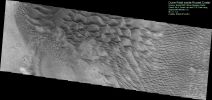
Craters-Russel_Crater-20080116a.jpgDunefield inside Russel Crater (Original NASA/2001 Mars Odyssey Orbiter b/w Frame)58 visitenessun commentoMareKromium
|
|

Craters-Pollack_Crater_and_White_Rock-20020419a-PCF-LXTT.jpgPollack Crater and "White Rock" (Slightly Saturated Absolute Natural Colors; credits for the additional process. and color.: Dr Paolo C. Fienga - Lunexit Team)58 visiteCaption NASA:"White Rock is the unofficial name for this unusual landform which was first observed during the Mariner 9 Mission in the early 70's. As later analysis of additional data sets would show, White Rock is neither white nor dense rock. Its apparent brightness arises from the fact that the material surrounding it is so dark. Images from the Mars Global Surveyor MOC camera revealed dark sand dunes surrounding White Rock and on the floor of the troughs within it.
Some of these dunes are just apparent in the THEMIS image. Although there was speculation that the material composing White Rock could be salts from an ancient dry lakebed, spectral data from the MGS TES instrument did not support this claim. Instead, the White Rock deposit may be the erosional remnant of a previously more continuous occurrence of air fall sediments, either volcanic ash or windblown dust.
The THEMIS image offers new evidence for the idea that the original deposit covered a larger area.
Approximately 10 Km to the South-East of the main deposit are some tiny knobs of similarly bright material preserved on the floor of a small crater. Given that the eolian erosion of the main White Rock deposit has produced isolated knobs at its edges, it is reasonable to suspect that the more distant outliers are the remnants of a once continuous deposit that stretched at least to this location.
The fact that so little remains of the larger deposit suggests that the material is very easily eroded and simply blows away".MareKromium
|
|
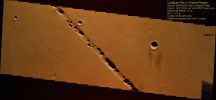
Volcanic_Features-Collapse_Pits-Tharsis_Region-20080526a-PCF-LXTT-00.jpgCollapse Pits in Tharsis Region (Enhanced and Saturated Natural Colors; credits for the additional process. and color.: Dr Paolo C. Fienga - Lunexit Team)58 visiteCaption NASA:"This chain of Collapse Pits occurs within one of the many tectonic graben of the Tharsis Region".MareKromium
|
|

North_Polar_Features-The_Erg-20080620a-PCF-LXTT.jpgThe North Polar Erg (Absolute Natural Colors; credits for the additional process. and color.: Dr Paolo C. Fienga - Lunexit Team)58 visiteCaption NASA:"Spring in the Northern Polar Region means the return of the Sun. This image shows a small portion of the North Polar Sand Sea, an immense Region of sand dunes. The dunes are just starting to shed their Winter frost and will darken as Spring becomes Summer and the dark sand is revealed".MareKromium
|
|

Craters-Unnamed_Crater_with_Dunefield-20080506a-PCF-LXTT.jpgUnnamed Crater with Small Dunefield (Darkened and Enhanced Natural Colors; credits for the additional process. and color.: Dr Paolo C. Fienga - Lunexit Team)58 visiteCaption NASA:"A field of Sand Dunes in located on the Floor of this Unnamed Crater of Noachis Terra. Uzboi Vallis runs along the Western Rim of this Crater".
MareKromium
|
|
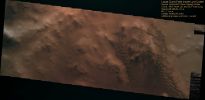
Craters-Lyot_Crater-Dunefield-20080625a-PCF-LXTT.jpgLarge Dunefield inside Lyot Crater (Absolute Natural Colors; credits for the additional process. and color.: Dr Paolo C. Fienga - Lunexit Team)58 visitenessun commentoMareKromium
|
|
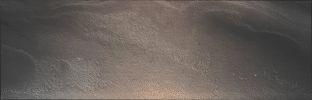
South_Polar_Regions-20080711a-PCF-LXTT.jpgVastitas Australis: the South Polar Region of Mars (Absolute Natural Colors; credits for the additional process. and color.: Dr Paolo C. Fienga - Lunexit Team)58 visiteCoord.: 85,6° South Lat. and 211,7° East Long.MareKromium
|
|
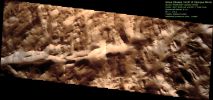
Chaotic_Terrain-Slope_Streaks-PCF-LXTT.jpgSlope Streaks (Enhanced and Saturated Natural Colors; credits for the additional process. and color.: Dr Paolo C. Fienga - Lunexit Team)58 visitenessun commentoMareKromium
|
|

Clouds-PCF-LXTT.jpgNorth Polar Clouds and Surface (Natural Colors; credits for the additional process. and color.: Dr Paolo C. Fienga - Lunexit Team)58 visiteCaption NASA:"When winds that have swept across the North Polar Ice encounter a trough in the ice, the laminar flow slows at the base of the trough, producing a turbulent wind regime that is easily recognized in the clouds formed in the trough".
MareKromium
|
|
| 1003 immagini su 84 pagina(e) |
 |
|
|
|
|
66 | |
|
|
|
|





