| Piú viste - Mars from Orbit (from July 2009) |

Aeolian_Features-Windstreaks-PIA15271-PCF-LXTT-IPF.jpgWindstreaks on Lava Plains (Absolute Natural Colors; credits for the additional process. and color.: Dr Paolo C. Fienga - Lunexit Team)60 visiteOrbit Number: 44420
Latitude: 33,386° North
Longitude: 232,799° East
Instrument: VIS
Captured: December, 19th, 2011
Mars Local Solar Time: 19:49 (Early Evening Hours)
MareKromium
|
|
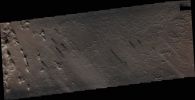
Aeolian_Features-Windstreaks-PIA16495-PCF-LXTT-IPF.jpgWindstreaks near Lycus Sulci (Absolute Natural Colors; credits for the additional process. and color.: Dr Paolo C. Fienga/Lunar Explorer Italia/IPF)60 visiteOrbit Number: 47254
Latitude: 32,905° North
Longitude: 226,441° East
Instrument: VIS
Captured: August, 9th, 2012MareKromium
|
|

Coprates_Chasma-PIA17517-PCF-LXTT-IPF.jpgFeatures of Coprates Chasma (Absolute Natural Colors; credits for the additional process. and color.: Dr Paolo C. Fienga/Lunar Explorer Italia/Italian Planetary Foundation)60 visiteIn this VIS image, taken by the NASA - Mars Odyssey Orbiter on August 12th, 2013, and during its 51.735th orbit around the Red Planet, we can see part of the Floor of Coprates Chasma, including a large Sand Sheet and a few smaller Dunes.
Latitude (centered): 13,967° South
Longitude (centered): 296,942° East
Instrument: VIS
This frame (taken from an Original Mars Odyssey Orbiter b/w and Map-Projected frame published on the NASA - Planetary Photojournal with the ID n. PIA 17517) has been additionally processed, magnified, contrast enhanced, Gamma corrected and then colorized in Absolute Natural Colors (such as the colors that a human eye would actually perceive if someone were onboard the NASA - Mars Odyssey Orbiter and then looked down, towards the Surface of Mars), by using an original technique created - and, in time, dramatically improved - by the Lunar Explorer Italia Team.MareKromium
|
|
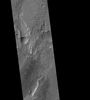
Craters-Holden_Crater-2-M0302733.jpgHolden Crater floor near intersection with Uzboi Vallis (2)59 visitenessun commento
|
|
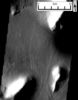
Islands.jpgThe Islands of Mars (Original NASA-2001 Mars Odyssey Orbiter b/w Frame)59 visiteNew HR images of mid-latitude Mars are revealing glacier-formed landscapes far from the Martian Poles, says a leading Mars Researcher.
Conspicuous trains of debris in valleys, arcs of debris on steep slopes and other features far from the polar ice caps bear striking similarities to glacial landscapes of Earth, says Brown University's James Head III. When combined with the latest climate models and orbital calculation for Mars, the geological features make a compelling case for Mars having ongoing climate shifts that allow ice to leave the poles and accumulate at lower latitudes.
"The exciting thing is a real convergence of these things, said Head, who will present the latest Mars climate discoveries on Sunday, 16 October, at the Annual Meeting of the Geological Society of America in Salt Lake City (Utah). "For decades people have been saying that deposits at mid and equatorial latitudes look like they are ice-created, said Head. But without better images, elevation data and some way of explaining it, ice outside of Mars' polar regions was a hard sell.
Now high-resolution images from the Mars Odyssey spacecraft's Thermal Emission Imaging System combined with images from the Mars Global Surveyor spacecraft's Mars Orbiter Camera and Mars Orbiter Laser Altimeter can be compared directly with glacier features in mountain and polar regions of Earth. The likenesses are hard to ignore.
For instance, consider what Head calls "lineated valley fill." These are lines of debris on valley floors that run downhill and parallel to the valley walls, as if they mark some sort of past flow. The same sorts of lines of debris are seen in aerial images of Earth glaciers. The difference is that on Mars the water ice sublimes away (goes directly from solid ice to gas, without any liquid phase between) and leaves the debris lines intact. On Earth the lines of debris are usually washed away as a glacier melts.
|
|
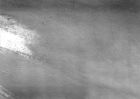
South_Polar_Regions-Clouds-PIA02171-2.jpgClouds (RAW and b/w NASA Original Frame)59 visiteIn questa immagine si possono vedere delle sottili (quasi trasparenti...) formazioni nuvolose che sovrastano le Regioni Presso-Sud Polari di Marte. L'evidente sottigliezza delle nuvole è indicativa della circostanza per cui esse dovrebbero essere composte in larga prevalenza da ghiaccio d'acqua. Da ricordare, quindi, che le formazioni nuvolose "spesse", su Marte, sono invece prevalentemente costituite da polveri.
Image information: VIS instrument;
Latitude: 86,7° South;
Longitude: 212,3° East;
Resolution: 17 meter/pixel.
|
|
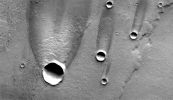
Aeolian_Features-Windstreaks-PIA08422-00.jpgBeautiful Windstreaks (Original NASA/JPL/ASU b/w Frame)59 visiteCaption NASA originale:"This group of Windstreaks is located on Lava Flows, West of Arsia Mons".
Image information: VIS instrument;
Latitude: 11,0° South;
Longitude: 219,5° East;
Resolution: 18 meter/pixel.
|
|

Volcanic_Features-Lava_Flows-PIA08463-00.jpgThe "End" of Lethe Vallis (Original NASA/JPL/ASU b/w Frame)59 visiteImage information: VIS instrument;
Latitude: 4,8° North;
Longitude: 156,1° East;
Resolution: 18 meter/pixel.
|
|
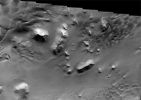
Juventae_Chasma-PIA08444-2.jpgUnusually-looking Landforms in Juventae Chasma (Original NASA-2001 Mars Odyssey Orbiter b/w Frame)59 visiteImage information: VIS instrument;
Latitude: 3,9° South;
Longitude: 299,2° East;
Resolution: 18 meter/pixel.
|
|
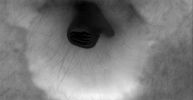
Craters-Unnamed_Southern_Crater-PIA08541-00.jpgUnnamed Southern Crater with possible surfacing Hydrocarbons (Original NASA/2001 Mars Odyssey Orbiter b/w Frame)59 visiteImage information: VIS instrument;
Latitude: - 68,1° North;
Longitude: 175,6° East;
Resolution: 17 meter/pixel.
Nota: quello che la NASA chiama "Mitten-like Dune Field" (e cioè un'area ricoperta di dune avente l'apparenza - forma - di un guanto) ci sembra, in realtà ed una volta effettuata un'analisi un pò più particolareggiata di questa immagine, una sorta di "palude".
Non ci è ovviamemte possibile essere definitivi, ma la "sensazione" che sul fondo di questo cratere - posto ad una medio-alta latitudine Sud - vi sia una sorta di "denso liquame scuro" (un giacimento di idrocarburi affioranti, magari? O un "laghetto" di Metano?...) è molto forte e precisa.
|
|

Craters-Unnamed_Crater_with_Clouds-01.jpgSpring Clouds...and something else! (EDM n.1)59 visiteIn questi 2 bellissimi detail mgnf elaborati dal Sig. Granzo, l'oggetto anomalo ha già acquisito una eccellente definizione e noi, dopo aver sottoposto l'elaborazione al nostro Tecnico dell'Immagine, siamo già in grado di dire che NON si tratta di un photoartifact: l'oggetto (qualsiasi cosa esso sia) è reale, è molto luminoso, sembra trasparente - ma non dovrebbe esserlo - e, con ogni probabilità, NON è un oggetto che si trova al suolo (e quindi siamo portati ad escludere il caso del cratere con pareti vetrificate - ed altamente riflettenti - che, ad esempio sulla Luna, allorchè viene ripreso da una Sonda che si muove sulla sua verticale (o in prossimità della medesima), acquisisce l'apparenza di una "cupola" (Lunar Dome) e spinge una intera categoria di Ricercatori (la Scuola del Prof. Hoagland) a supporre l'esistenza di mega-cupole Lunari.
Questo effetto ottico noi lo chiamiamo "effetto bolla" ed esso si sostanzia nel far apparire convesse le superfici concave - allorchè riprese, come ovvio, da altezze molto consistenti (dai 400 ai 1200/1500 Km).
|
|

Craters-Unnamed_Craters_in_Thaumasia_Region.jpgUnnamed Craters in Thaumasia Region (Original NASA/JPL/ASU CTX b/w Frame)59 visiteLocation near: 22,1° North; 53,2° East
Image width: ~3 Km (~1,9 mi)
Season: Northern Spring
Resolution: 18 mt/pixel
|
|
| 1003 immagini su 84 pagina(e) |
 |
|
|
|
|
61 | |
|
|
|
|





