| Piú viste - Mars from Orbit (from July 2009) |
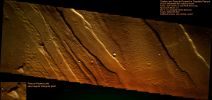
Volcanic_and_Tectonic_features-Graben-20080102a-PCF-LXTT.jpgGraben and Pseudo-Pyramid (Enhanced and Darkened Natural Colors; credits for the additional process. and color.: Dr Paolo C. Fienga - Lunexit Team)62 visiteUn esempio (piccolo e scelto a caso fra TANTISSIMI) di rilievo anomalo a base triangolare, meglio noto come "Pseudo-Piramide". Secondo Hoagland & C., la "D&M Pyramid" era/è un'evidenza "indiscutibile" di artificialità. Ok, diciamo noi, va bene.
Ma se la "D&M Pyramid" è "palesemente" artificiale, allora questa - MOLTO più precisa, netta e squadrata - che cos'è?!? O forse solo Hoagland & C. possono "scoprire" e "battezzare" le Piramidi Marziane?
La Verità? Hoagland dice una stupidata, e tutti la prendono in considerazione (motivazione: "perchè l'ha detto Hoagland"...); noi troviamo un dettaglio MOLTO più "piramidale" del suo...e nessuno sa nè dice nulla.
Ah, cosa riesce a fare il Marketing...MareKromium
|
|
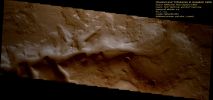
Channels-Unnamed_Channel_in_Auqakuh_Vallis.jpgUnnamed Channel in Auqakuh Vallis (Natural Colors/Tri-Chromatic Version; credits: Dr Paolo C. Fienga - Lunexit Team)62 visiteCaption NASA:"This VIS image shows a small portion of Auqakuh Vallis. Several tributaries enter the main channel in the center and upper portions of the image".MareKromium
|
|
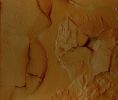
Volcanic_Regions-Elysium_Planitia-PIA11446.jpgFractured Mounds in Elysium Planitia (3D and Enhanced Natural Colors; credits: NASA and Lunar Explorer Italia)62 visiteThis stereo view shows fractured mounds on the southern edge of Elysium Planitia on Mars. It combines two images taken by the High Resolution Imaging Science Experiment (HiRISE) camera on NASA's Mars Reconnaissance Orbiter. When seen through red-green (or blue) glasses, the view appears three dimensional.
This is one example of 362 stereo views posted by the HiRISE team on Dec. 8, 2008, at http://hirise.lpl.arizona.edu/anaglyphs. This view spans an area about 6 Km (3,7 miles) wide.
The mounds on the southern edge of Elysium Planitia are typically a few kilometers or miles in diameter and about 60 meters (200 feet) tall. Fractures that crisscross their surfaces are dilational (extensional) in nature, suggesting that the mounds formed by localized uplift (meaning that they were pushed up from below).
The 3D perspective shows that the uplift is not uniform along a fracture and can favor one side.
The mounds are probably composed of solidified lava. They are contiguous with, and texturally similar to, flood lavas that blanket much of Elysium Planitia. Where dilation cracks provide cross-sectional exposure, the uplifted material is rocky.
Patches of mechanically weak and disrupted material overlie the rocky mound material. This is particularly conspicuous in the northeast corner of the image. These patches may be remnants of a layer that was once more continuous but has been extensively eroded. Smooth lava plains fill the low-lying areas between the mounds. They are riddled with sinuous pressure ridges. The entire area is covered by a relatively thin layer of dust and sand.
One of the HiRISE images used in this stereo view is catalogued as PSP_003597_1765, taken May 3, 2007, and as PSP_002542_1765, taken Feb. 10, 2007. The location is about 3° South Lat. and 168° East Long. .MareKromium
|
|

Channels-Unnamed_Channel_in_Noachis_Terra-MO-20090331a.jpgUnnamed Channel in Noachis Terra (Natural Colors/Tri-Chromatic Version; credits: Dr Paolo C. Fienga - Lunexit Team)62 visiteCaption NASA:"Numerous Channels dissect the Inner Rim of this Unnamed Crater in Noachis Terra. Several small, dark dunes are located in the center of the Crater".
Coord.: 38,0° South Lat. and 9,8° East Long.MareKromium
|
|
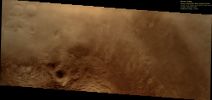
Craters-Moreux_Crater-20090811a.jpgMoreux Crater (Natural Colors; credits: Lunexit)62 visitenessun commentoMareKromium
|
|

Channel-CoracisFossae-BosporusPlanum-20091106b.jpgDry Riverbed and a possible Skylight (or an EXTREMELY fresh Impact Crater) between Coracis Fossae and Bosporos Planum (EDM - credits: Lunexit)62 visiteIl rilievo ambiguo è sostanzialmente indefinibile a questa risoluzione, ma la sua colorazione "pitch black" e l'apparente assenza di rim ci fa pensare ad un Pozzo Verticale da Collasso.
Le "sbavature" scure che caratterizzano l'intero versante Nord della Surface Feature e, in parte, il lato Est-Sud/Est (senza interessamento della sua zona Ovest ed Ovest-Sud/Ovest), invece, potrebbero anche far pensare ad un impatto il quale, oltre che essere occorso assai di recente, potrebbe - se non altro parzialmente - essere ricondotto alla Classe dei "Mid-Air Impact" (ossia il bolide generatore del dettaglio si sarebbe, in questo caso, parzialmente disintegrato - esploso - in prossimità del suolo, mentre una sua parte avrebbe comunque raggiunto la superficie, così creando un cratere).
L'ipotesi del Vertical Collapse Pit, comunque, ci sembra preferibile (anche se una ragionevole spiegazione delle "sbavature" scure, in questo scenario, non siamo in grado di poterla fornire).MareKromium
|
|
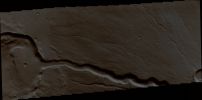
Volcanoes-CerauniusTholus-20091210a.jpgDeep Channel in the N/W Flank of Ceraunius Tholus (False Colors; credits: Lunexit)62 visiteThis VIS image shows part of the North/Western Flank of Ceraunius Tholus, one of the smaller Volcanoes in the Tharsis Region.
Several Channels dissect the Flank of the Volcano, including a larger channel that deposited material in Rahe Crater.
Coord.: 24,6° North Lat. and 262,3° East Long.MareKromium
|
|

Ascraeus_Mons-PIA13209.jpgPortion of the N/W Flank of Ascraeus Mons (Enhanced and Saturated Natural Colors; credits for the additional process. and color.: Dr Paolo C. Fienga - Lunexit Team)62 visitenessun commentoMareKromium
|
|
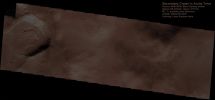
Craters-Secondary_Crater-Aonia_Terra-PCF-LXTT.jpgSecondary Crater in Aonia Terra (Absolute Natural Colors; credits for the additional process. and color.: Dr Paolo C. Fienga)62 visitenessun commentoMareKromium
|
|

Landslides-Chrise_Planitia-PIA13254.jpgChrise Chaos (Saturated Natural Colors; credits for the additional process. and color.: Dr Paolo C. Fienga - Lunexit Team)62 visitenessun commentoMareKromium
|
|
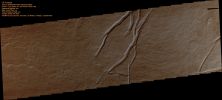
Pits_and_Channels-Oti_Fossae-PIA13253.jpgPits and Channels in Oti Fossae (Natural Colors; credits for the additional process. and color.: Dr Paolo C. Fienga - Lunexit Team)62 visitenessun commentoMareKromium
|
|
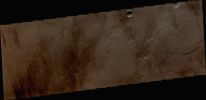
Windstreaks-PIA13292.jpgWindstreaks in Tharsis (Natural Colors; credits: Dr Paolo C. Fienga - Lunexit Team)62 visiteThis VIS image shows are region of lava covered plains east of Olympus Mons. Winds are common in the area and have created Windstreaks downwind of Craters in the Region and on the Lava Flows.
Orbit Number: 37693
Latitude: 22,596° North
Longitude: 240,567° East
Instrument: VIS
Captured: 2010, June, 13thMareKromium
|
|
| 1003 immagini su 84 pagina(e) |
 |
|
|
|
|
56 | |
|
|
|
|





