| Piú viste - Mars from Orbit (from July 2009) |
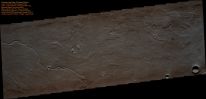
Channel-Elysium_Planitia-PIA13527.jpgChannel at the Edge of Elysium Planitia (Natural Colors; credits for the additional process. and color.: Dr Paolo C. Fienga - Lunexit Team)75 visitenessun commentoMareKromium
|
|
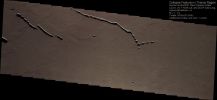
Volcanic_Features-Collapse_Pit_Chains-Tharsis-MO-PCF-LXTT.jpgPit-Chains in Tharsis (Absolute Natural Colors; credits for the additional process. and color.: Dr Paolo C. Fienga - Lunexit Team) 75 visitenessun commentoMareKromium
|
|
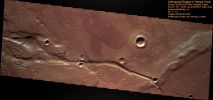
Ridges-Tempe_Terra-20080326a-PCF-LXTT.jpgRidges in Tempe Terra (Absolute Natural Colors; credits for the additional process. and color.: Dr Paolo C. Fienga - Lunexit Team)75 visitenessun commentoMareKromium
|
|

Aeolian_Features-Yardangs-Elysium_Planitia-20080501a-PCF-LXTT.jpgYardangs in Elysium Planitia (Natural Colors; credits for the additional process. and color.: Dr Paolo C. Fienga - Lunar Explorer Italia)75 visitenessun commentoMareKromium
|
|

Channels-Dao_Vallis-PIA15215-PCF-LXTT-IPF.jpgFeatures of Dao Vallis (Absolute Natural Colors; credits for the additional process. and color.: Dr Paolo C. Fienga/Lunar Explorer Italia/Italian Planetary Foundation)75 visiteDao Vallis is a Martian Channel that, as the peculiar texture and color of its bottom and edges show us quite well, was not carved by Molten (and very fluid) Lava, but by real Water instead. Dao Vallis runs South/Westward into the Hellas Planitia Region, and it has been identified (among others, by Dr M.H. Carr) as a so-called Outflow Channel. Dao Vallis has a main Tributary Channel, known as Niger Vallis, and it extends on the Martian Southern Hemisphere's Surface for over 1200 Km. Its name, just out of curiosity, apparently comes from a Thai word meaning "star" (and God only knows why the IAU made such a bizarre and, in our opinion, pointless choice...).
However, talking again about our today's APOD Surface Feature, we can say that we know that the (possible) sources of Dao Vallis are near an extremely old Martian Volcano, called Hadriaca Patera; it is thought by many Scientists that the Water that formed it came out from the Subsurface when a huge quantity of hot Magma, erupted from Hadriaca Patera, melted, in a very short time period (in a case like this, we might be talking about minutes), huge amounts of Ice that was caught in the otherwise already frozen Ground. Anyway, much of this Water may have also been released during the occurrence of a few very large "Outburst Floods".
In addition to the above, and after a carfeul examination of Dao Vallis' now completely desiccated Riverbed, we, as IPF, strongly believe that, whatever the actual origin of the Channel might have been, Dao Vallis must have carried liquid Water for a very long time, before drying up. As a matter of fact, and as it is clearly visible in this NASA - 2001 Mars Odyssey Orbiter frame, on the bottom of the Channel can be identified several layers of dried material (Mud, likely) that, in our opinion, make the physical evidence that the desiccation process of Dao Vallis took some time before it was complete. In other words, the desiccation (or, like some Scientists say, evaporation and/or sublimation) of the Waters that ran through the Channel, was far from being semi-instantaneous or (this, of course, relatively speaking) rather fast. Furthermore, the almost complete lack of Impact Craters on the Riverbed, if seen and evaluated in direct contrast with the strong presence of Impact Craters (of various size and shape - meaning both Primary and Secondary Craters) that exist and is VERY well visible on both the edges of the Channel, proves us that, when Liquid Water ran through Dao Vallis, the strong meteoric activity which scarred most of the Surface of the Red Planet, was already ended. In other words, Dao Vallis hosted liquid and running Waters until a very (always relatively - and geologically - speaking) recent time.
Picture Data: Orbit Number: 44201; Latitude: 39,4843° South and Longitude: 86,4444° East; Instrument: VIS; Captured: December, 1st, 2011; Mars Local Time (M.L.T.): 17:39 (Late Aftrnoon)
This frame has been colorized in Absolute Natural Colors (such as the colors that a human eye would actually perceive if someone were onboard the NASA - 2001 Mars Odyssey Orbiter and then looked down towards the Surface of Mars), by using an original technique created - and, in time, dramatically improved - by the Lunar Explorer Italia Team.MareKromium
|
|
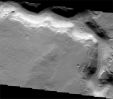
Channels-Auqakuh_Vallis-PIA08465-00.jpgFeatures of Auqakuh Vallis (Original NASA/JPL/ASU b/w Frame)74 visiteImage information: VIS instrument;
Latitude: 31,0° North;
Longitude: 60,6° East;
Resolution: 19 meter/pixel.
|
|
Unusually-looking_Surface_Feature-S22-00831d-01.jpgPossible Surface Anomaly (EDM - False Colors)74 visiteA questo (super) ingrandimento, l'ipotesi che si possa trattare di un image-artifact svanisce totalmente: si tratta, effettivamente, di una Regione "ricoperta" da qualcosa. Qualcosa di bianco e di brillante.
Qualcosa che, con ogni probabilità, è effettivamente "ghiaccio".
Ma come ci è arrivato in quel punto? E perchè solo in quel punto?
Domande, domande, domande...
|
|

Clouds-Soth_Polar_Regions-20090417a-PCF-LXTT-2.jpgSouthern Storm (2 - Natural Colors; credits for the additional process. and color.: Dr Paolo C. Fienga - Lunar Explorer Italia)74 visiteCoord.: 68,7° South Lat. and 146,4° East Long.MareKromium
|
|
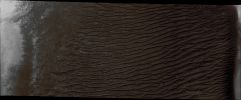
Craters-Richardson_Crater-20090730a-1.jpgThe Dunes of Richardson Crater (Natural Colors; credits: Lunexit)74 visiteCoord.: 72,3° South Lat. and 180,2° East Long.MareKromium
|
|

Craters-Richardson_Crater-20090806a.jpgRichardson Crater (Visible Light and Natural Colors; credits: Lunexit)74 visiteCaption NASA:"This VIS image of Richardson Crater was collected at the same time as yesterday's IR image. While the dunes appeared uniform in temperature in the IR, they are varied in appearance in the visible wavelengths. The sand is darker than the surrounding and covering dust".
Coord.: 72,2° South Lat. and 178,5° East Long.MareKromium
|
|
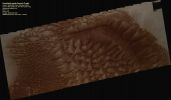
Craters-Russel_Crater-20091019a.jpgUnusually-looking Dunefield inside Russel Crater (Natural Colors; credits: Lunexit)74 visitenessun commentoMareKromium
|
|

Craters-Briault_Crater-PIA13177.jpgDunes in Briault Crater (Natural Colors; credits for the additional process. and color.: Dr Paolo C. Fienga - Lunexit Team)74 visitenessun commentoMareKromium
|
|
| 1003 immagini su 84 pagina(e) |
 |
|
|
|
|
46 | |
|
|
|
|





