| Piú viste - Mars from Orbit (from July 2009) |

Craters-Unnamed_Craters-AP-PIA17856-PCF-LXTT-IPF.jpgCraters in Southern Amazonis Planitia (Absolute Natural Colors - Credits for the additional process. and color.: Dr Paolo C. Fienga/Lunar Explorer Italia/Italian Planetary Foundation)77 visiteIn this VIS image, taken by the NASA - Mars Odyssey Orbiter on November, 20th, 2013, and during its 52.949th orbit around the Red Planet, we can see two Impact Craters - with a compact Ejecta Blanket - that stand out above the surrounding Surface (these Craters are technically defined as "Pedestal Craters") and one - slightly bigger than the first two - Impact Crater that has been almost completely buried, most likely, by a Flow of Volcanic Material (you can see that only the small upper portion of the Outer Rim of this Crater can still be seen, with two small Buttes located to the North/East).
The Ejecta Blanket of the two Pedestal Craters has remained in place, while the surrounding Material was, in time, removed by the action of powerful Winds and, as a matter of fact, here, in this (Southern Side) of the Martian Region known as "Amazonis Planitia", an extensive phenomenon of Wind-related Erosion is quite common. Amazonis Planitia is one of the smoothest Volcanic Plains that can be found on Mars and it is located between the Tharsis and Elysium Volcanic Provinces, to the West of Olympus Mons, in the Amazonis and Memnonia Quadrangles.
This Martian Region is centered at 24,8° North Latitude and 196° East Longitude and, just out of curiosity, the Plain's Topography exhibits extremely smooth Surface Features at several different lengths of scale.
Latitude (centered): 6,131° North
Longitude (centered): 194,416° East
Instrument: VIS
This image (which is an Original Mars Odyssey Orbiter b/w and Map-Projected frame published on the NASA - Planetary Photojournal with the ID n. PIA 17856) has been additionally processed, magnified, contrast enhanced, Gamma corrected and then colorized in Absolute Natural Colors (such as the colors that a human eye would actually perceive if someone were onboard the NASA - Mars Odyssey Orbiter and then looked down, towards the Surface of Mars), by using an original technique created - and, in time, dramatically improved - by the Lunar Explorer Italia Team.MareKromium
|
|
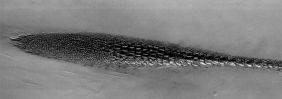
North_Polar_Features-Dunes-PIA08557.jpgNorth Polar Dunes (Original NASA/JPL/ASU b/w Frame)76 visiteImage information: VIS instrument;
Latitude: 82,4° North;
Longitude: 314,5° East;
Resolution: 40 meter/pixel.
|
|

Clouds-South_Polar_regions-20090415a-PCF-LXTT.jpgSouthern Cloud-Front (Natural Colors; credits for the additional process. and color.: Dr Paolo C. Fienga - Lunar Explorer Italia)76 visiteCaption NASA:"This VIS image of the South Polar Region of Mars shows the edge of a front of clouds. These clouds are near enough to the Surface to be affected by surface topography".
Coord.: 73,7° South Lat. and 133,0° East LongMareKromium
|
|
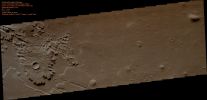
Erosional_Features-PIA13334.jpgErosional Surface Features near Gordii Dorsum (Natural Colors; credits for the additional process. and color.: Dr Paolo C. Fienga - Lunexit Team)76 visitenessun commentoMareKromium
|
|
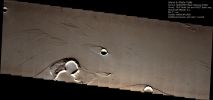
Streamlined_Islands-Marte_Vallis-PCF-LXTT.jpgStreamlined Islands in Marte Vallis (Absolute Natural Colors; credits for the additional process. and color.: Dr Paolo C. Fienga - Lunexit Team:)76 visitenessun commentoMareKromium
|
|

Collapse_Features-Cerberus_Fossae-20080604a-PCF-LXTT.jpgFissure in Cerberus Fossae (Absolute Natural Colors; additional process.: Dr Paolo C. Fienga - Lunexit Team)76 visitenessun commentoMareKromium
|
|

Chaotic_Terrain-Hydraotes_Chaos-20071218a-PCF-LXTT.jpgHydraotes Chaos (Absolute Natural Colors; credits for the additional process. and color.: Elisabetta Bonora and Paolo C. Fienga - Lunexit Team)76 visitenessun commentoMareKromium
|
|
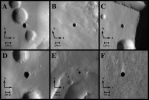
Volcanic_Features-Caverns-PIA09929-00.jpgOn the Northern Slope of Arsia Mons: candidates Cavern Entrance (1)75 visiteCaption NASA:"Seven very dark holes on the North Slope of Arsia Mons (about 9° South Lat. and 239° East Long.) have been proposed as possible cave skylights, based on day-night temperature patterns suggesting they are openings to subsurface spaces. These 6 excerpts of images taken in visible-wavelength light by the Thermal Emission Imaging System (THEMIS) camera on NASA's Mars Odyssey orbiter show the 7 openings.
Solar illumination comes from the left in each frame.
The features have been given informal names to aid comparative discussion. They range in diameter from about 100 meters (328 feet) to about 225 meters (738 feet).
The candidate cave skylights are (A) "Dena", (B) "Chloe", (C) "Wendy", (D) "Annie", (E) "Abby" (left) and "Nikki", and (F) "Jeanne."
Arrows signify North and the Direction of Illumination".MareKromium
|
|
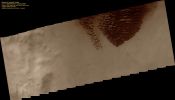
Craters-Lamont_Crater-20090908a.jpgLamont Crater (Natural Colors; credits: Lunexit)75 visitenessun commentoMareKromium
|
|

Channel-Terra_Sabaea-PIA13354-1.jpgChannel in Terra Sabaea (Absolute Natural Colors; credits for the additional process. and color.: Dr Paolo C. Fienga - Lunexit Team)75 visitenessun commentoMareKromium
|
|
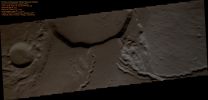
Volcanoes-Ceraunius_Tholus-PIA13433-PCF-LXTT.jpgPartial View of Ceraunius Tholus' Summit Caldera (Natural Colors; credits for the additional process. and color.: Dr Paolo C. Fienga - Lunexit Team)75 visitenessun commentoMareKromium
|
|
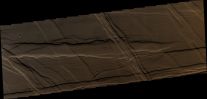
Volcanic_Regions-Ulysses_Fossae-PIA13232.jpgUlysses Fossae (Absolute Natural Colors; credits for the additional process. and color.: Dr Paolo C. Fienga - Lunexit Team)75 visiteOrbit Number: 38891
Latitude (centered): 12,387°
Longitude (East): 237,298°
Instrument: VIS
Captured: September, 20th, 2010
Mars Local Time: 15:12 (early afternoon)MareKromium
|
|
| 1003 immagini su 84 pagina(e) |
 |
|
|
|
|
45 | |
|
|
|
|





